
Inquire Now
Key Strategic Points
The market comprises diagnostic instruments, consumables, and testing platforms used to determine the effectiveness of antimicrobial agents against specific pathogens. These solutions evaluate microbial response to antibiotics or antifungals through phenotypic, genotypic, and automated methods, generating data such as resistance profiles and minimum inhibitory concentrations.
AST systems convert laboratory findings into clinically actionable insights that support appropriate therapy selection, antimicrobial stewardship, and infection control. They play a critical role in infection diagnosis, antimicrobial stewardship, and resistance surveillance across hospitals, clinical laboratories, diagnostic centers, pharmaceutical research facilities, and public health institutions.
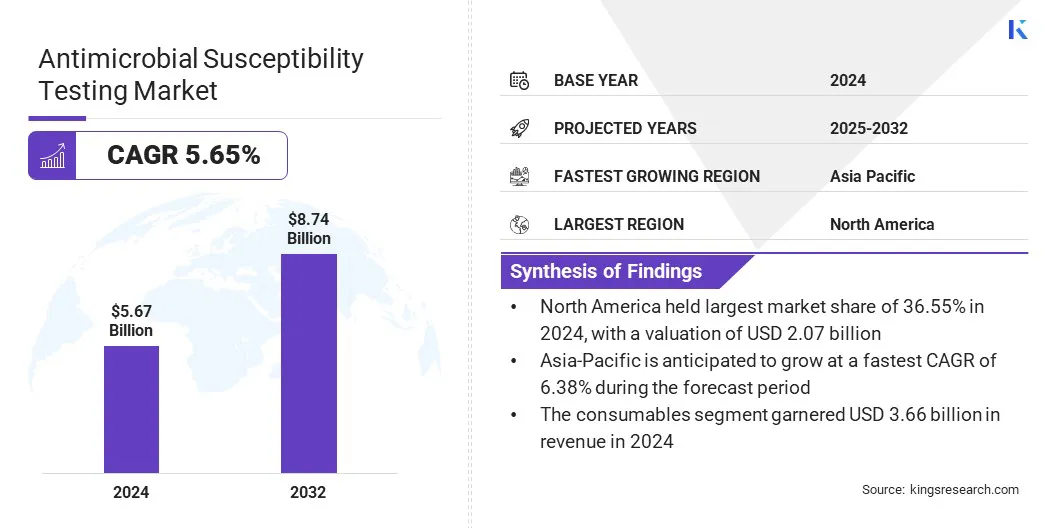
The global antimicrobial susceptibility testing market size was valued at USD 5.67 billion in 2024 and is projected to grow from USD 5.95 billion in 2025 to USD 8.74 billion by 2032, exhibiting a CAGR of 5.65% over the forecast period.
The market is expanding due to increasing antimicrobial resistance and the growing need for timely, accurate therapy selection. Market growth is supported by rising infection prevalence, expanding antimicrobial stewardship programs (ASPs), and wider adoption of automated and rapid AST technologies across healthcare settings.
Major companies operating in the antimicrobial susceptibility testing market are Accelerate Diagnostics, Inc., Alifax S.r.l., Beckman Coulter, Inc., BD, Bio-Rad Laboratories, Inc, BIOMÉRIEUX, Bruker, Cepheid., Creative Diagnostics, F. Hoffmann-La Roche, Hain Lifescience GmbH, Hardy Diagnostics, HiMedia Laboratories., Liofilchem S.r.l., and Merck KGaA.
Market growth is driven by the increasing need for accurate interpretation of complex antimicrobial susceptibility data to support effective clinical decision-making. Rising antimicrobial resistance has increased the clinical importance of combining rapid pathogen identification with reliable susceptibility profiling to guide targeted therapy.
Healthcare providers are adopting advanced AST systems that integrate automated testing with decision-support and informatics capabilities to reduce interpretation variability and improve diagnostic confidence.
Leading companies such as BD, BIOMÉRIEUX, Accelerate Diagnostics, Inc., and others continue to enhance AST platforms with integrated analytics and workflow support to improve data usability and standardization, reinforcing broader adoption of antimicrobial susceptibility testing solutions across clinical laboratories.
The market growth is driven by the rising global burden of antimicrobial resistance, which has increased the need for accurate and timely identification of effective therapies. Hospitals and clinical laboratories increasingly rely on antimicrobial susceptibility testing to guide targeted treatment decisions, reduce inappropriate antibiotic use, and comply with antimicrobial stewardship requirements.
Increasing infection rates, extended hospital stays associated with resistant pathogens, and stronger regulatory emphasis on resistance monitoring are further reinforcing routine AST adoption across healthcare systems.
A key challenge restraining the growth of the antimicrobial susceptibility testing market is the high cost and operational complexity associated with implementing and maintaining advanced AST systems.
Deploying automated and rapid susceptibility platforms requires significant capital investment, laboratory infrastructure upgrades, and skilled microbiology personnel. In addition, variability in testing standards, validation requirements, and integration with laboratory information systems increases workflow complexity for clinical laboratories. These factors may limit adoption, particularly among smaller hospitals, diagnostic centers, and resource-constrained healthcare settings.
To address this challenge, market participants are focusing on modular system designs, automation-friendly workflows, and standardized testing panels, while expanding training programs, technical support services, and partnerships with healthcare providers to improve accessibility and support wider AST adoption.
A key trend influencing the antimicrobial susceptibility testing market is the increasing integration of rapid and automated AST technologies, into routine laboratory workflows. Clinical laboratories are moving beyond manual and standalone testing methods toward systems embedded within laboratory information systems and microbiology automation platforms to support seamless susceptibility analysis and reporting.
This integration enables faster result generation, standardized interpretation, and improved data connectivity across diagnostic processes. Embedding automated and digitally enabled AST solutions within existing laboratory environments improves operational efficiency, reduces turnaround times, and supports consistent antimicrobial stewardship practices, thereby accelerating adoption across healthcare settings and driving sustained market demand.
|
Segmentation |
Details |
|
By Product Type |
Instruments, Consumables |
|
By Method |
Disk Diffusion Method, Broth Dilution, Agar Dilution, Others |
|
By Application |
Clinical Diagnostics, Drug Discovery & Development, Epidemiology & Surveillance, Others |
|
By End User |
Hospitals & Clinical Laboratories, Diagnostic Centers, Pharmaceutical & Biotechnology Companies, Others |
|
By Region |
North America: U.S., Canada, Mexico |
|
Europe: France, UK, Spain, Germany, Italy, Russia, Rest of Europe |
|
|
Asia-Pacific: China, Japan, India, Australia, ASEAN, South Korea, Rest of Asia-Pacific |
|
|
Middle East & Africa: Turkey, U.A.E., Saudi Arabia, South Africa, Rest of Middle East & Africa |
|
|
South America: Brazil, Argentina, Rest of South America |
Based on region, the market has been classified into North America, Europe, Asia Pacific, Middle East & Africa, and South America.
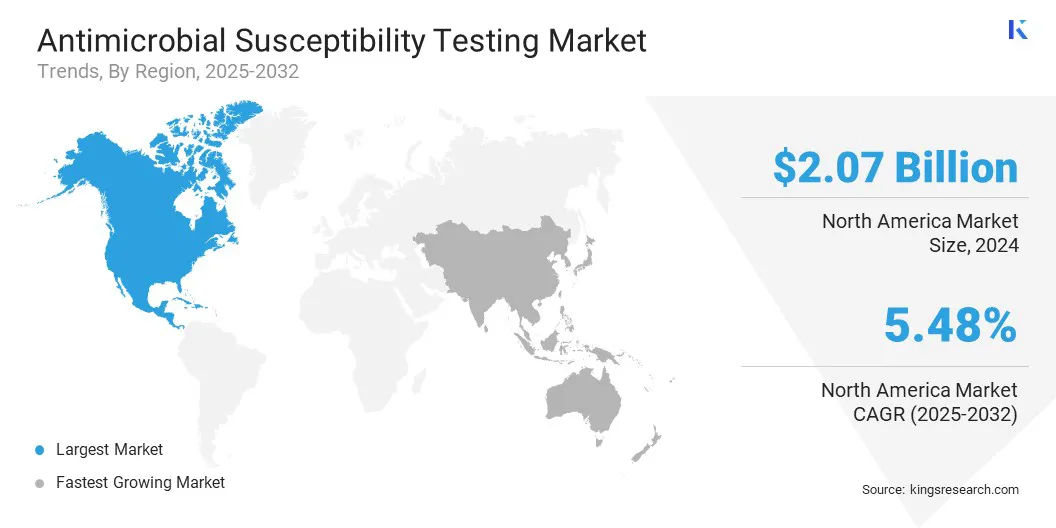
North America antimicrobial susceptibility testing market share stood around 36.55% in 2024 in the global market, with a valuation of USD 2.07 billion. This dominance is attributed to the advanced healthcare infrastructure, high diagnostic testing volumes, and strong regulatory emphasis on antimicrobial stewardship.
High prevalence of healthcare-associated infections is prompting healthcare providers in this region to implement routine antimicrobial susceptibility testing as a standard component of infection diagnosis and treatment optimization.
In addition, government initiatives, surveillance programs, and guidelines issued by public health agencies further reinforce demand for accurate and timely susceptibility testing. High adoption of automated and rapid AST platforms, along with early uptake of innovative phenotypic and molecular technologies is further driving the market growth across North America.
Asia-Pacific is poised for significant growth at a robust CAGR of 6.38% over the forecast period, driven by its large patient population, high incidence of infectious diseases, and increasing exposure to antibiotic misuse across both hospital and community settings.
The region experiences elevated rates of drug-resistant infections due to the widespread misuse and over prescription of antibiotics, which accelerates microbial resistance development, particularly in densely populated and rapidly urbanizing areas, which is intensifying the need for routine susceptibility testing. Market expansion is further fueled by the scaling of public hospital networks, the expansion of diagnostic laboratories, and the gradual standardization of microbiology practices.
Leading players in the antimicrobial susceptibility testing industry are focusing on advancing automation, speed, and clinical integration to strengthen their competitive positioning.
Major diagnostic companies are launching rapid and fully automated AST platforms that deliver faster results directly from positive cultures, addressing critical care and sepsis management needs. Several players are integrating AST systems with laboratory information systems and digital microbiology workflows to improve standardization and data connectivity.
Frequently Asked Questions

Swati is a committed research analyst with a passion for optimizing systems and processes across industries, specializing in healthcare but also bringing valuable expertise to sectors such as consumer goods, life sciences, and more. Her cross-domain research approach allows her to generate clear, actionable reports that inform strategic decisions in a variety of fields. Swati is committed to staying ahead of evolving trends, leveraging her broad understanding of different sectors to provide insights that are relevant to a range of industries. In her personal time, she enjoys music and spending quality time with her family, which inspires her creativity and enriches her professional approach. Her systematic methodology ensures that every report is both thorough and practical. Swati's ability to bridge regulatory frameworks with market realities gives her recommendations a distinct edge. She collaborates seamlessly with cross-functional teams, distilling complex data into straightforward narratives. Her proactive monitoring of policy and technological shifts keeps her analysis forward-looking.
With many years of consulting experience across global pharma, biotech, and MedTech markets, Minaz brings deep domain expertise, strategic clarity, and analytical rigor to every engagement. She has led 130+ consulting assignments spanning market entry, competitive landscaping, and portfolio prioritization, helping clients navigate complex, high-stakes decisions with confidence. Known for her ability to synthesize primary and secondary research into executive-ready recommendations, Minaz has built forecasting models and market sizing frameworks that have informed multi-million dollar investment decisions in oncology, diagnostics, and peptide therapeutics. Beyond her analytical strength, Minaz is a trusted client partner, translating complex datasets into clear, actionable insights for senior stakeholders. She currently leads a team of research analysts, driving business expansion, and shaping client engagement strategy.