
Inquire Now
Key strategic points
Antifreeze proteins (AFPs) are specialized proteins that prevent ice formation and recrystallization in biological systems, enabling organisms to survive in sub-zero environments. They bind to ice crystals, lowering the freezing point of liquids without altering their overall composition.
The market encompasses the production, distribution, and commercialization of various types of antifreeze proteins. It covers applications across medical, food, cosmetics, agriculture, and research sectors, and includes proteins derived from fish, plants, insects, and synthetic or recombinant sources.
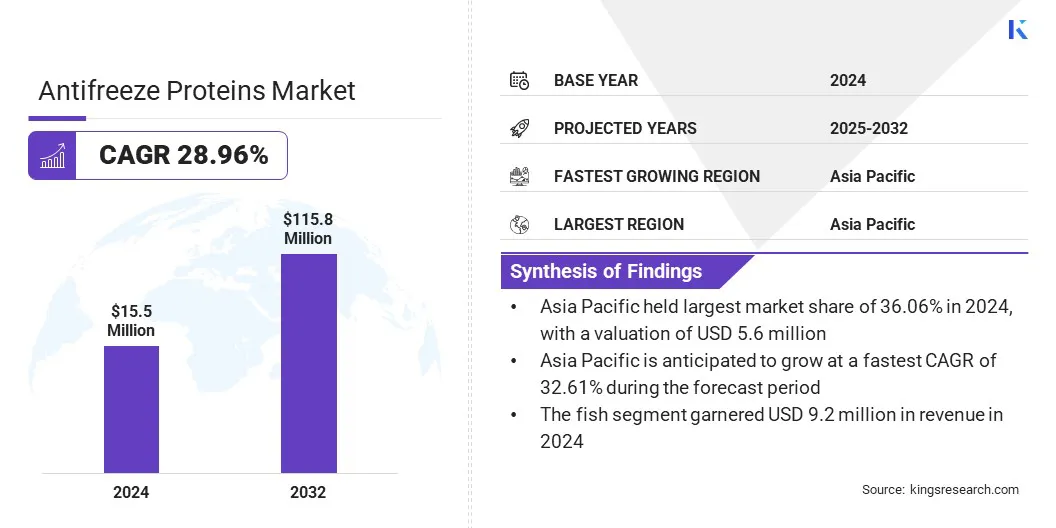
According to Kings Research, the global antifreeze proteins market size was valued at USD 15.5 million in 2024 and is projected to grow from USD 19.5 million in 2025 to USD 115.8 million by 2032, exhibiting a CAGR of 28.96% during the forecast period.
The market is expanding rapidly, propelled by increasing adoption of antifreeze proteins (AFPs) in medical cryopreservation, organ transplantation, and fertility preservation.
Growing use in frozen food processing, aquaculture, and cosmetic formulations for enhancing stability, texture, and shelf life further drives demand. Advances in synthetic and engineered AFPs are enabling scalable production, enhancing application versatility and supporting sustained market growth.
Major companies operating in the antifreeze proteins market are A/F Protein Inc., KANEKA CORPORATION, and MyBioSource.
Companies are prioritizing research and development to strengthen protein functionality and improve scalability. Current initiatives emphasize the development of synthetic and recombinant AFPs to overcome limited natural sources and ensure reliable production.
These R&D activities focus on delivering stable, application-specific variants that support adoption in medical cryopreservation, frozen food processing, and biotechnology.
The growth of the antifreeze proteins market is driven by rising fertility treatments worldwide, with AFPs serving as essential cryoprotectants for gametes and embryos in assisted reproductive technology (ART).
AFPs prevent ice crystal formation and maintain cellular integrity, enhancing reproductive cell survival during freezing and thawing. They improve success rates in fertility procedures and reinforce confidence in ART outcomes. Continued emphasis on reproductive healthcare and advancements in cryopreservation techniques is further supporting market expansion.
The antifreeze proteins market faces a major challenge due to limited natural sources, which restrict large-scale production and widespread adoption.
Extracting AFPs from fish, insects, or plants requires significant time and cost, creating supply bottlenecks for industrial and medical applications. To address this, market players are developing synthetic, recombinant, and engineered AFP variants.
These approaches enable scalable production and maintain protein functionality while reducing dependency on natural sources. Scaling synthetic and recombinant technologies ensures consistent availability of AFPs and supports growth in key applications such as medical cryopreservation, frozen foods, and biotechnological research.
A key trend in the antifreeze proteins market is the growing integration of AFPs in frozen food processing. Food producers are adopting AFP-based formulations to prevent freezer burn, which compromises flavor, texture, and product quality.
This trend highlights the rising focus on advanced preservation technologies that enhance product stability and extend shelf life in refrigerated and frozen foods. Rising demand for premium frozen meals and processed foods is accelerating AFP adoption, as consumers demand consistent quality.
|
Segmentation |
Details |
|
By Type |
Type I AFPs, Type III AFPs, Antifreeze Glycoproteins, Synthetic AFPs, Others |
|
By Source |
Fish, Plants, Insects, Others |
|
By End Use |
Medical, Food, Cosmetics, Agriculture, Research, Others |
|
By Region |
North America: U.S., Canada, Mexico |
|
Europe: France, UK, Spain, Germany, Italy, Russia, Rest of Europe |
|
|
Asia-Pacific: China, Japan, India, Australia, ASEAN, South Korea, Rest of Asia-Pacific |
|
|
Middle East & Africa: Turkey, U.A.E., Saudi Arabia, South Africa, Rest of Middle East & Africa |
|
|
South America: Brazil, Argentina, Rest of South America |
Based on region, the market has been classified into North America, Europe, Asia Pacific, Middle East & Africa, and South America.
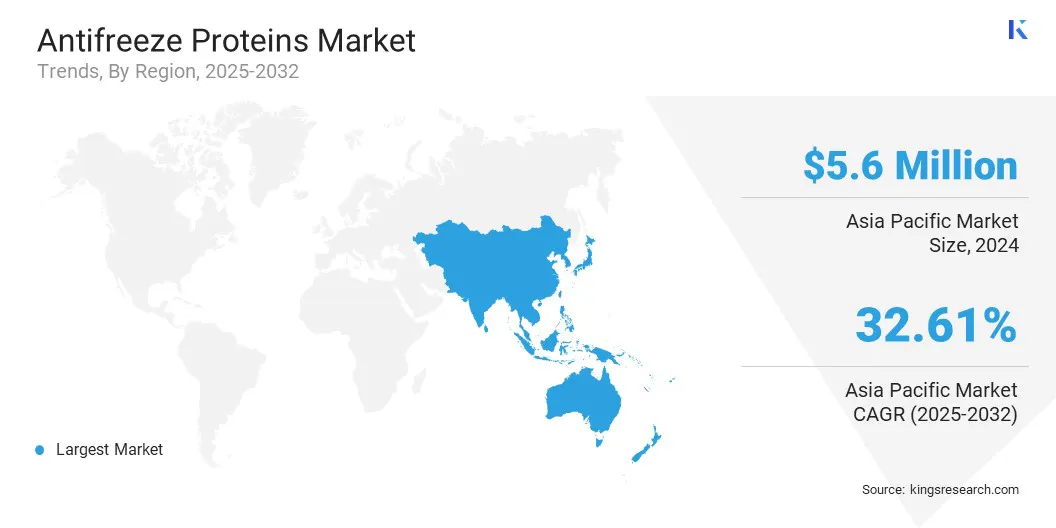
Asia Pacific antifreeze proteins market share stood at around 36.06% in 2024, with a valuation of USD 5.6 million. This dominance is reinforced by private sector investments and collaborations focusing on early-stage research and clinical development.
Regional players are increasingly investing in R&D to develop novel antifreeze protein applications in pharmaceuticals, cryopreservation, and food technology. These efforts are strengthening product development pipelines and regional manufacturing capabilities.
The antifreeze proteins industry in North America is expected to register the fastest growth, with a projected CAGR of 28.58% over the forecast period. This growth is supported by the advanced biopharmaceutical sector, where antifreeze proteins are essential for the cryopreservation of biologics, stem cells, and regenerative therapies.
Strong integration of advanced biopharmaceutical technologies and ongoing R&D further support their expanding use of antifreeze proteins in medical and clinical applications.
Moreover, regional biotechnology companies and research institutions are increasing investments in synthetic and recombinant antifreeze proteins (AFPs) to improve scalability, stability, and production reliability. These advancements enable consistent supply for applications in food preservation, cryopreservation, and biopharmaceuticals, thereby fueling regional market growth.
Key players in the antifreeze proteins industry are strengthening their position by focusing on R&D collaborations with universities, biotechnology institutes, and research organizations to accelerate advancements in cryopreservation and biomedical applications.
Companies also emphasizing the development of synthetic and recombinant AFPs to overcome natural sourcing limitations, improve scalability, and ensure consistent product performance across medical, food, and research applications.
Frequently Asked Questions

Over the years, Versha brings over 15 years of experience managing consulting assignments across industries, including Food and Beverage, Consumer Goods, ICT, Aerospace, and more. Her work has spanned diverse sectors. Her cross-domain expertise and adaptability make her a versatile and dependable professional. She is known for her keen business insight and foresight. With sharp analytical skills and a curious mindset, Versha excels at transforming complex data into actionable insights. She has a proven track record of unraveling market dynamics, identifying trends, and delivering tailored solutions to meet client needs. As a skilled leader, Versha has successfully mentored research teams and directed projects with precision, ensuring high-quality outcomes. Her collaborative approach and strategic vision enable her to turn challenges into opportunities and consistently deliver impactful results. Whether analyzing markets, engaging stakeholders, or crafting strategies, Versha draws on her deep expertise and industry knowledge to drive innovation and deliver measurable value.

With over a decade of research leadership across global markets, Ganapathy brings sharp judgment, strategic clarity, and deep industry expertise. Known for precision and an unwavering commitment to quality, he guides teams and clients with insights that consistently drive impactful business outcomes.



.webp&w=128&q=75&dpl=dpl_3pUwJtNgpk6oXgXnK9PBcvvUhHi3)