
Inquire Now
Key strategic points
Aircraft exhaust systems are engineered components that channel and manage gases produced by aircraft engines to ensure efficient propulsion and optimal engine performance. They help control temperature, reduce noise, and limit harmful emissions during flight operations.
Applications include engine maintenance, performance optimization, and compliance with environmental and safety standards, supporting safe and efficient aircraft operation. Commercial, military, and general aviation sectors rely on these systems to improve reliability, operational efficiency, and adherence to regulatory requirements.
The global aircraft exhaust systems market size was valued at USD 1,214.7 million in 2024 and is projected to grow from USD 1,301.4 million in 2025 to USD 2,250.8 million by 2032, exhibiting a CAGR of 8.14% over the forecast period.
This growth is attributed to the increasing demand for efficient & high-performance aircraft exhaust systems that boost engine efficiency, and reduce emissions. Growing use of advanced materials, noise-reduction technologies, and optimized exhaust designs is improving propulsion performance, operational reliability, and regulatory adherence, thereby driving market expansion.
Major companies operating in the aircraft exhaust systems market are Magellan Aerospace Corporation, Safran Group, Nicrocraft, Doncasters Group, General Electric Company, GKN Aerospace, Triumph Group, Franke Group, The NORDAM Group LLC, Power Flow Systems, Inc., Acorn Welding, TransDigm Group, Wall Colmonoy, Aerospace Welding Minneapolis, Inc., Pratt & Whitney, and Parker Hannifin Corp.
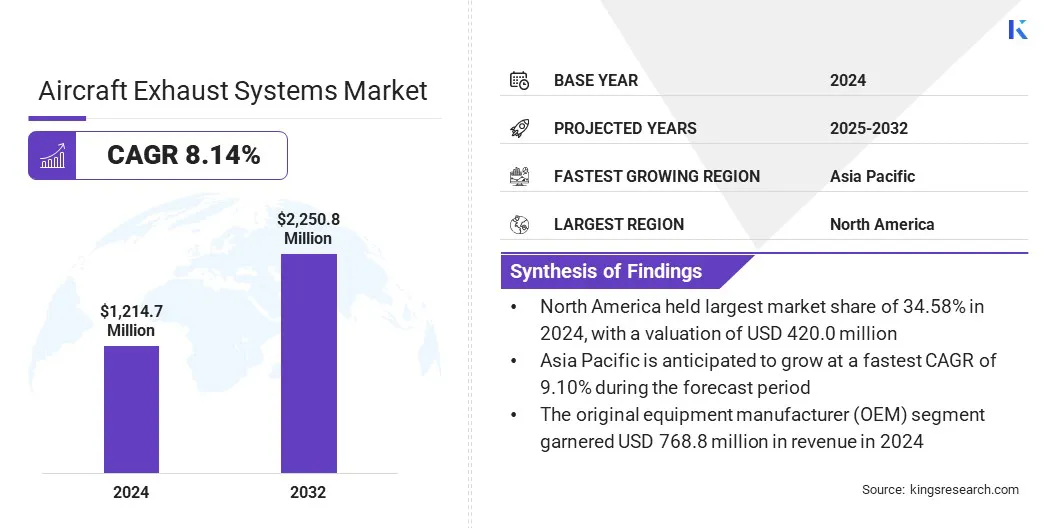
The rising focus on fuel efficiency, engine longevity, and operational safety across commercial, military, and general aviation is driving the integration of modern exhaust systems into new and retrofitted aircraft. Additionally, ongoing technological innovations, along with strategic collaborations and aircraft modernization initiatives are accelerating market growth.
Rising Focus on Engine Efficiency and Fuel Optimization
Growth of the aircraft exhaust systems market is fueled by the rising focus on engine efficiency and fuel optimization across the aviation sector. These systems improve engine performance and reduce fuel consumption, while remaining compliant with environmental and safety regulations.
In February 2024, the U.S. Department of Energy announced a USD 15 million investment in projects developing high-energy storage solutions for domestic aircraft, to support energy-efficient aviation technologies. These projects aim to create storage systems achieving or exceeding 1,000 watt-hours per kilogram and per liter, improving energy density over current technologies.
Commercial, military, and general aviation operators are using advanced exhaust technologies to improve operational reliability, lower emissions, and extend engine life. This is reinforced by regulatory standards, rising fuel costs, and the focus on sustainable and cost-effective aviation operations. This shift is strengthening the industry’s ability to deliver high-performance, efficient, and environmentally compliant aircraft solutions.
Complexities in System Integration and Compatibility
Complexities in system integration and compatibility create a significant barrier to the growth of the aircraft exhaust systems market. Modern exhaust systems must interface seamlessly with diverse engine types, airframes, and auxiliary components, which often requires custom engineering, precise regulation, and extensive testing. Retrofitting or upgrading existing aircraft fleets can be time-consuming and costly, particularly for older models with varied configurations.
Operators in commercial, military, and general aviation face additional challenges as integration must ensure compliance with strict safety, performance, and environmental regulations. Limited availability of skilled engineers to manage complex installations also increases these difficulties.
To address this, manufacturers and operators are increasingly adopting standardized modular designs, advanced simulation tools, and professional integration services. These approaches aim to simplify compatibility, reduce installation complexity, and accelerate the use of high-performance exhaust systems across different aircraft platforms.
Advancement in Noise-Reduction Technologies
Advancement in noise-reduction technologies is transforming the aircraft exhaust systems market by allowing quieter and more environmentally compliant operations. This trend is driven by strict global noise regulations, increasing passenger comfort expectations, and the need to minimize community noise impact near airports.
Innovative solutions such as acoustic liners, optimized ducting, and vibration-damping materials improve sound attenuation while maintaining engine efficiency. These features are particularly valuable for commercial, military, and general aviation operators, where performance, safety, and regulatory compliance are critical.
Aircraft manufacturers and operators are adopting advanced noise-reduction designs to enhance operational reliability and reduce environmental impact. Integration of these technologies helps lower noise levels, improve public perception, and support sustainable aviation initiatives. The growing focus on acoustic optimization establishes these advancements as essential drivers for modern, high-performance, and compliant aircraft exhaust systems.
|
Segmentation |
Details |
|
By System |
Turbine Engine Exhaust Systems, Piston Engine Exhaust Systems, and Auxiliary Power Unit (APU) Exhaust Systems |
|
By Component |
Exhaust Pipes and Tubes, Exhaust Cones, Exhaust Nozzles, Exhaust Liners and Shields, and Sensors and Monitoring Devices |
|
By Aviation Type |
Commercial Aviation, Military Aviation, General Aviation, and Business Aviation |
|
By End User |
Original Equipment Manufacturer (OEM), and Maintenance, Repair & Overhaul (MRO) |
|
By Region |
North America: U.S., Canada, Mexico |
|
Europe: France, UK, Spain, Germany, Italy, Russia, Rest of Europe |
|
|
Asia-Pacific: China, Japan, India, Australia, ASEAN, South Korea, Rest of Asia-Pacific |
|
|
Middle East & Africa: Turkey, U.A.E., Saudi Arabia, South Africa, Rest of Middle East & Africa |
|
|
South America: Brazil, Argentina, Rest of South America |
Based on region, the market has been classified into North America, Europe, Asia Pacific, the Middle East & Africa, and South America.
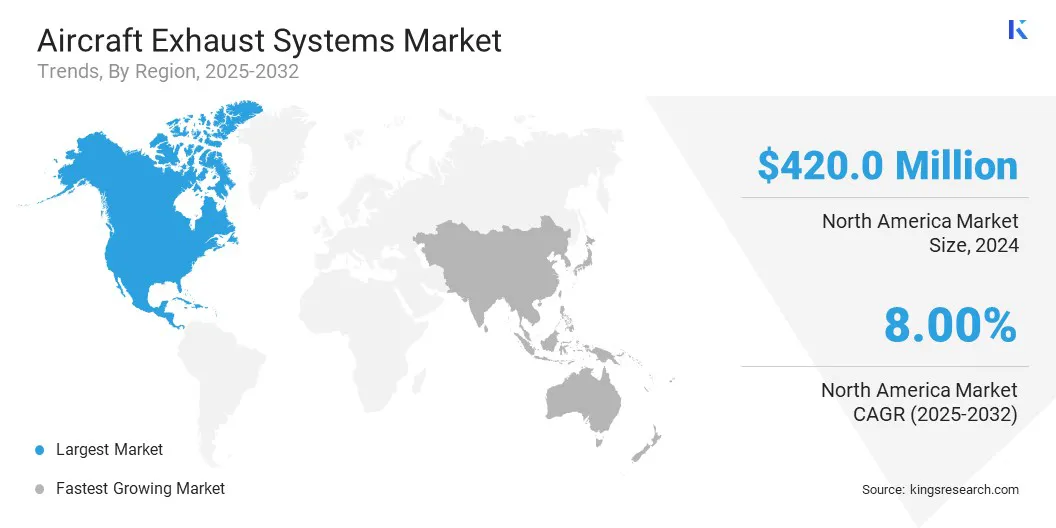
The North America aircraft exhaust systems market share stood at 34.58% in 2024, valued at USD 420.0 million. This strong position is reinforced by a well-established commercial and military aviation ecosystem, fleet modernization programs, and strict environmental and noise regulations.
Additionally, the market benefits from the increasing use of advanced exhaust system technologies, including lightweight materials, acoustic solutions, and thermal management components, across diverse aircraft types.
Ongoing investments in research and development and the integration of simulation-driven design tools contribute to the steady deployment of high-performance exhaust systems. Technological advancements and operational efficiency initiatives also boost regional market expansion.
The Asia Pacific aircraft exhaust systems industry is set to grow at a CAGR of 9.10% over the forecast period. This growth is fueled by rising air travel demand, expanding commercial airline fleets, and increasing defense modernization initiatives.
Expanding aviation sectors are using advanced exhaust systems to improve engine performance, and fuel efficiency. Collaborations between aircraft manufacturers and global technology providers are helping the deployment of high-performance exhaust solutions.
Additionally, the emphasis on lightweight materials, noise-reduction technologies, and thermal management, combined with industrial and defense sector growth, supports long-term adoption. Ongoing investments in aircraft production and maintenance infrastructure also strengthen the market for aircraft exhaust systems.
Companies operating in the aircraft exhaust systems industry are maintaining competitiveness through investments in advanced materials and technologies, along with collaborations and acquisitions. They are developing exhaust systems for improved engine performance, fuel efficiency, emission reduction, and regulatory compliance across commercial, military, and general aviation sectors.
Market players are improving their products with lightweight alloys, thermal management solutions, and simulation-driven designs to meet evolving performance and safety requirements.
They are establishing regional manufacturing and service facilities and collaborating with aircraft OEMs to improve system integration. Additionally, companies are providing technical support, maintenance services, and performance monitoring solutions to ensure reliability and sustain competitive positioning.
Frequently Asked Questions

Over the years, Versha brings over 15 years of experience managing consulting assignments across industries, including Food and Beverage, Consumer Goods, ICT, Aerospace, and more. Her work has spanned diverse sectors. Her cross-domain expertise and adaptability make her a versatile and dependable professional. She is known for her keen business insight and foresight. With sharp analytical skills and a curious mindset, Versha excels at transforming complex data into actionable insights. She has a proven track record of unraveling market dynamics, identifying trends, and delivering tailored solutions to meet client needs. As a skilled leader, Versha has successfully mentored research teams and directed projects with precision, ensuring high-quality outcomes. Her collaborative approach and strategic vision enable her to turn challenges into opportunities and consistently deliver impactful results. Whether analyzing markets, engaging stakeholders, or crafting strategies, Versha draws on her deep expertise and industry knowledge to drive innovation and deliver measurable value.

With over a decade of research leadership across global markets, Ganapathy brings sharp judgment, strategic clarity, and deep industry expertise. Known for precision and an unwavering commitment to quality, he guides teams and clients with insights that consistently drive impactful business outcomes.



.webp&w=128&q=75&dpl=dpl_3pUwJtNgpk6oXgXnK9PBcvvUhHi3)