
Inquire Now
Key Strategic Points
The market involves the development and integration of imaging systems that capture three-dimensional data for precise analysis, inspection, and automation. These systems combine advanced cameras, sensors, and software to enable accurate measurement, object recognition, and quality assessment in in factories and production facilities.
The report includes segmentation based on component, application, industry vertical, and region. Key sectors such as automotive, electronics, logistics, and pharmaceuticals utilize 3D machine vision to enhance production accuracy, reduce defects, and improve process efficiency in manufacturing and quality control operations.
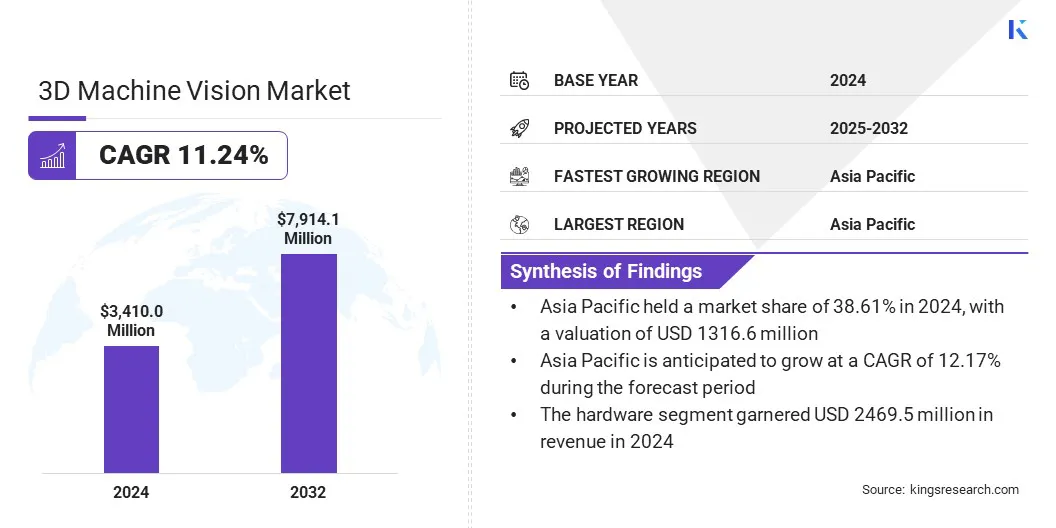
The global 3D machine vision market size was valued at USD 3,410.0 million in 2024 and is projected to grow from USD 3,754.1 million in 2025 to USD 7,914.1 million by 2032, exhibiting a CAGR of 11.24% during the forecast period.
The market is driven by the integration of 3D vision with the Internet of Things (IoT) and digital twin technologies that enable real-time process optimization and predictive analysis. The adoption of AI-driven image processing further enhances inspection accuracy and analytical capabilities across manufacturing and logistics sectors.
Major companies operating in the 3D machine vision market are Cognex Corporation, Keyence Corporation, OMRON Corporation, ISRA Vision, Kron Technologies, Basler AG, ORBBEC, SICK AG, wenglor sensoric GmbH, NATIONAL INSTRUMENTS CORP., MVTec Software GmbH, Stemmer Imaging, LMI TECHNOLOGIES INC., Hermary, and Teledyne Vision Solutions.
Growing adoption of robotics and automated inspection systems in automotive, electronics, and packaging industries is driving the market. Increasing reliance on automated systems is creating demand for technologies that improve accuracy and efficiency in production.
3D machine vision enhances defect detection and precise measurement of components, supporting consistent quality standards. Integrating these vision systems with robotics enables real-time monitoring and rapid corrective actions during manufacturing processes. This integration reduces production errors and lowers operational costs, improving overall factory performance.
Integration of 3D vision with IoT and digital twins is driving the market. Combining these technologies enables intelligent manufacturing with real-time monitoring of production processes. Implementing 3D machine vision supports accurate defect detection and precise measurement across complex operations.
Linking vision systems with digital twins allows simulation and optimization of manufacturing workflows before execution. This integration improves productivity, reduces errors, and enhances resource utilization in factories. Increasing adoption of Industry 4.0 solutions is accelerating the deployment of 3D machine vision in smart factories globally.
A key challenge in the 3D machine vision market is the high expense associated with advanced cameras, processors, and analytical software. Implementation requires precise calibration, specialized training, and integration with existing automation systems, increasing overall costs. These financial and technical demands limit adoption among small and medium enterprises with constrained budgets.
To address this challenge, market players are developing modular, plug-and-play systems, providing cloud-based software options, and offering training and support services to reduce setup complexity. These measures are making 3D machine vision technology more accessible while maintaining accuracy and performance across applications.
A key trend in the market is the integration of AI-driven image processing to improve inspection and analysis capabilities. Deep learning algorithms are enhancing object detection by identifying complex shapes and features with higher accuracy. These algorithms are also supporting precise defect classification, reducing false positives and improving quality control.
Real-time adaptive decision-making is enabling automated adjustments in manufacturing and sorting processes, optimizing operational efficiency. Industries such as automotive, electronics, and logistics are implementing AI-powered 3D vision systems to reduce downtime and improve throughput.
|
Segmentation |
Details |
|
By Component |
Hardware, Software |
|
By Application |
Quality Control & Inspection, Measurement, Autonomous Navigation & Guidance, 3D Scanning, Others |
|
By Industry Vertical |
Automotive, Electronics & Semiconductors, Logistics & Warehousing, Pharmaceuticals, Others |
|
By Region |
North America: U.S., Canada, Mexico |
|
Europe: France, UK, Spain, Germany, Italy, Russia, Rest of Europe |
|
|
Asia-Pacific: China, Japan, India, Australia, ASEAN, South Korea, Rest of Asia-Pacific |
|
|
Middle East & Africa: Turkey, U.A.E., Saudi Arabia, South Africa, Rest of Middle East & Africa |
|
|
South America: Brazil, Argentina, Rest of South America |
Based on region, the global 3D machine vision market has been classified into North America, Europe, Asia Pacific, Middle East & Africa, and South America.
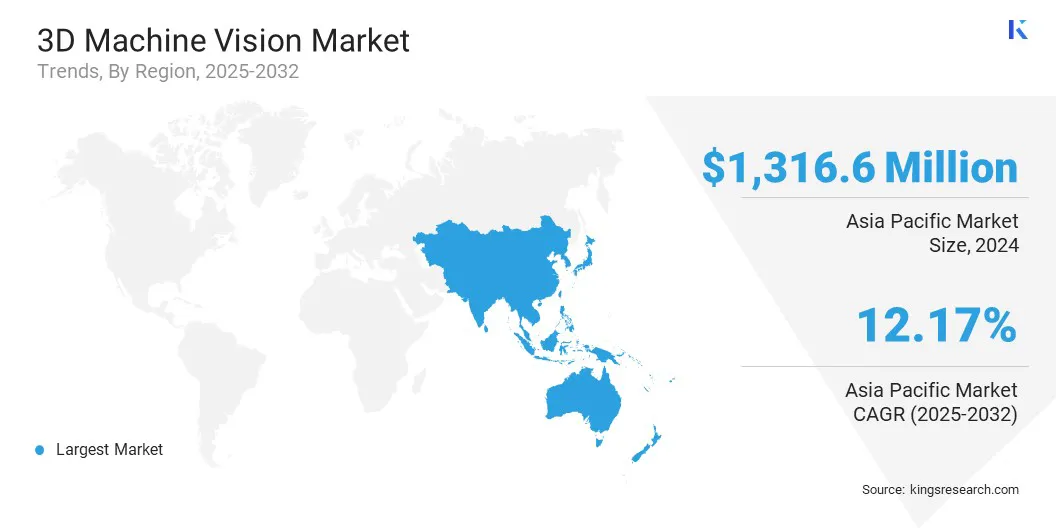
The Asia Pacific 3D machine vision market share stood around 38.61% in 2024 in the global market, with a valuation of USD 1,316.6 million. This dominance is due to the rapid development of advanced industrial parks and smart factories across the region. Countries such as China, Japan, and South Korea are investing heavily in digitalized production lines that require accurate inspection and monitoring.
Electronics, automotive, and semiconductor manufacturers are increasingly adopting 3D machine vision to maintain high precision. Rising labor costs and skill shortages are further pushing companies to replace manual inspection with automated systems.
The market in North America is expected a significant CAGR of 11.47% over the forecast period. This growth is due to the presence of highly advanced automotive and aerospace manufacturing facilities across North America. Manufacturers are integrating 3D machine vision systems for precise inspection of components and assemblies.
These systems help detect defects and ensure quality standards in complex manufacturing processes. Rising demand for electric vehicles and aerospace innovation increases the need for high-precision inspection technologies. This environment is driving consistent adoption of 3D machine vision solutions in manufacturing operations.
Market players are expanding R&D in 3D imaging and developing compact high-performance vision systems to remain competitive in the market. Companies are increasingly focusing on integrating meta-optics, liquid lenses, diffractive optical elements, and other advanced optical components to achieve smaller form factors without compromising depth accuracy.
Investments in near-infrared sensing and high-precision imaging are enabling reliable operation across diverse industrial and automotive applications. Strategic partnerships between vision hardware developers and semiconductor manufacturers are supporting faster commercialization of compact 3D vision modules.
Frequently Asked Questions

Sunanda is a proficient research analyst with strong cross-domain expertise, excelling in identifying market trends and delivering insightful analyses across various industries, including consumer goods, food & beverages, healthcare, and more. Her ability to connect insights from diverse sectors enables her to offer actionable recommendations that support strategic decision-making in a range of business contexts. Sunanda's research is driven by thorough data analysis and her commitment to providing relevant, data-driven insights. Her keen eye for patterns allows her to spot emerging opportunities before they become mainstream. Sunanda's synthesis of cross-sector learnings often reveals unconventional solutions that clients find invaluable. She adapts her analytical frameworks to suit each industry's unique nuances, ensuring reports are both accurate and contextually relevant. Clients appreciate her ability to deliver crisp, actionable findings under tight deadlines, consistently exceeding expectations with her thoroughness and insight.

Ganapathy Subramaniam Suresh
With over a decade of research leadership across global markets, Ganapathy brings sharp judgment, strategic clarity, and deep industry expertise. Known for precision and an unwavering commitment to quality, he guides teams and clients with insights that consistently drive impactful business outcomes.