
Inquire Now
Key Strategic Points
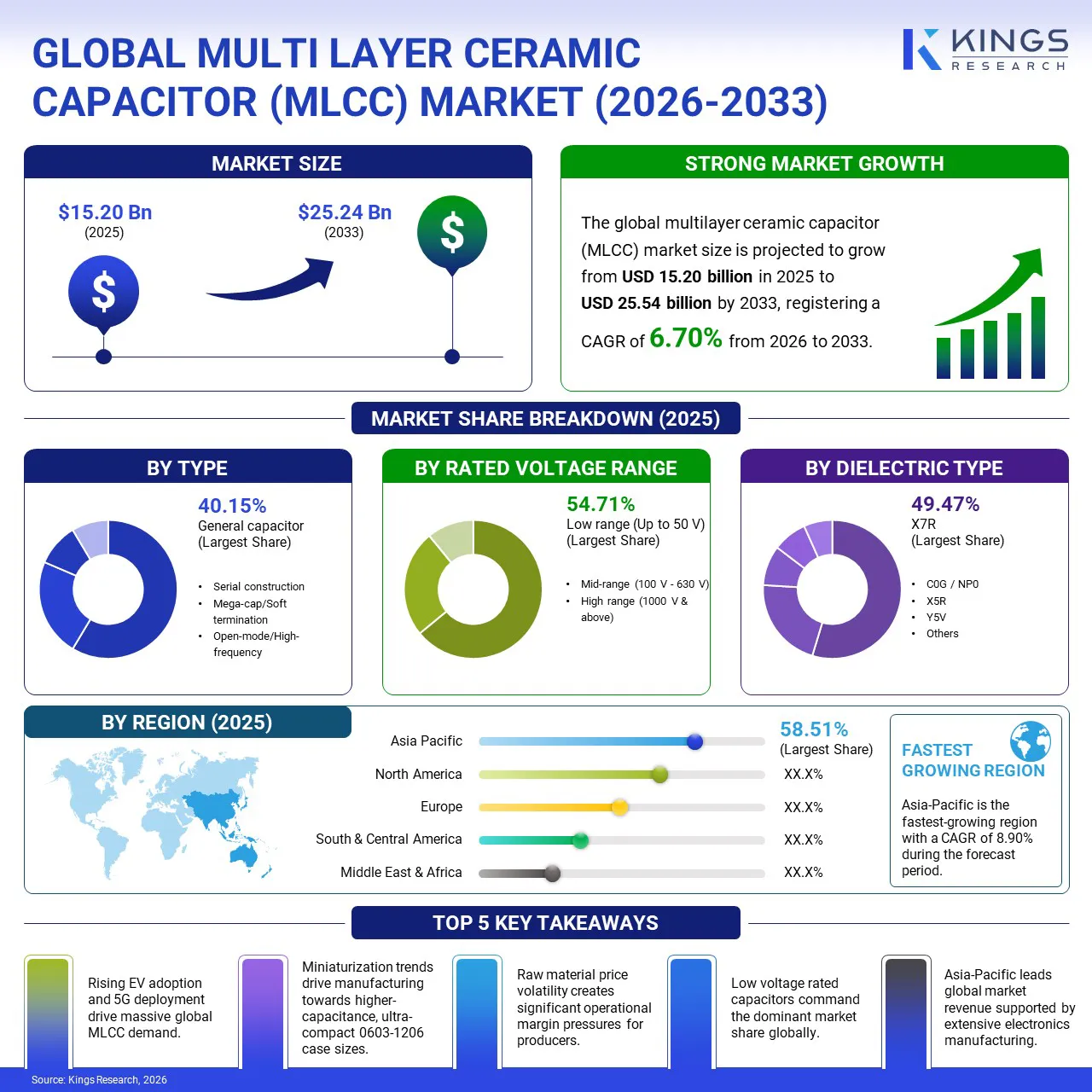
According to Kings Research, the global multilayer ceramic capacitor market size was valued at USD 15.20 billion in 2025 and is projected to reach USD 25.54 billion by 2033, exhibiting a CAGR of 6.70% during the forecast period (2026-2033).
The market encompasses general capacitors, array capacitors, serial construction MLCCs, and mega-cap configurations utilized across automotive electronics, consumer devices, industrial machinery, and telecommunications infrastructure. The report explores key drivers of market development, offering detailed regional analysis and a comprehensive overview of the competitive landscape shaping future opportunities.
The market is expanding steadily, driven by increasing adoption of electric vehicles (EVs), rapid 5G infrastructure rollouts, and the miniaturization of high-performance consumer electronics. Multilayer ceramic capacitors play an essential role in noise filtering, decoupling, and voltage stabilization across high-density circuit boards. Their ability to deliver high capacitance in a compact footprint makes them essential for smartphones, electric vehicles, and precision industrial equipment.
Major companies operating in the multilayer ceramic capacitor market include Murata Manufacturing Co., Ltd., Samsung Electro-Mechanics, TDK Corporation, Taiyo Yuden Co., Ltd., YAGEO Corporation, Walsin Technology Corporation, KYOCERA AVX Components Corporation, KEMET Corporation, Vishay Intertechnology, Inc., and Würth Elektronik eiSos GmbH & Co. KG.
In April 2025, TDK Corporation introduced an automotive-grade multilayer ceramic capacitor featuring high capacitance at 100 V in a compact 3225 case size, supporting high-voltage powertrain systems.
In March 2025, KYOCERA AVX introduced a 47 µF multilayer ceramic chip capacitor designed for high-density servers and data center power modules.
In February 2025, Samsung Electro-Mechanics launched a 2.2 µF, 10 V MLCC engineered specifically for automotive LiDAR systems.
The global multilayer ceramic capacitor market is experiencing steady expansion, driven by the rapid electrification of the automotive sector, expanding 5G telecommunication networks, and the continuous miniaturization of smart consumer devices. Modern electric vehicles require thousands of automotive-grade MLCCs per vehicle to manage high-voltage battery management systems (BMS), ADAS radar sensors, and inverter power modules.
Furthermore, 5G base stations and high-frequency smartphones demand low-ESR, high-capacitance MLCCs to maintain signal integrity and manage thermal dissipation on densely packed printed circuit boards (PCBs). Collaborating with OEMs improves demand forecasting and alignment with product development cycles.
For instance, in April 2025, TDK Corporation launched its 100 V automotive-grade MLCC in a 3225 case size, enabling higher power density for EV power conversion circuits.
A primary restraint facing the multilayer ceramic capacitor market involves price fluctuations in critical raw materials, including palladium, nickel, barium titanate, and high-purity ceramic powders. High material costs directly impact component manufacturing margins.
Additionally, the ultra-thin ceramic layer sintering process requires high thermal precision and capital-intensive manufacturing cleanrooms. Technical difficulties in scaling micro-layer stacking without dielectric breakdown or internal delamination pose manufacturing hurdles for secondary producers.
The market is undergoing significant technological evolution driven by the demand for high-voltage automotive-grade components, sub-0201 micro-case sizes, and low-ESR capacitors for AI data center accelerators. Automotive MLCCs are increasingly rated for 100 V to 1250 V operation to withstand high-voltage EV architectures.
Simultaneously, AI server power delivery architectures require high-capacitance MLCCs placed directly adjacent to GPU processors for high-speed transient current decoupling. Designed for high-density applications such as servers and data centers, these components enable space-saving circuit designs while maintaining stable performance and low ESR (equivalent series resistance).
In January 2025, TDK Corporation launched a 10 nF MLCC rated at 1250 V designed for high-voltage onboard chargers and industrial power supplies, enabling compact circuit layouts and improving efficiency by reducing component count.
|
Segmentation |
Details |
|
By Type |
General Capacitor, Array, Serial Construction, Mega Cap, and Others |
|
By Rated Voltage Range |
Low Range (up to 50 V), Mid-range (100 V - 630 V), High Range (1000 V & above) |
|
By Case Size |
Less than 0603 inches, 0603-1206 inches, more than 1206 inches |
|
By Dielectric Type |
X7R, X5R, C0G, Y5V, Others |
|
By End-Use |
Electronics, Automotive, Industrial, Telecommunication, Data Transmission, and Others |
|
By Region |
North America: U.S., Canada, Mexico |
|
Europe: France, UK, Spain, Germany, Italy, Russia, and the rest of Europe |
|
|
Asia-Pacific: China, Japan, India, Australia, ASEAN, South Korea, Rest of Asia-Pacific |
|
|
Middle East & Africa: Turkey, U.A.E., Saudi Arabia, South Africa, Rest of Middle East & Africa |
|
|
South and Central America: Brazil, Argentina, and the rest of South and Central America |
The market is categorized into general capacitor, serial construction, mega-cap/soft termination, and open-mode/high-frequency. According to Kings Research, the general capacitor segment has the highest market share of 40.15% in 2025, mainly due to its widespread use across consumer electronics and automotive applications requiring reliable, high-performance components.
The market is categorized into low range (up to 50 V), mid-range (100 V–630 V), and high range (1000 V & above). According to Kings Research, the low range (up to 50 V) segment held a share of 54.71% in 2025, propelled by its extensive application in compact consumer electronics and low-power devices requiring efficient and cost-effective capacitors.
The market is categorized into X7R, C0G / NP0, X5R, Y5V, and Others. According to Kings Research, the X7R segment has the highest market share of 49.47% in 2025, fostered by its balanced capacitance stability, temperature tolerance, and cost-effectiveness, making it ideal for a wide range of electronic applications.
The market is categorized into Electronics, Automotive, Industrial, Telecommunication, Data Transmission, and Others. According to Kings Research, the electronics segment has the highest market share in 2025, fueled by the growth of consumer electronics such as smartphones, laptops, and wearable devices, which demand compact and reliable capacitors for enhanced performance.
Based on region, the market has been classified into North America, Europe, Asia Pacific, the Middle East & Africa, and South and Central America.
The Asia-Pacific multilayer ceramic capacitor market share stood at around 58.51% in 2025 and has a growth rate of 8.90% CAGR in the forecast period. This dominance is reinforced by its role as a global electronics manufacturing hub, a strong automotive industry, and significant investments in electric vehicle technology.
Furthermore, rapid industrialization, the growing adoption of consumer electronics, and expanding telecommunications infrastructure such as 5G networks are propelling domestic market growth. The region's supportive government policies and strong supply chain capabilities bolster its dominance. Additionally, ongoing research and development activities aimed at improving capacitor performance and miniaturization support regional market development.
The North America multilayer ceramic capacitor industry is experiencing considerable growth over the forecast period. This growth is propelled by rising demand from the automotive industry, particularly due to the increasing adoption of electric vehicles and advanced driver-assistance systems.
The rapid growth of data centers and increasing demand for high-speed connectivity are intensifying the need for capacitors with superior electrical performance and reliability. Government support for innovation and investments in research and development are fostering advancements in capacitor technology, enhancing reliability and miniaturization.
Furthermore, the growing emphasis on industrial automation and smart device integration is accelerating the utilization of multilayer ceramic capacitors across various sectors.
Europe represents a major revenue hub, supported by advanced automotive manufacturing in Germany, Sweden, and France. Strict vehicular safety regulations and high EV adoption accelerate demand for high-reliability automotive-grade MLCCs. The Middle East & Africa region is witnessing steady growth in MLCC adoption, supported by digital infrastructure expansion, smart grid utility projects, and industrial automation investments across GCC economies. South & Central America is experiencing expanding market growth, led by Brazil and Mexico, propelled by automotive assembly expansions, consumer electronics manufacturing, and regional telecommunication upgrades.
Key players in the multilayer ceramic capacitor industry are prioritizing strategies such as technological innovation, product miniaturization, and the development of high-performance materials to meet the growing demands of diverse applications across automotive, consumer electronics, and telecommunications sectors.
Companies are heavily investing in research and development to enhance capacitor reliability, capacitance density, and thermal stability while ensuring compliance with rigorous industry standards.
Additionally, strategic collaborations with original equipment manufacturers, along with mergers and acquisitions, are being utilized to strengthen market presence, expand product portfolios, and address evolving customer needs in both industrial and consumer markets.
How We Gather This Information
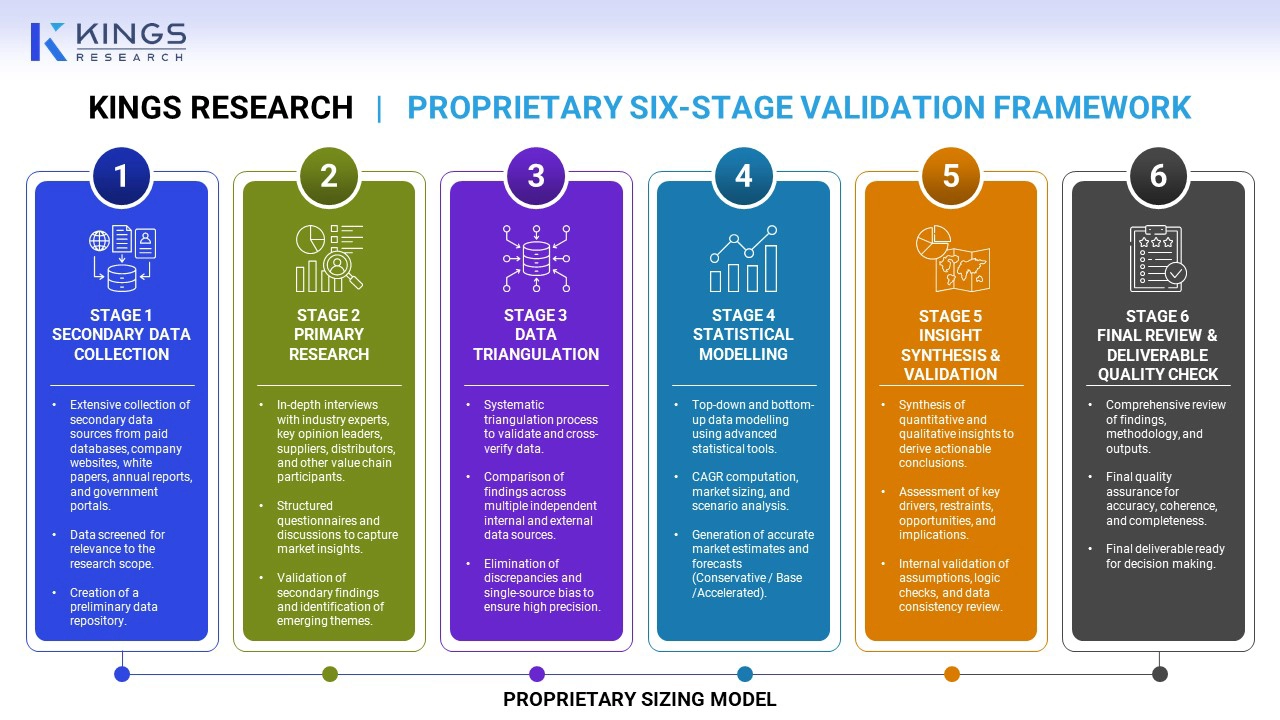
Our methodology triangulates insights from multiple independent and publicly available research databases and is further validated against regulatory filings and public company disclosures. All estimates are cross-verified; no single-source data is presented without validation.
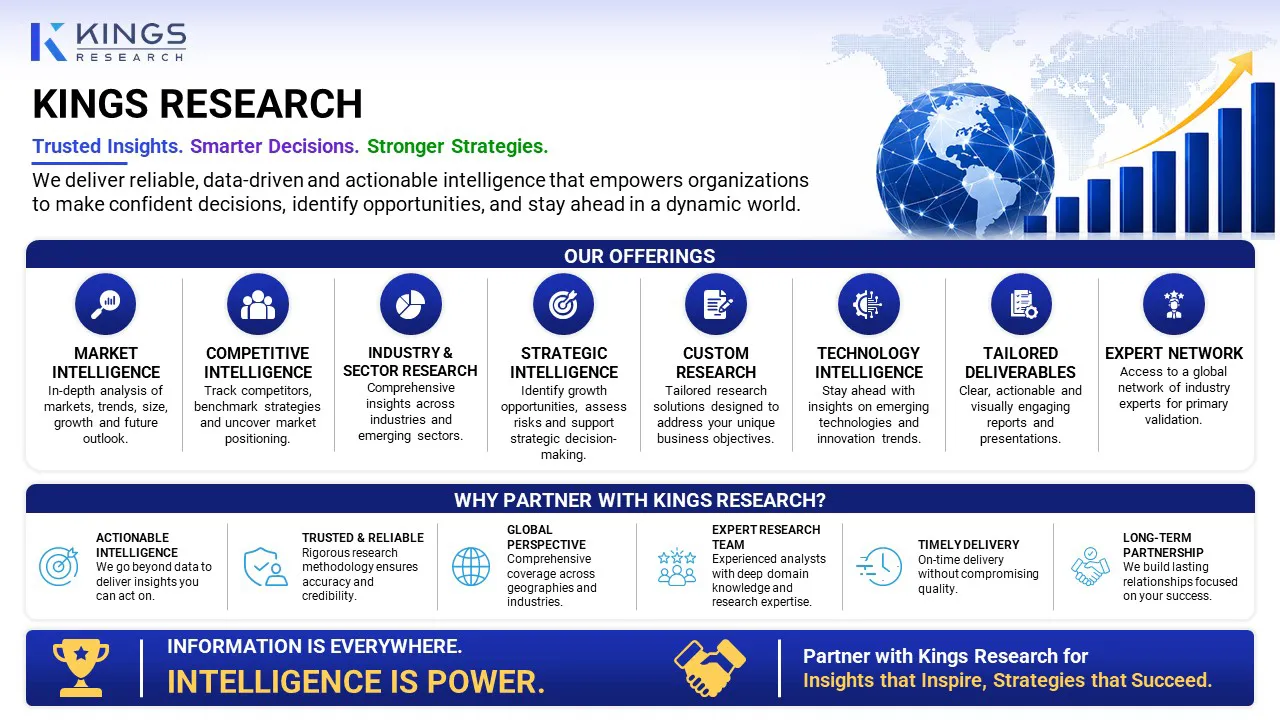
Our custom offerings deliver tailored, data-driven intelligence and strategic guidance to help organizations identify, evaluate, and capitalize on key market opportunities.
Frequently Asked Questions

Omkar is an accomplished research analyst with experience across a wide range of industries, including but not limited to pharmaceuticals, biotechnology, healthcare, chemicals & materials, energy, and consumer goods. His cross-domain expertise allows him to analyze complex market dynamics, uncover actionable insights, and provide high-value research that supports strategic decision-making. Skilled in both qualitative and quantitative analyses, Omkar synthesizes large datasets to create insightful, stakeholder-focused reports. His broad industry knowledge enables him to identify synergies across sectors, adding value to his research. Outside of work, Omkar is a passionate movie enthusiast. His love for cinema fuels his creativity and enhances his ability to think critically-skills that complement his research capabilities. Omkar’s data validation skills and cross-industry expertise make him a partner. He translates complex findings into strategic narratives. His commitment to continuous learning keeps him ahead of evolving markets, while his collaborative nature strengthens team synergy, driving stakeholder confidence and impactful outcomes.
Habi is a seasoned research and consulting leader with renowned experience in guiding clients on strategic growth and transformation initiatives across global markets. He has led high-performing research teams that deliver actionable insights on market expansion, M&A strategies, opportunity assessment, new business development, and product launches. His project portfolio spans large petrochemical producers, electronic device manufacturers, lubricants companies, and other leading enterprises across diverse industrial and consumer sectors. He currently heads the research department at Kings Research, where he is responsible for setting the research agenda, mentoring analysts, and ensuring client-ready deliverables that support executive decision-making. With extensive experience in market intelligence, strategic research, and consulting, Habi brings a strong understanding of evolving industry dynamics, competitive landscapes, emerging opportunities, and business growth challenges. His expertise includes developing research frameworks, translating complex market data into actionable strategic recommendations, and working closely with senior stakeholders to address critical business questions. He has also contributed to building research capabilities, strengthening analytical methodologies, and driving a culture of quality and insight-led decision-making within research teams. His cross-industry exposure enables him to connect market trends with broader business implications and provide perspectives that help organizations identify opportunities, mitigate risks, and make informed strategic decisions.



.webp&w=128&q=75&dpl=dpl_DPva2LrvfsBdTJm1XZj67UTrvMHL)
