
Inquire Now
Key Strategic Points
According to Kings Research, the global deepfake AI detection market size was valued at USD 832.5 million in 2025 and is estimated to reach USD 10,600.1 million by 2033, growing at a CAGR of 37.44% from 2026 to 2033.
As content produced by AI is growing at a rapid rate across sectors like entertainment, marketing, and social media, there is a growing demand for strong content verification and authentication solutions.
As AI tools become more accessible and powerful, the risk of misinformation and digital manipulation has increased. This surge in risk is driving demand for effective deepfake detection technologies to safeguard content integrity and maintain trust.
Major companies operating in the deepfake AI detection industry are Pindrop Security, DuckDuckGoose B.V., Sightengine, SentinelOne, Sensity AI, Attestiv Inc., Oz Forensics, Reality Defender Inc., Resemble AI, WeVerify, DeepBrain AI, Kroop AI, BioID, Clarity, and FaceOnLive.
The market is rapidly evolving as AI-produced content becomes more common and can be misused across a growing range of applications. Deepfakes are becoming increasingly sophisticated, and so is the need for advanced detection tools for cybersecurity, media, law enforcement, and beyond.
As the risks of manipulated media grow more evident, companies and consumers are turning to software tools that guarantee content authenticity and guard against digital deception. For instance, in October 2024, Microsoft introduced the Content Integrity Suite, aimed at improving transparency in AI-generated media. The tool enables users to verify the authenticity of digital content by providing essential metadata to trace its origin and reduce the risk of manipulation.
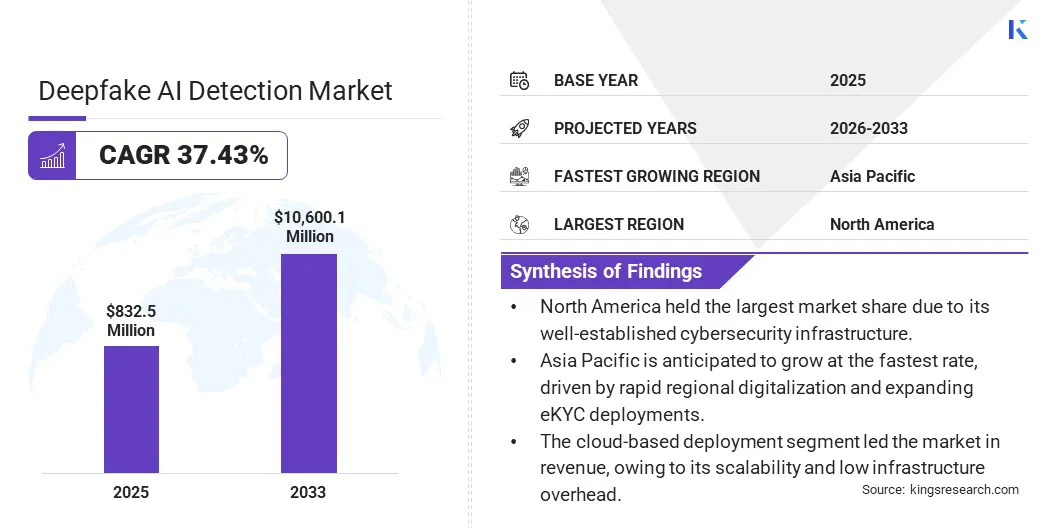
The increasing adoption of content created by AI is one of the key growth factors for the deepfake AI detection market. As AI tools get better at making realistic videos, images, and audio, it is getting harder to tell what is real and what has been manipulated.
This surge in AI content creation in entertainment, advertising, and social media is increasing the need for advanced detection systems for content authenticity.
Data privacy concerns are a key challenge in the deepfake AI detection market. Analyzing content for manipulation requires processing personal or sensitive media, increasing the risk of unauthorized access, data breaches, or misuse.
This has resulted in user and organizational resistance to using detection tools due to the possibility of privacy violations. To address this, developers are focusing on on-device processing, performing analysis locally without transferring data to external servers.
Additionally, implementing robust encryption protocols and ensuring strict adherence to data protection regulations such as GDPR and CCPA can help build trust.
Real-time detection capabilities are emerging as a pivotal trend in the market, driven by increasing demand for instant identification of manipulated media in live content and streaming environments. The widespread use of deepfakes across social media, news outlets, and live broadcasts has increased the need for rapid, accurate detection.
This demand is driving the development of advanced solutions that analyze and verify content in real time, enabling swift response to deceptive media and minimizing the spread of misinformation. For instance, in March 2025, Infibeam Avenues Ltd entered into a strategic Memorandum of Understanding (MoU) with the Indian Institute of Science (IISc), Bangalore, to collaboratively develop advanced real-time deepfake detection systems.
|
Segmentation |
Details |
|
By Type |
Video Deepfake Detection, Image Deepfake Detection, Voice Deepfake Detection |
|
By Deployment Mode |
Cloud-Based, On-Premises |
|
By Enterprise Size |
Small and Medium-Sized Enterprises (SMEs), Large Enterprises |
|
By End-Use Industry |
Media and Entertainment, BFSI (Banking, Financial Services, and Insurance), Government and Politics, Healthcare and Life Sciences, Others |
|
By Region |
North America: U.S., Canada, Mexico |
|
Europe: France, U.K., Spain, Germany, Italy, Russia, Rest of Europe |
|
|
Asia-Pacific: China, Japan, India, Australia, ASEAN, South Korea, Rest of Asia-Pacific |
|
|
Middle East & Africa: Turkey, UAE, Saudi Arabia, South Africa, Rest of Middle East & Africa |
|
|
Central & South America: Brazil, Argentina, Rest of Central & South America |
Based on region, the global market has been classified into North America, Europe, Asia Pacific, Middle East & Africa, and Central & South America.
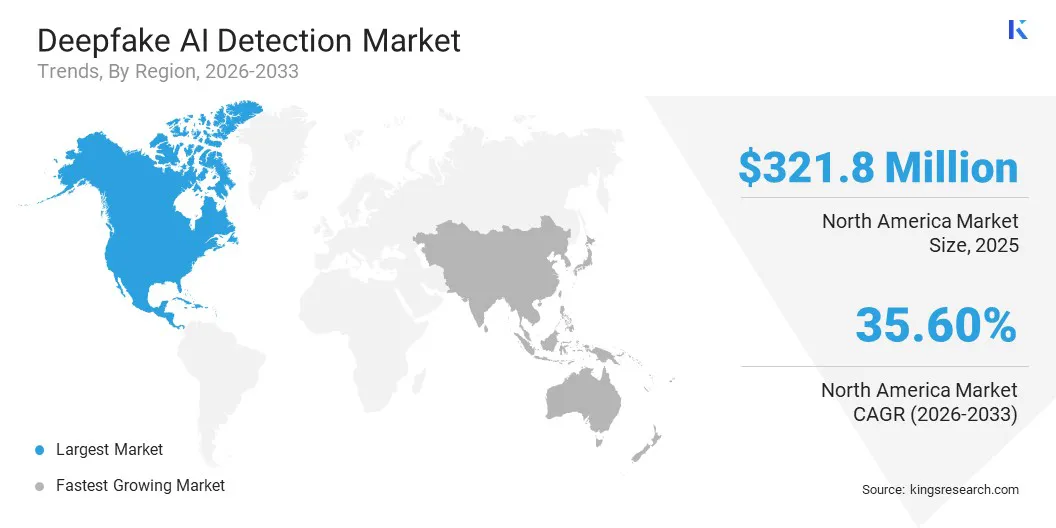
North America accounted for the largest share of the global deepfake AI detection market in 2025. According to Kings Research, this dominant position reflects the region's high adoption of advanced technologies, strong AI capabilities, and significant demand for security and privacy solutions.
The presence of key players along with substantial investments in research and development further enhances North America's leadership in the market. Additionally, the region's well-established technological infrastructure supports the growth of deepfake detection solutions.
Growing concerns over cybersecurity, privacy violations, and deepfake-related threats in sectors such as media, entertainment, and government continue to propel demand for effective AI-based detection tools across North America. For instance, in May 2024, McAfee announced enhanced AI-powered deepfake detection technology at the Rivest Shamir Adleman (RSA) Conference in San Francisco, leveraging the Intel Core Ultra processor's NPU. This collaboration improves performance, privacy, and detection of AI-generated deepfakes, and provides consumers with advanced local analysis for greater security.
Asia-Pacific is anticipated to register the highest CAGR over the forecast period, emerging as the fastest-growing region in the deepfake AI detection industry, fueled by rapid digital transformation, increasing internet penetration, and a surge in AI adoption.
Growing concerns about online fraud, cybersecurity threats, and misinformation in the region are prompting governments and enterprises to invest in deepfake detection solutions. Large-scale government-backed digital infrastructure projects and AI innovation programs are further supporting the development and deployment of advanced detection tools, driving market growth across Asia-Pacific. For instance, in September 2024, Ensign InfoSecurity launched Aletheia, an AI-driven real-time deepfake detection solution in Asia. Aletheia provides up to 90% accuracy in detecting manipulated media, offering seamless protection via endpoint software or a browser plug-in.
Strategic investments in the deepfake AI detection industry are rising as companies focus on advancing AI and machine learning technologies. These investments focus on real-time detection capabilities, improved accuracy, and scalable solutions.
Partnerships with academic institutions and cybersecurity firms further drive innovation, aiming to combat misinformation, fraud, and security risks associated with deepfake technology across various sectors. For instance, in October 2024, Accenture made a strategic investment in Reality Defender, an AI-powered deepfake detection company. This investment enhances Accenture's cybersecurity offerings, providing enterprises and governments with advanced tools to detect and prevent deepfake fraud, disinformation, and cybercrime in real time.
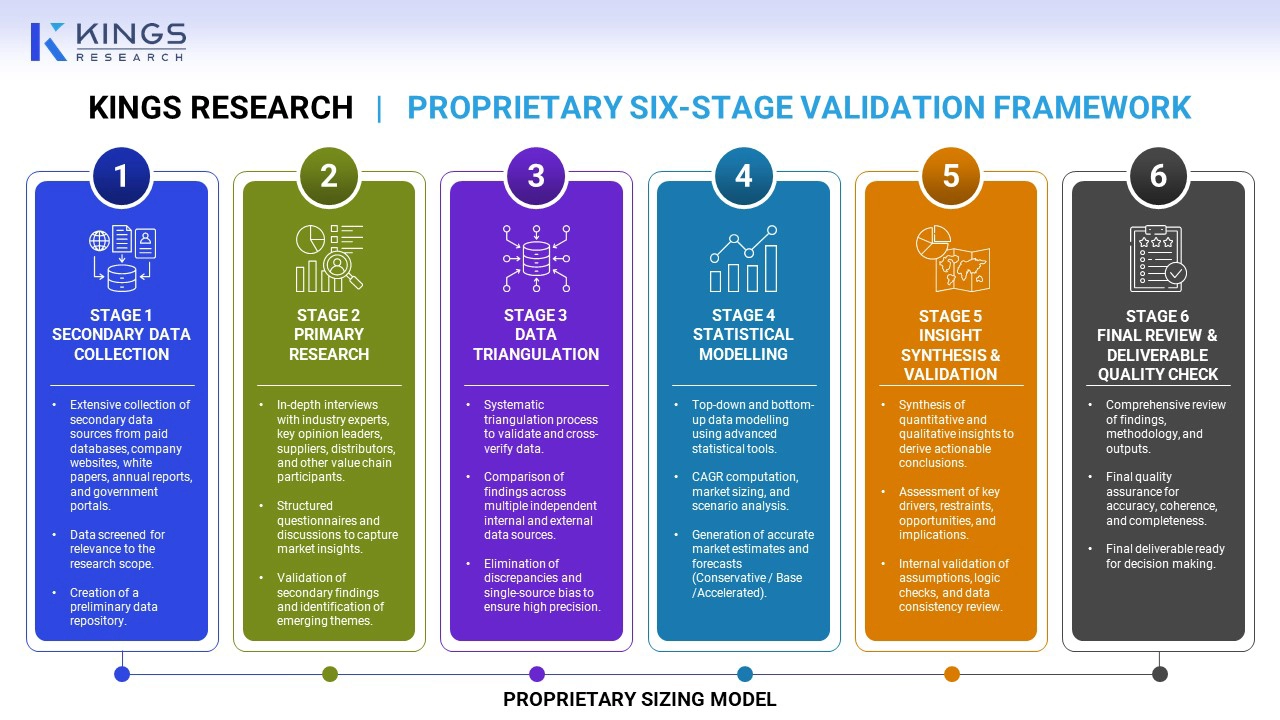
Our methodology triangulates insights from multiple independent and publicly available research databases and is further validated against regulatory filings and public company disclosures. All estimates are cross-verified; no single-source data is presented without validation.
Frequently Asked Questions

Sharmishtha is a budding research analyst with a strong commitment to achieving excellence in her field. She brings a meticulous approach to every project, delving deep into details to ensure comprehensive and insightful outcomes. Passionate about continuous learning, she strives to enhance her expertise and stay ahead in the dynamic world of market research. Beyond work, Sharmishtha enjoys reading books, spending quality time with friends and family, and engaging in activities that foster personal growth. Her dedication to precision ensures that no critical detail is overlooked, and her analytical rigor consistently produces reliable, evidence-based conclusions. Sharmishtha's proactive curiosity drives her to explore emerging research methodologies, which she readily applies to deliver fresh perspectives on complex market questions. Her collaborative nature and openness to constructive feedback make her a dependable team player. She balances technical accuracy with clear communication, ensuring her insights are actionable for clients and stakeholders alike.
Habi is a seasoned research and consulting leader with renowned experience in guiding clients on strategic growth and transformation initiatives across global markets. He has led high-performing research teams that deliver actionable insights on market expansion, M&A strategies, opportunity assessment, new business development, and product launches. His project portfolio spans large petrochemical producers, electronic device manufacturers, lubricants companies, and other leading enterprises across diverse industrial and consumer sectors. He currently heads the research department at Kings Research, where he is responsible for setting the research agenda, mentoring analysts, and ensuring client-ready deliverables that support executive decision-making. With extensive experience in market intelligence, strategic research, and consulting, Habi brings a strong understanding of evolving industry dynamics, competitive landscapes, emerging opportunities, and business growth challenges. His expertise includes developing research frameworks, translating complex market data into actionable strategic recommendations, and working closely with senior stakeholders to address critical business questions. He has also contributed to building research capabilities, strengthening analytical methodologies, and driving a culture of quality and insight-led decision-making within research teams. His cross-industry exposure enables him to connect market trends with broader business implications and provide perspectives that help organizations identify opportunities, mitigate risks, and make informed strategic decisions.