
Inquire Now
Key Strategic Points
AI-based threat detection and response refers to the use of new technologies, including machine learning, behavioral analytics, Internet of Things (IoT), and orchestration, to detect and address cyber threats across global digital infrastructure. This involves real-time telemetry, predictive modeling, and autonomous incident remediation to improve security for large enterprises and SMEs across industries such as BFSI, IT and telecom, government, and healthcare.
The global AI-Powered threat detection and response market size was valued at USD 5.59 billion in 2024 and is projected to grow from USD 6.56 billion in 2025 to USD 23.52 billion by 2032, exhibiting a CAGR of 20.00% during the forecast period.
This expansion is primarily propelled by the urgent necessity for heightened digital resilience, which compels organizations to adopt autonomous defense systems to sustain operational continuity. A global shift toward accelerated and more intelligent identification frameworks further enables security teams to neutralize sophisticated risks with minimal human delay.
Major companies operating in the global AI-powered threat detection and response industry are CrowdStrike, Palo Alto Networks, Darktrace Holdings Limited, SentinelOne, Cisco Systems, Inc., Fortinet, Inc., Vectra AI, Inc., Check Point Software Technologies Ltd., Splunk LLC, Rapid7, Abnormal AI, Inc., Cybereason, Musarubra US LLC, and Recorded Future, Sophos Ltd.
The urgent necessity to mitigate insider risk is boosting the adoption of AI-powered threat detection and response by requiring more granular and adaptive behavioral oversight. Companies use these technologies to make the internal data access, find anomalies in record time, and reduce the chances of sensitive information leakage.
These smart architectures can fasten remediation and triage processes by automatically ranking the most significant internal alerts and implementing quick response measures to control possible attacks. This is an automated system that saves the workload of the security teams and makes sure that suspicious internal operations are dealt with before they can destroy corporate governance.
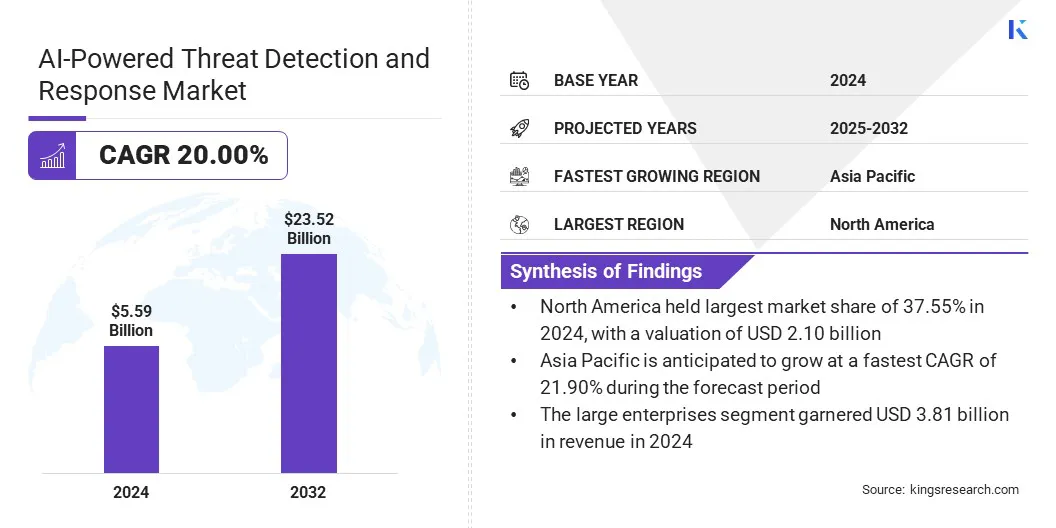
The market is growing rapidly growing to address the need for enhanced digital resilience in global enterprise infrastructures. This adoption enables organizations to maintain continuous business operations by proactively identifying and neutralizing vulnerabilities before they escalate into systemic failures. In addition to fortifying network perimeters, AI-powered resilience is utilized in behavioral analytics, automated incident remediation, predictive risk modeling, and security orchestration.
Technologies such as cloud-native telemetry and real-time data analysis increase the efficiency of identifying zero-day exploits. It forms the basis of the present-day security operations centers (SOC) and supports key data protection, ensuring the stability of the organization in a continuously developing world of advanced cyber threats.
One of the major issues in the market is the high capital investment and technical skills required to implement and maintain advanced machine learning models. Such systems are also costly in terms of training and highly trained staff to handle the complex tuning of algorithms, which in most cases is beyond the budgetary and human resource capabilities of most organizations.
To overcome this challenge, firms are increasingly moving towards cloud-based Security-as-a-Service and managed automated detection models. Those solutions provide scalable, ready-to-use AI services, and thus eliminate the need for specialized on-premise infrastructure and reduce deployment complexity across a wide range of enterprise environments.
A major trend in the market is the increasing adoption of automated, high-speed identification systems for risk mitigation. These intelligent frameworks are designed to work alongside security analysts in tasks such as incident triage, behavioral analysis, and real-time response orchestration. They are different from traditional signature-based tools, which do not allow for the autonomous detection of unknown or zero-day vulnerabilities.
Faster and more intelligent solutions are being increasingly used as cyber threats become more varied and complex, making them a widely implemented security solution across diverse enterprise environments.
|
Segmentation |
Details |
|
By Organization Size |
Large Enterprises, SMEs |
|
By End User |
BFSI, IT & Telecom, Government, Healthcare, Others |
|
By Region |
North America: U.S., Canada, Mexico |
|
Europe: France, UK, Spain, Germany, Italy, Russia, Rest of Europe |
|
|
Asia-Pacific: China, Japan, India, Australia, ASEAN, South Korea, Rest of Asia-Pacific |
|
|
Middle East & Africa: Turkey, U.A.E., Saudi Arabia, South Africa, Rest of Middle East & Africa |
|
|
South America: Brazil, Argentina, Rest of South America |
Based on region, the market has been classified into North America, Europe, Asia Pacific, Middle East & Africa, and South America.
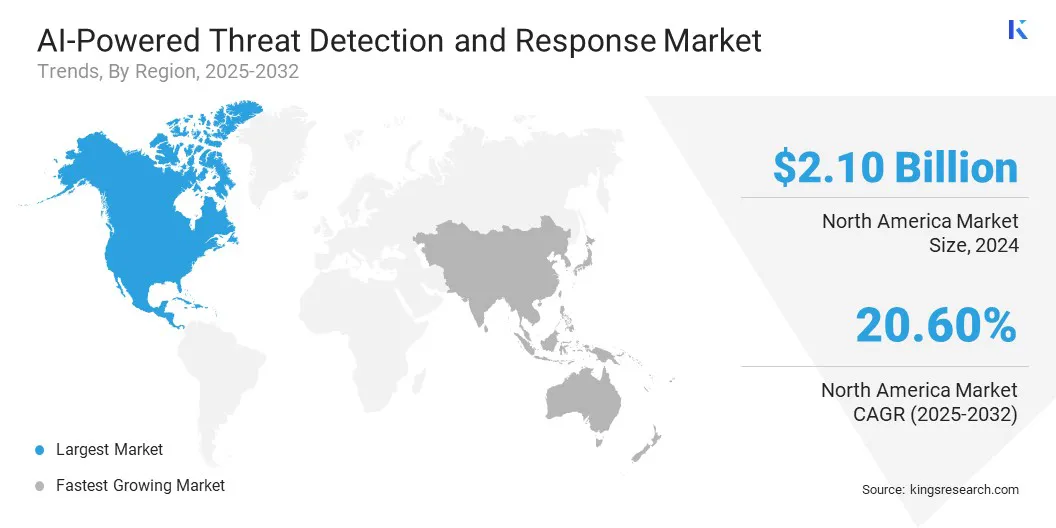
North America accounted for a substantial share of 37.55% in 2024, valued at USD 2.10 billion. This dominance is reinforced by the presence of major players specializing in offering threat detection and response services to meet the increasing demand for improved detection systems. The local market enjoys a mature technological ecosystem that enables better security orchestration and real-time remediation of incidents.
This market share is further enhanced by the early and widespread use of cloud-native security structures among government entities as well as corporations, and by stringent regulatory frameworks that enforce proactive monitoring of threats.
The Asia-Pacific AI-powered threat detection and response market is expected to register the fastest CAGR of 21.90% over the forecast period. This growth is supported by the rapid digital change and the increasing internet penetration in emerging economies.
These countries are undergoing digitization, transitioning to digital financial systems and smart city initiatives, which have created a dire need to secure data against increasingly sophisticated cyber-physical attacks. The rise of local technology companies and government policies supporting the adoption of advanced cybersecurity technologies is driving the development of AI-based monitoring.
Key players operating in the AI-powered threat detection and response industry are actively forging alliances and enhancing next-generation technology to gain a competitive edge over the enterprises that are implementing AI on a large scale. Major security providers are partnering with cloud infrastructure developers to bring in real-time adaptive monitoring, which can be used to implement zero-trust architecture and risk optimization of huge datasets in real-time.
Meanwhile, technology developers are utilizing AWS infrastructure and scalable cloud configurations to enable synchronization of global data, distributed security processing, and smooth integration with existing enterprise ecosystems. These alliances and emerging technologies can assist in making security operations more adaptable, supporting the transition to software-defined protection, and accelerating the implementation of automated defense models for protection.
Frequently Asked Questions

Tejasv specializes in secondary research and data validation, transforming complex information into clear market insights. He supports multi-industry research initiatives by delivering reliable intelligence that informs planning and strategic direction. With a disciplined and detail-focused approach, he emphasizes analytical clarity and practical application. His interest in geopolitics and history informs his broader market perspective. This unique lens allows him to contextualize industry shifts within larger socio-political frameworks, adding depth to his analyses. He maintains rigorous documentation standards, making his findings auditable and easily reproducible. His ability to distill vast amounts of secondary data into concise, decision-ready summaries has earned him the trust of project leads across multiple verticals. Tejasv actively tracks regulatory changes and economic indicators, which he incorporates into his research to enhance its forward-looking relevance. His methodical work ethic, combined with a calm demeanor under tight deadlines, ensures that his contributions remain both timely and impactful.
Habi is a seasoned research and consulting leader with renowned experience in guiding clients on strategic growth and transformation initiatives across global markets. He has led high-performing research teams that deliver actionable insights on market expansion, M&A strategies, opportunity assessment, new business development, and product launches. His project portfolio spans large petrochemical producers, electronic device manufacturers, lubricants companies, and other leading enterprises across diverse industrial and consumer sectors. He currently heads the research department at Kings Research, where he is responsible for setting the research agenda, mentoring analysts, and ensuring client-ready deliverables that support executive decision-making. With extensive experience in market intelligence, strategic research, and consulting, Habi brings a strong understanding of evolving industry dynamics, competitive landscapes, emerging opportunities, and business growth challenges. His expertise includes developing research frameworks, translating complex market data into actionable strategic recommendations, and working closely with senior stakeholders to address critical business questions. He has also contributed to building research capabilities, strengthening analytical methodologies, and driving a culture of quality and insight-led decision-making within research teams. His cross-industry exposure enables him to connect market trends with broader business implications and provide perspectives that help organizations identify opportunities, mitigate risks, and make informed strategic decisions.