
Inquire Now
Key Strategic Points
The market involves the production and installation of wind towers, vital components of wind turbines that elevate the rotor for optimal energy capture. This market includes various types of towers, such as lattice, tubular, and hybrid structures, used in both onshore and offshore wind farms.
The market is driven by the increasing demand for renewable energy, government incentives, and advancements in turbine technology, with factors like material costs and global energy policies significantly impacting market dynamics.
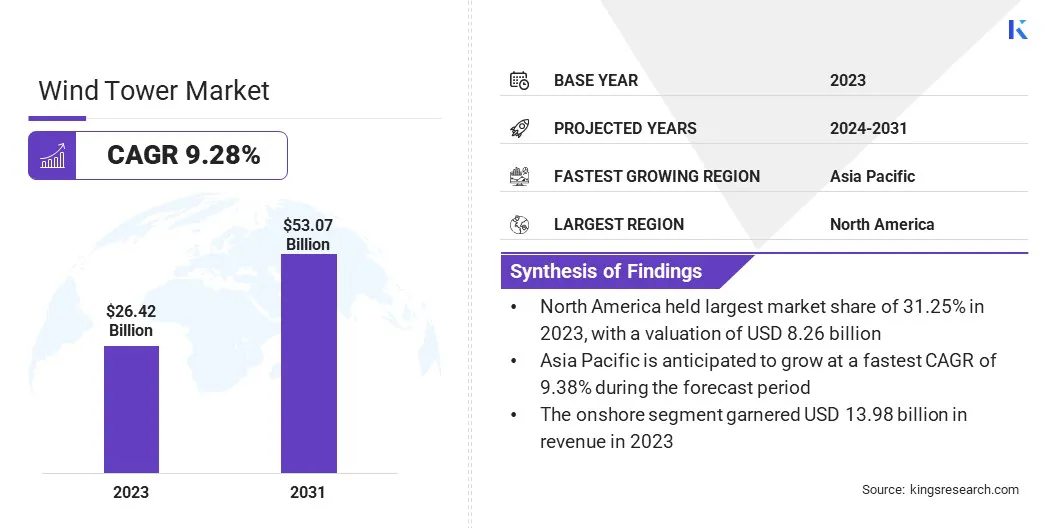
The global wind tower market size was valued at USD 26.42 billion in 2023 and is projected to grow from USD 28.52 billion in 2024 to USD 53.07 billion by 2031, exhibiting a CAGR of 9.28% during the forecast period.
The market is growing rapidly, due to the rising adoption of wind energy as a key component of the global transition to sustainable energy sources. Increased investments in wind energy infrastructure, coupled with favorable government policies and incentives, drive this growth. The shift toward larger and more efficient wind turbines boosts the demand for advanced wind tower designs, contributing further to market expansion.
Major companies operating in the wind tower industry are General Electric Company, goldwind.com, Siemens Gamesa Renewable Energy, Envision Group, Nordex SE, Suzlon Energy Limited, ENERCON Global GmbH, ACCIONA, KGW, Senvion Wind Technology Pvt. Ltd, Suzlon Energy Limited, CS WIND Corporation, DONGKUK S&C, Inoxwind, Vestas, and Arcosa Wind Towers, Inc.
Declining costs of wind energy technology, environmental concerns, and the need for energy security are driving the market. The demand for both onshore and offshore wind installations is expected to rise as countries strive to meet renewable energy targets and cut greenhouse gas (GHG) emissions, benefiting the market.
Innovations in materials and manufacturing are also improving performance and reducing costs, ensuring sustained growth in the years ahead.
 Key Highlights
Market Driver
“Expansion of Offshore Wind Farms”
Offshore wind energy is growing rapidly, due to its ability to harness stronger, more consistent winds, resulting in higher energy output than onshore installations. Technological advancements, such as floating wind turbines and taller wind towers, are improving feasibility even in deeper waters.
The demand for specialized, durable offshore wind towers is set to rise significantly as nations prioritize energy security and carbon neutrality.
The continuous expansion of offshore wind projects is driving renewable energy growth, which contributes to local economic and social development. This long-term commitment highlights the broader impact of wind energy beyond power generation, which is accelerating the growth of the wind tower market.
Market Challenge
“High Initial Costs”
The high initial costs associated with manufacturing and installing wind towers, especially for offshore wind farms, present one of the most important challenges in the global wind tower market.
These significant upfront expenses, which include advanced materials, installation, and infrastructure, can deter investments, particularly in developing regions with limited access to capital. Wind energy offers long-term environmental and economic benefits; however, the capital-intensive nature of the industry can delay the transition to renewable energy, slowing overall market growth.
Governments can offer incentives, while economies of scale and technological advancements in materials and manufacturing processes can help lower costs over time, encouraging more widespread adoption of wind energy.
Market Trend
“Rising Adoption of Modular & Prefabricated Wind Towers”
The rising adoption of modular & prefabricated wind towers is reshaping the wind energy sector by addressing key challenges like transportation, installation time, and cost. Modular wind towers are made up of pre-manufactured sections that can be transported more easily compared to traditional, massive single-piece towers.
This modularity allows for faster on-site assembly, reducing construction time and labor costs. Additionally, prefabrication in controlled environments ensures high-quality standards and reduces material waste.
Modular designs are becoming essential as the demand for taller towers increases, as they allow for the efficient construction of taller and more robust towers. These towers can be customized to suit specific wind conditions and terrain, making them ideal for remote or difficult-to-access locations. This trend not only helps lower the overall cost of wind power but also improves the feasibility of deploying wind turbines in a broader range of locations.
|
Segmentation |
Details |
|
By Type |
Steel Tower, Concrete Tower, Hybrid Tower |
|
By Deployment |
Onshore, Offshore |
|
By Application |
Industrial, Commercial, Residential, Utility |
|
By Region |
North America: U.S., Canada, Mexico |
|
Europe: France, UK, Spain, Germany, Italy, Russia, Rest of Europe |
|
|
Asia Pacific: China, Japan, India, Australia, ASEAN, South Korea, Rest of Asia Pacific |
|
|
Middle East & Africa: Turkey, UAE, Saudi Arabia, South Africa, Rest of Middle East & Africa |
|
|
South America: Brazil, Argentina, Rest of South America |
Market Segmentation
Based on region, the market has been classified into North America, Europe, Asia Pacific, Middle East & Africa, and Latin America.
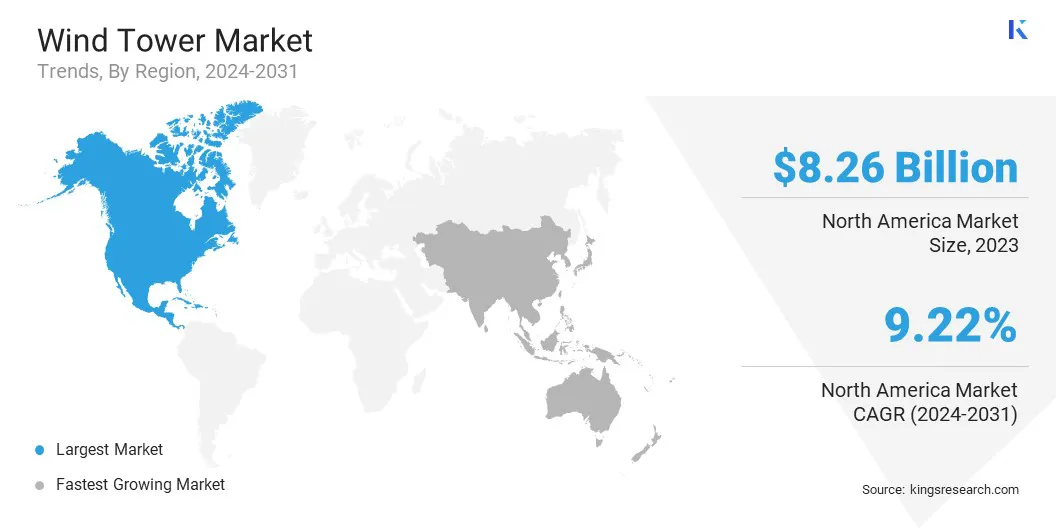 North America accounted for a significant wind tower market share of around 31.25% in 2023, valued at USD 8.26 billion. This is attributed to increased investments in renewable energy, state and federal incentives, and a strong push for clean power generation.
The U.S. and Canada are leading the way with onshore wind projects, supported by favorable wind conditions, technological advancements, and an evolving energy infrastructure.
The wind tower industry in Asia Pacific is poised to grow at a CAGR of 9.38% through the projection period. This growth is driven by increasing investments in renewable energy, government support for wind energy projects, and the growing demand for clean energy solutions in countries like China, India, and Japan. The wind power market in Asia Pacific is set to expand significantly as the region continues to prioritize sustainable energy.
Companies should focus on innovative tower designs, including modular and hybrid structures that enhance transport and installation efficiency, to gain a competitive edge in the wind tower market.
Additionally, sustainability and cost reduction through advanced manufacturing techniques and materials can increase profitability. Firms must also stay ahead by aligning with government policies, securing renewable energy incentives, and investing in offshore wind projects.
Recent Developments
Frequently Asked Questions

Over the years, Versha brings over 15 years of experience managing consulting assignments across industries, including Food and Beverage, Consumer Goods, ICT, Aerospace, and more. Her work has spanned diverse sectors. Her cross-domain expertise and adaptability make her a versatile and dependable professional. She is known for her keen business insight and foresight. With sharp analytical skills and a curious mindset, Versha excels at transforming complex data into actionable insights. She has a proven track record of unraveling market dynamics, identifying trends, and delivering tailored solutions to meet client needs. As a skilled leader, Versha has successfully mentored research teams and directed projects with precision, ensuring high-quality outcomes. Her collaborative approach and strategic vision enable her to turn challenges into opportunities and consistently deliver impactful results. Whether analyzing markets, engaging stakeholders, or crafting strategies, Versha draws on her deep expertise and industry knowledge to drive innovation and deliver measurable value.

Ganapathy Subramaniam Suresh
With over a decade of research leadership across global markets, Ganapathy brings sharp judgment, strategic clarity, and deep industry expertise. Known for precision and an unwavering commitment to quality, he guides teams and clients with insights that consistently drive impactful business outcomes.



.webp&w=128&q=75&dpl=dpl_DPva2LrvfsBdTJm1XZj67UTrvMHL)