
Inquire Now
Key Strategic Points
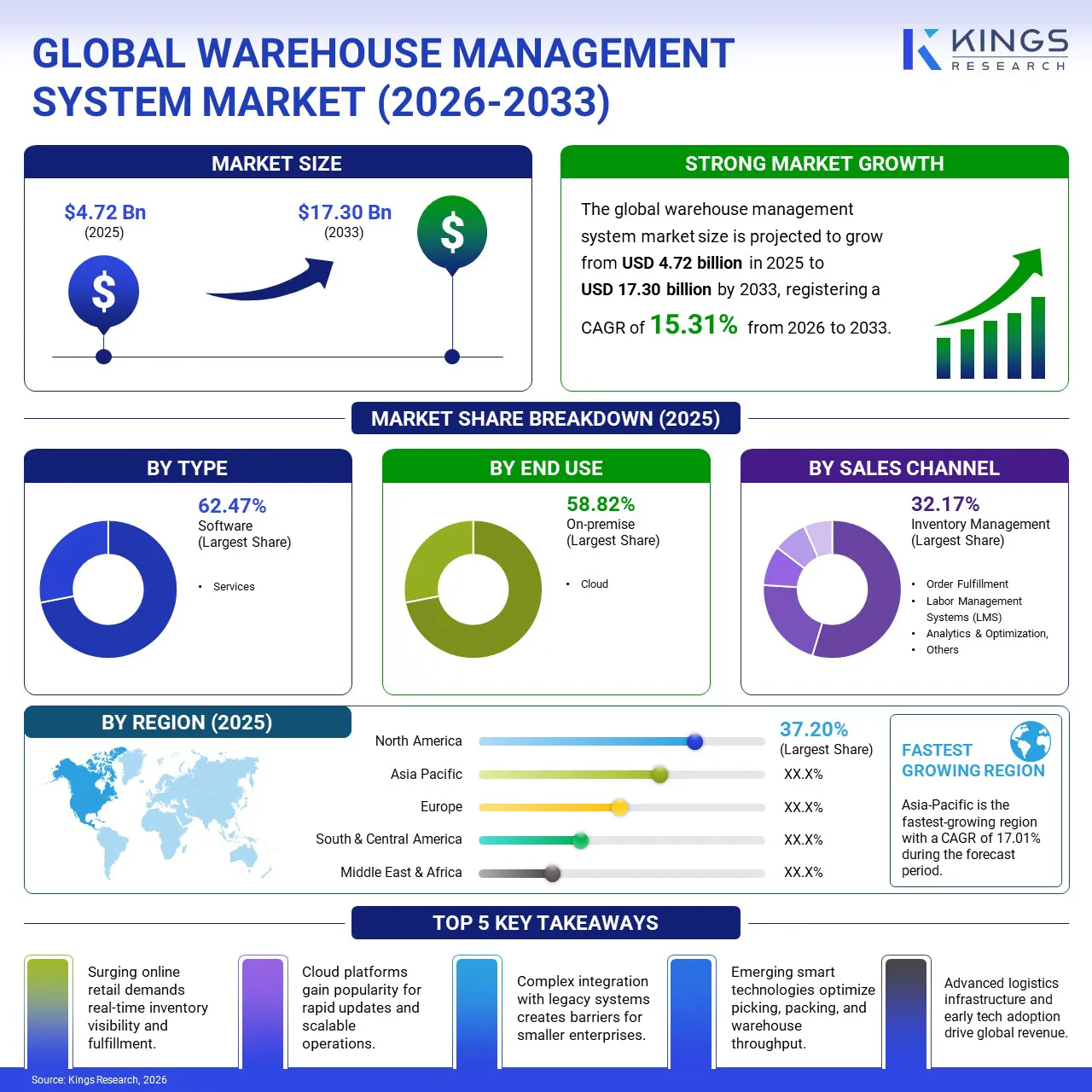
According to Kings Research, the global market for warehouse management systems was valued at USD 4.72 billion in 2025 and is projected to reach USD 17.30 billion by 2033, exhibiting a CAGR of 15.31% during the forecast period (2026–2033).
The market encompasses software solutions, cloud platforms, and automated workflow systems designed to optimize inventory tracking, order fulfillment, and logistics operations for warehouses, distribution centers, and fulfillment hubs. The report explores key drivers of market development, offering detailed regional analysis and a comprehensive overview of the competitive landscape shaping future opportunities.
The market is expanding rapidly, driven by the increasing need for operational efficiency, real-time inventory visibility, and automated fulfillment processes across global supply chains. This growth is further supported by the rapid expansion of online commerce and the rising popularity of multi-channel retailing, encouraging organizations to invest in advanced warehouse software. The need for automation and streamlined supply chain processes is contributing to market expansion.
Major companies operating in the warehouse management system market are SAP SE, Oracle Corporation, Manhattan Associates, Inc., Blue Yonder Group, Inc., Infor, HighJump / Körber AG, Tecsys Inc., PTC Inc., Epicor Software Corporation, and PSI Software AG.
The global warehouse management system market is experiencing robust growth, driven by the rising demand for real-time inventory tracking, e-commerce acceleration, and omni-channel retail expansion. Rising customer expectations for fast, accurate, and flexible delivery options are compelling businesses to upgrade their warehouse operations with advanced real-time capabilities.
Modern WMS solutions enable end-to-end visibility into stock levels, automated order picking, and seamless integration with transportation management systems (TMS) and enterprise resource planning (ERP) platforms. This end-to-end connectivity is essential for retailers seeking to optimize their fulfillment networks, meet dynamic market demands, and maintain a competitive edge in a digital-first economy.
In April 2026, Manhattan Associates and Genuine Parts Company (GPC) announced the successful go-live of Manhattan Active Warehouse Management at GPC’s Brisbane distribution center. The cloud-native WMS replaced multiple legacy systems and manual processes, providing real-time visibility, intelligent automation, and improved scalability across warehouse operations.
High initial deployment costs and implementation complexities represent a primary restraint facing the warehouse management system market. Implementing a full-scale WMS involves significant capital outlays for software licenses, hardware infrastructure, cloud integration, data migration, and workforce training.
For many organizations, particularly small and medium-sized enterprises (SMEs), these costs can be a major barrier to adoption. Furthermore, integrating modern WMS platforms with legacy ERP systems or customized legacy warehouse software often results in extended implementation timelines, operational downtime, and technical friction.
A key trend in the warehouse management system market is the growing integration of artificial intelligence (AI) and machine learning (ML), which is leading to the development of smarter, more adaptive warehouse operations.
Modern warehouse management system platforms leverage AI and ML algorithms to analyze vast amounts of data, enabling predictive demand forecasting, dynamic inventory optimization, and intelligent resource allocation to enhance operational efficiency. These technologies support real-time decision-making and continuous process improvement by identifying patterns, anticipating fluctuations in demand, and optimizing order-picking routes and workflows.
The integration of AI-powered analytics into warehouse management systems also facilitates automation beyond simple rule-based systems, allowing warehouses to respond more effectively to changing conditions and complex supply chain challenges.
Moreover, the ongoing enhancement of machine learning models is enabling warehouse management system solutions to become increasingly autonomous, reducing manual intervention and improving accuracy in inventory management.
|
Segmentation |
Details |
|
By Component |
Software (stand-alone WMS, integrated WMS, and cloud-based WMS software) and services (consulting services, system integration & implementation services, training & support services, and managed services) |
|
By Deployment Type |
On-premises, cloud |
|
By Application |
Inventory Management, Order Fulfillment, Labor Management Systems (LMS), Analytics & Optimization, and Others (Shipping Management, Billing & Cost Management, Return Management/Reverse Logistics) |
|
By Industry Vertical |
Retail & E-commerce, Manufacturing, Transportation & Logistics (3PLs/4PLs), Healthcare & Pharmaceuticals, Automotive, and Others (Consumer Goods, Chemicals & Materials, Electronics, Construction, Aerospace) |
|
By Region |
North America: U.S., Canada, Mexico |
|
Europe: France, UK, Spain, Germany, Italy, Russia, and the rest of Europe |
|
|
Asia-Pacific: China, Japan, India, Australia, ASEAN, South Korea, Rest of Asia-Pacific |
|
|
Middle East & Africa: Turkey, U.A.E., Saudi Arabia, South Africa, Rest of Middle East & Africa |
|
|
South and Central America: Brazil, Argentina, and the rest of South and Central America |
Based on component, the market is segmented into software (stand-alone WMS, integrated WMS, and cloud-based WMS software) and services (consulting services, system integration & implementation services, training & support services, and managed services). Software holds the largest market share of 62.47% in 2025, driven by widespread adoption of standalone and integrated WMS solutions across fulfillment networks, inventory operations, and warehouse management processes.
Based on deployment type, the market is segmented into on-premise and cloud. On-premise holds the largest market share of 58.82% in 2025, supported by the continued use of internally managed WMS infrastructure among organizations requiring greater control over data, systems, and warehouse operations. Cloud is witnessing the fastest growth, driven by scalability, remote accessibility, flexible deployment, and lower upfront infrastructure requirements.
Based on application, the market is segmented into Inventory Management, Order Fulfillment, Labor Management Systems (LMS), Analytics & Optimization, and Others (Shipping Management, Billing & Cost Management, Return Management/Reverse Logistics). Inventory management holds the largest market share of 32.17% in 2025, supported by the increasing need for real-time inventory visibility, accurate stock tracking, and efficient warehouse operations. Analytics & Optimization is witnessing the fastest growth, driven by the growing adoption of data-driven tools to improve warehouse productivity, workforce utilization, and operational decision-making.
Based on industry vertical, the market is segmented into Retail & E-commerce, Manufacturing, Transportation & Logistics (3PLs/4PLs), Healthcare & Pharmaceuticals, Automotive, and Others (Consumer Goods, Chemicals & Materials, Electronics, Construction, Aerospace). Transportation & Logistics (3PLs/4PLs) holds the largest market share, driven by rapid inventory turnover, multi-tenant warehouse operations, and increasing demand for efficient fulfillment and logistics management. Healthcare & Pharmaceuticals is witnessing the fastest growth, supported by stringent regulatory compliance requirements, traceability needs, and the increasing adoption of automated warehouse processes.
Based on region, the global market is classified into North America, Europe, Asia-Pacific, MEA, and South & Central America.
According to Kings Research, North America held the largest market share of 37.20% in 2025, supported by the presence of leading WMS vendors and high adoption of automated fulfillment technologies across distribution networks.
The Asia Pacific warehouse management system industry is expected to register the fastest growth of 17.01% CAGR over the forecast period. According to Kings Research, the expansion of regional manufacturing hubs and continuous investments in technology development and innovation are enhancing the availability and sophistication of warehouse management solutions throughout the region.
According to Kings Research, Europe accounts for a major share of the global WMS market; this is attributed to well-established logistics infrastructure, high adoption rates of warehouse automation technologies, and a strong focus on digital transformation in the supply chain. Government policies promoting Industry 4.0 initiatives and investments in smart manufacturing and e-commerce are further propelling this growth.
Additionally, growing demand for efficient, scalable systems in retail, manufacturing, and third-party logistics providers is fostering regional market expansion. The Middle East & Africa region is witnessing progressive growth in WMS adoption, propelled by strategic logistics investments across GCC economies and expanding retail logistics hubs. South & Central America is experiencing steady market expansion, led by Brazil and Mexico, driven by expanding e-commerce fulfillment networks and ongoing investments in logistics infrastructure modernization.
The warehouse management system industry is highly competitive, with key players focusing on innovation, strategic partnerships, and expansions to enhance their offerings. There is a greater emphasis on integrating advanced technologies such as artificial intelligence, machine learning, the Internet of Things, and cloud computing, fostering product development.
Customization and industry-specific solutions, along with strong service support, remain critical for customer retention. Continuous technological advancements and evolving customer needs are shaping a dynamic and rapidly growing market.
How We Gather This Information
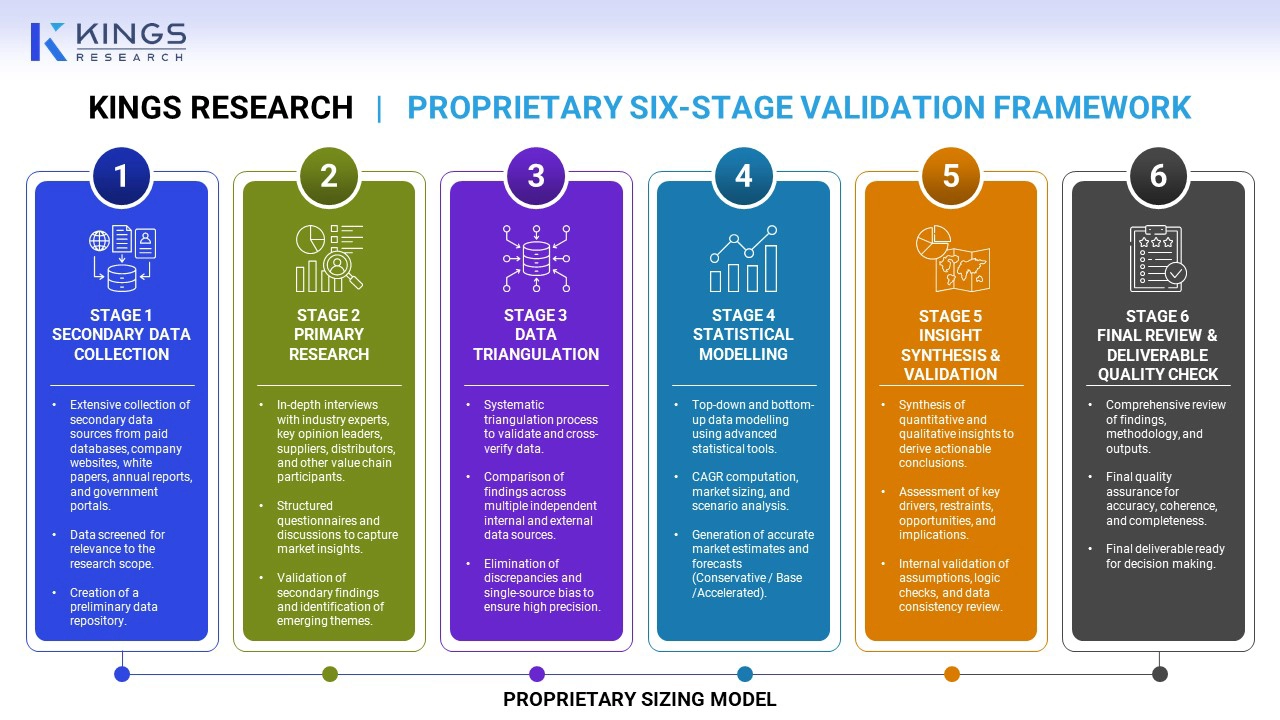
Our methodology triangulates insights from multiple independent and publicly available research databases and is further validated against regulatory filings and public company disclosures. All estimates are cross-verified; no single-source data is presented without validation.
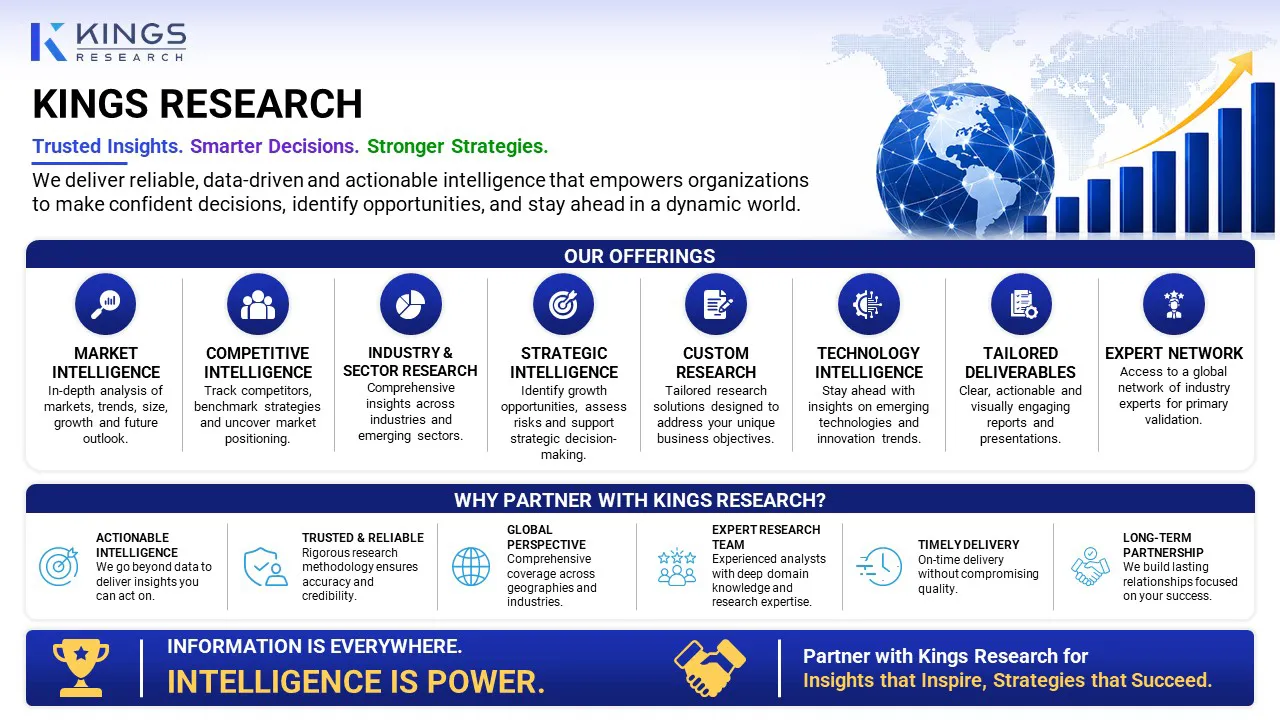
Our custom offerings deliver tailored, data-driven intelligence and strategic guidance to help organizations identify, evaluate, and capitalize on key market opportunities.
Frequently Asked Questions

Sunanda is a proficient research analyst with strong cross-domain expertise, excelling in identifying market trends and delivering insightful analyses across various industries, including consumer goods, food & beverages, healthcare, and more. Her ability to connect insights from diverse sectors enables her to offer actionable recommendations that support strategic decision-making in a range of business contexts. Sunanda's research is driven by thorough data analysis and her commitment to providing relevant, data-driven insights. Her keen eye for patterns allows her to spot emerging opportunities before they become mainstream. Sunanda's synthesis of cross-sector learnings often reveals unconventional solutions that clients find invaluable. She adapts her analytical frameworks to suit each industry's unique nuances, ensuring reports are both accurate and contextually relevant. Clients appreciate her ability to deliver crisp, actionable findings under tight deadlines, consistently exceeding expectations with her thoroughness and insight.
Habi is a seasoned research and consulting leader with renowned experience in guiding clients on strategic growth and transformation initiatives across global markets. He has led high-performing research teams that deliver actionable insights on market expansion, M&A strategies, opportunity assessment, new business development, and product launches. His project portfolio spans large petrochemical producers, electronic device manufacturers, lubricants companies, and other leading enterprises across diverse industrial and consumer sectors. He currently heads the research department at Kings Research, where he is responsible for setting the research agenda, mentoring analysts, and ensuring client-ready deliverables that support executive decision-making. With extensive experience in market intelligence, strategic research, and consulting, Habi brings a strong understanding of evolving industry dynamics, competitive landscapes, emerging opportunities, and business growth challenges. His expertise includes developing research frameworks, translating complex market data into actionable strategic recommendations, and working closely with senior stakeholders to address critical business questions. He has also contributed to building research capabilities, strengthening analytical methodologies, and driving a culture of quality and insight-led decision-making within research teams. His cross-industry exposure enables him to connect market trends with broader business implications and provide perspectives that help organizations identify opportunities, mitigate risks, and make informed strategic decisions.