
Inquire Now
Key Strategic Points
The sputter coater market involves the production, sale, and usage of sputter coating equipment and services. This market has registered significant growth, due to the increasing demand for thin film coatings across various sectors, including electronics, automotive, medical devices, solar energy, and optics. A sputter coater is a device that is used in materials science and surface engineering to apply thin films of metal or other materials onto a substrate.
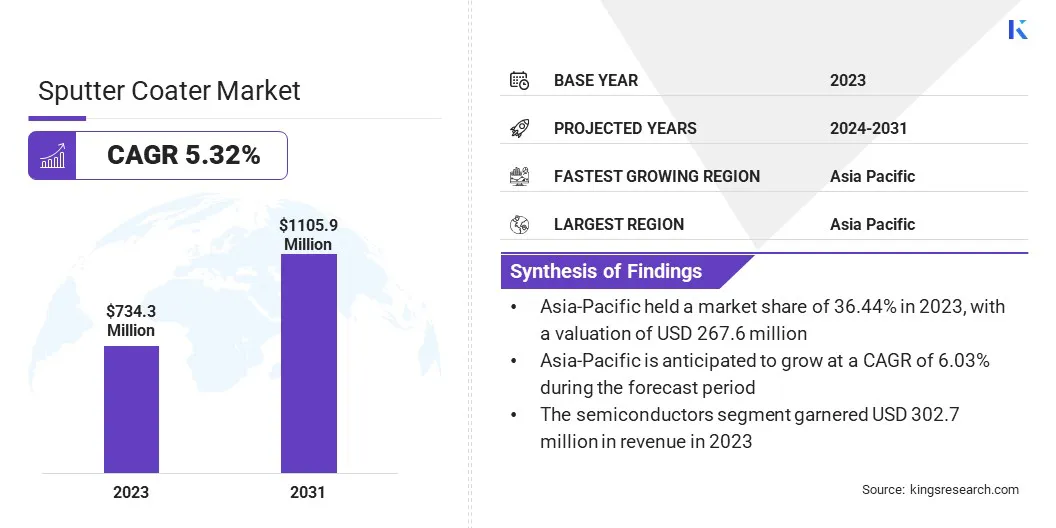
The global sputter coater market size was valued at USD 734.3 million in 2023 and is projected to grow from USD 769.4 million in 2024 to USD 1,105.9 million by 2031, exhibiting a CAGR of 5.32% during the forecast period.
This growth is driven by the increasing demand across various industries, particularly in electronics, semiconductors, renewable energy, and automotive sectors. Sputtering technology has become essential for depositing thin films with precise control over material properties such as thickness, uniformity, and adhesion.
Major companies operating in the global sputter coater inustry are ULVAC, Semicore Equipment Inc., Hitachi High-Tech Corporation., PVD Products, Inc., Quorum Technologies, Vac Coat Ltd., Cressington Scientific Instruments Ltd., Bühler, PLASSYS BESTEK, Angstrom Sciences, Inc., Oxford Instruments, Nanoscience Instruments., Denton Vacuum, Leica Microsystems, and JEOL USA, Inc.
The demand for high-performance sputter coating systems has grown significantly, pushing companies to invest in advanced technologies, such as magnetron sputtering, dual-target systems, and AI-driven process optimization. The market is poised for continued growth, spurred by technological innovation, expanding application areas, and the increasing need for high-quality, precise thin films in cutting-edge industries.
Market Driver
"Increasing Demand for Thin Film Coatings"
The increasing demand for thin film coatings is boosting the sputter coater market, as thin films are essential for various applications due to their ability to enhance the performance and durability of products across numerous industries. Thin film coatings offer significant advantages, including improved corrosion resistance, wear resistance, optical properties, and electrical conductivity.
Sputter coating offers several benefits, including the ability to apply uniform, high-quality coatings on complex substrates, making it an ideal solution for the production of thin films.
Market Challenge
"Process Complexity and Technical Expertise"
Process complexity and technical expertise presents a significant challenge to the sputter coater market, as industries demand increasingly sophisticated thin films with precise properties. The process needs to be meticulously controlled to ensure that factors like film thickness, uniformity, adhesion, and material composition meet stringent specifications.
Technical expertise is crucial to successfully operate sputter coaters and optimize the process for different materials and applications. Engineers and technicians must possess a deep understanding of materials science, plasma physics, and vacuum systems to manage and fine-tune the sputtering process.
Investing in automated systems and advanced monitoring technologies can help reduce human error and improve process control. Automation tools, such as real-time sensors and AI-driven process optimization, can continuously monitor variables like deposition rate, pressure, and temperature, ensuring more consistent results with less hands-on intervention.
Developing modular, user-friendly sputter coating systems with built-in process controls and easy-to-understand interfaces can lower the barrier to entry for less-experienced operators while still ensuring high-quality results.
Market Trend
"Rise in Nanotechnology and Advanced Materials"
Nanotechnology enables the creation of materials with enhanced mechanical, electrical, optical, and chemical properties, which are essential for emerging industries such as electronics, healthcare, energy storage, and materials science. In the electronics industry, sputtered thin films are used to create semiconductors, sensors, and memory devices, where the ability to control film thickness and material composition at the nanoscale is crucial for improving device performance and efficiency.
In medical devices and biotechnology, sputtering enables the creation of biocompatible coatings for implants, drug delivery systems, and biosensors. These coatings can be engineered to interact with biological tissues at the molecular level, offering new solutions for medical applications.
|
Segmentation |
Details |
|
By Substrate |
Metal, Glass, Semiconductor, Others (Ceramics and Plastics) |
|
By End-Use Industry |
Electronics and Semiconductor, Automotive, Medical, Others (Hardware, FMCG, Construction) |
|
By Region |
North America: U.S., Canada, Mexico |
|
Europe: France, UK, Spain, Germany, Italy, Russia, Rest of Europe |
|
|
Asia-Pacific: China, Japan, India, Australia, ASEAN, South Korea, Rest of Asia-Pacific |
|
|
Middle East & Africa: Turkey, UAE, Saudi Arabia, South Africa, Rest of Middle East & Africa |
|
|
South America: Brazil, Argentina, Rest of South America |
Market Segmentation
Based on region, the global market has been classified into North America, Europe, Asia Pacific, Middle East & Africa, and Latin America.
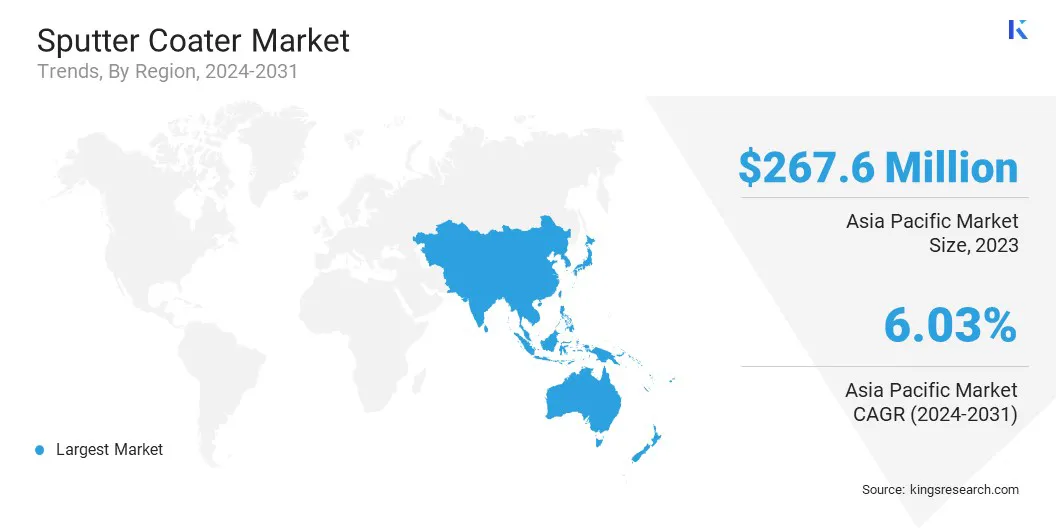
Asia Pacific accounted for a sputter coater market share of around 36.44% in 2023, with a valuation of USD 267.6 million. The substantial market share can be attributed to the rapid industrialization, significant investments in electronics and semiconductor manufacturing, and the growing adoption of advanced technologies across the region.
The sputter coater in Asia Pacific is further bolstered by the increasing demand for consumer electronics, renewable energy applications, and automotive technologies that require high-performance coatings.
The sputter coater industry in Europe is poised for significant growth at a robust CAGR of 5.33% over the forecast period, driven by the increasing demand for high-quality thin-film coatings in industries such as electronics, automotive, and renewable energy. Technological innovations coupled with the rising adoption of advanced materials and sustainable manufacturing processes are further boosting the demand for sputter coater.
Europe’s emphasis on green energy initiatives, such as the expansion of solar power infrastructure, and its efforts to support high-tech manufacturing in countries like Germany, France, and the UK, are also contributing to the market's expansion.
The global sputter coater market is characterized by the presence of several key players that offer a range of sputtering equipment and solutions catering to diverse industry needs.
A major competitive factor in the market is the ability to deliver advanced sputtering systems that offer high precision, flexibility, and scalability, allowing manufacturers to cater to sectors like electronics, semiconductor fabrication, automotive, and renewable energy.
Companies are increasingly investing in research and development (R&D) to develop next-generation sputtering technologies, such as high-rate deposition systems, multi-target sputtering, and AI-powered process control, which help improve efficiency, reduce costs, and provide superior coatings.
Recent Developments (M&A/Partnerships/Agreements/New Product Launch)
Frequently Asked Questions

Over the years, Versha brings over 15 years of experience managing consulting assignments across industries, including Food and Beverage, Consumer Goods, ICT, Aerospace, and more. Her work has spanned diverse sectors. Her cross-domain expertise and adaptability make her a versatile and dependable professional. She is known for her keen business insight and foresight. With sharp analytical skills and a curious mindset, Versha excels at transforming complex data into actionable insights. She has a proven track record of unraveling market dynamics, identifying trends, and delivering tailored solutions to meet client needs. As a skilled leader, Versha has successfully mentored research teams and directed projects with precision, ensuring high-quality outcomes. Her collaborative approach and strategic vision enable her to turn challenges into opportunities and consistently deliver impactful results. Whether analyzing markets, engaging stakeholders, or crafting strategies, Versha draws on her deep expertise and industry knowledge to drive innovation and deliver measurable value.
Habi is a seasoned research and consulting leader with renowned experience in guiding clients on strategic growth and transformation initiatives across global markets. He has led high-performing research teams that deliver actionable insights on market expansion, M&A strategies, opportunity assessment, new business development, and product launches. His project portfolio spans large petrochemical producers, electronic device manufacturers, lubricants companies, and other leading enterprises across diverse industrial and consumer sectors. He currently heads the research department at Kings Research, where he is responsible for setting the research agenda, mentoring analysts, and ensuring client-ready deliverables that support executive decision-making. With extensive experience in market intelligence, strategic research, and consulting, Habi brings a strong understanding of evolving industry dynamics, competitive landscapes, emerging opportunities, and business growth challenges. His expertise includes developing research frameworks, translating complex market data into actionable strategic recommendations, and working closely with senior stakeholders to address critical business questions. He has also contributed to building research capabilities, strengthening analytical methodologies, and driving a culture of quality and insight-led decision-making within research teams. His cross-industry exposure enables him to connect market trends with broader business implications and provide perspectives that help organizations identify opportunities, mitigate risks, and make informed strategic decisions.


