
Inquire Now
Key Strategic Points
The white oil market refers to the production, distribution, and marketing of ultra-refined, colorless, odorless, and tasteless mineral oils. These oils, also known as liquid paraffin or mineral oil, are widely used in sectors such as pharmaceuticals, cosmetics, personal care, food processing, and plastics due to their high purity and safety standards. The market offers a broad range of white oil grades that are customized to meet the specific requirements of various applications, including ointments, creams, lotions, food-grade lubricants, plasticizers, and processing agents for various industrial processes.
The global white oil market size was valued at USD 2,480 million in 2025 and is projected to grow from USD 2,574.1 million in 2026 to USD 3,447.7 million by 2033, exhibiting a CAGR of 4.26% during the forecast period. This growth is primarily driven by the increasing demand for high-purity, non-toxic mineral oils across industries such as pharmaceuticals, cosmetics, personal care, and food processing.
Moreover, market players are being compelled to improve their production processes and comply with safety guidelines due to stringent quality standards and regulatory requirements.
Major companies operating in the global white oil industry are Sonneborn LLC, Exxon Mobil Corporation, Calumet, Inc., Shell PLC , China Petrochemical Corporation, savita.com, Gandhar Oil Refinery (India) Limited, APAR Industries Ltd., Sasol Limited, TotalEnergies, Bharat Petroleum Corporation Limited, Petro‐Canada Lubricants Inc., Indian Oil Corporation Ltd, Panama Petrochem Ltd., and FUCHS.
Technological advancements in refining processes and the introduction of specialized white oil grades are helping suppliers meet increasingly specific industry requirements. Simultaneously, key market players are expanding their product portfolios and reinforcing their distribution networks to leverage growth opportunities in emerging markets, which further boosts overall market growth.
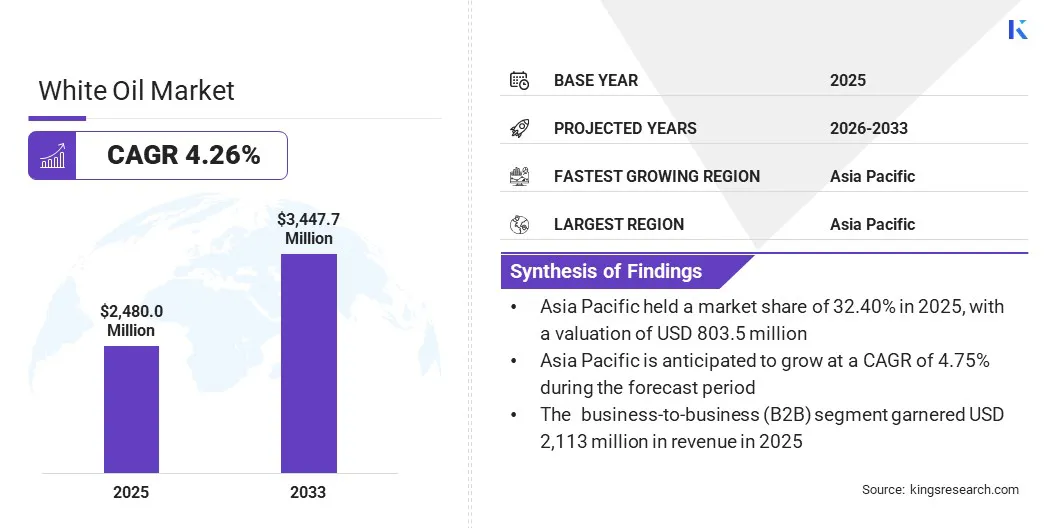
White oil is prized for its purity, inertness, and safety, making it a preferable ingredient in a wide range of health and beauty products such as ointments, creams, lotions, and baby oils. In the pharmaceutical industry, white oil is used as a base for topical formulations and as a lubricant in various processes.
In the cosmetics and personal care industries, its non-toxic and non-allergenic properties make it ideal for use in sensitive skin products. This rising demand is further supported by increasing consumer awareness of product safety and a growing preference for high-quality, safe ingredients.
Since white oil is a by-product of petroleum, changes in crude oil prices can directly impact manufacturers’ production costs, pricing strategies, and overall profitability. Sudden spikes in oil prices can compress margins and create uncertainty in supply contracts, complicating long-term planning.
Furthermore, raw material prices may be volatile, and the volatility can be a challenge to a company’s ability to offer competitive prices to end-users and may also affect demand. To overcome this challenge, firms are increasingly adopting strategic sourcing agreements and expanding supplier networks to reduce risks. Many companies are also focusing on process improvements and efficiency gains to better cope with cost fluctuations and ensure smooth operations.
A prominent trend in the white oil market is the shift toward sustainable and bio-based alternatives. As environmental concerns gain momentum and regulatory pressures increase, both manufacturers and end-users are seeking greener options to replace traditional mineral oil. Bio-based white oils, derived from renewable plant sources, offer advantages such as biodegradability and a reduced carbon footprint, aligning with corporate sustainability goals and consumers’ preferences for eco-friendly products.
This trend is driving research and development investments, with companies focusing on innovative formulations that deliver comparable performance to petroleum-based white oils. As sustainability becomes a key differentiator in the market, the adoption of bio-based alternatives is expected to accelerate, reshaping the competitive landscape.
|
Segmentation |
Details |
|
By Grade |
Technical Grade, Medicinal Grade, and Others |
|
By Distribution Channel |
Business-to-Business (B2B), and Business-to-Consumer (B2C) |
|
By End Use Industry |
Agriculture, Chemical, Cosmetics and Personal Care, Industrial, Pharmaceuticals, and Plastics and Polymers |
|
By Region |
North America: U.S., Canada, Mexico |
|
Europe: France, UK, Spain, Germany, Italy, Russia, Rest of Europe |
|
|
Asia-Pacific: China, Japan, India, Australia, ASEAN, South Korea, Rest of Asia-Pacific |
|
|
Middle East & Africa: Turkey, U.A.E., Saudi Arabia, South Africa, Rest of Middle East & Africa |
|
|
South America: Brazil, Argentina, Rest of South America |
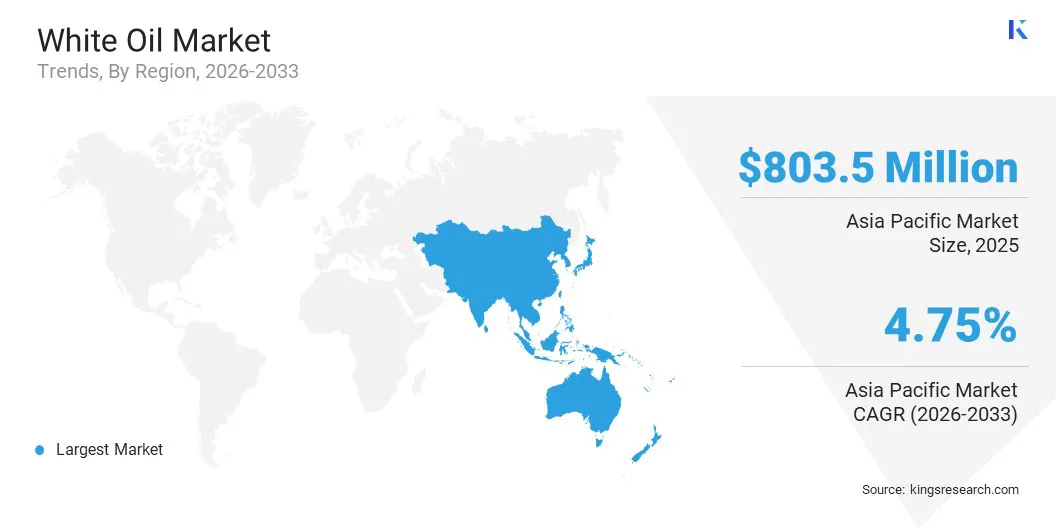
Asia Pacific white oil market share stood at 32.40% in 2025, valued at USD 803.5 million. The region’s strong market position can be attributed to the growing cosmetics, personal care, and food processing industries, which increasingly rely on high-purity white oil for product formulations. The presence of prominent white oil producers in the region, coupled with government initiatives to encourage the growth of the industrial sector and export manufacturing, has also been contributing to regional market development.
The rising urbanization and the growing middle-class population have led to increased consumption of pharmaceuticals and the packaged food sectors widely using white oil. Additionally, advancements in refining technologies and the rise in contract manufacturing have enabled local suppliers to meet the stringent quality requirements of global clients.
The North America white oil market is set to grow at a CAGR of 4.38% over the forecast period. This growth is fueled by the increasing demand for white oil in specialized sectors like pharmaceuticals, healthcare, and plastics, where the purity and stability of the product are valued. Furthermore, the regional market benefits from continuous product development innovations and the presence of strict regulatory standards that demand high-quality ingredients.
The food packaging and polymer industries are also on the rise, driven by consumer demand for safe, non-toxic additives. Higher R&D investments and a strong supply chain infrastructure allow manufacturers to respond to evolving customer requirements and seize new opportunities across the region.
The white oil market is highly competitive with the presence of both multinational and regional manufacturers. The key differentiators are product purity, regulatory compliance, and supply reliability. Companies are using advanced refining technologies and innovation to develop specialty grades for a variety of end-use applications, including pharmaceuticals, cosmetics, and food processing.
Strategic moves such as capacity expansions, joint ventures, and collaborations with downstream manufacturers are some of the ways to increase market penetration and develop customer loyalty. The growing focus on sustainability and compliance with international quality standards is also providing a competitive edge to the leading players in the market, driving continuous improvements and shaping global market trends.
Frequently Asked Questions

Aswathi holds cross-domain expertise, translating market trends and competitive intelligence into decision-ready insights. Her work helps clients interpret evolving market conditions and identify growth opportunities. She brings a focused, insight-led approach to research execution. She translates these findings into clear, prioritized action plans that align with client capabilities. Her research often includes scenario modeling to test growth strategies under varying economic conditions. She maintains a rigorous validation process, cross-checking primary and secondary sources to ensure reliability. Clients value her ability to synthesize noisy data into concise executive summaries that drive board-level discussions. Her sector-specific lens, combined with a pragmatic focus on execution, consistently delivers high-impact, commercially sound recommendations. Her structured yet flexible research frameworks adapt to client timelines without compromising depth. She is known for distilling complex trade-offs into straightforward, defensible positions that facilitate confident decision-making.
Habi is a seasoned research and consulting leader with renowned experience in guiding clients on strategic growth and transformation initiatives across global markets. He has led high-performing research teams that deliver actionable insights on market expansion, M&A strategies, opportunity assessment, new business development, and product launches. His project portfolio spans large petrochemical producers, electronic device manufacturers, lubricants companies, and other leading enterprises across diverse industrial and consumer sectors. He currently heads the research department at Kings Research, where he is responsible for setting the research agenda, mentoring analysts, and ensuring client-ready deliverables that support executive decision-making. With extensive experience in market intelligence, strategic research, and consulting, Habi brings a strong understanding of evolving industry dynamics, competitive landscapes, emerging opportunities, and business growth challenges. His expertise includes developing research frameworks, translating complex market data into actionable strategic recommendations, and working closely with senior stakeholders to address critical business questions. He has also contributed to building research capabilities, strengthening analytical methodologies, and driving a culture of quality and insight-led decision-making within research teams. His cross-industry exposure enables him to connect market trends with broader business implications and provide perspectives that help organizations identify opportunities, mitigate risks, and make informed strategic decisions.