
Inquire Now
Key Strategic Points
The next generation sequencing (NGS) market refers to the industry that deals in the high-throughput sequencing of DNA and RNA, including instruments, consumables, and services. NGS allows rapid sequencing of DNA or RNA with reduced costs compared to traditional sequencing techniques. The market comprises applications such as oncology, rare genetic disorders, reproductive health, infectious disease testing, drug discovery, etc., with clinical laboratories & hospitals, biotechnology companies, academic institutions, and pharmaceutical companies operating nationwide.
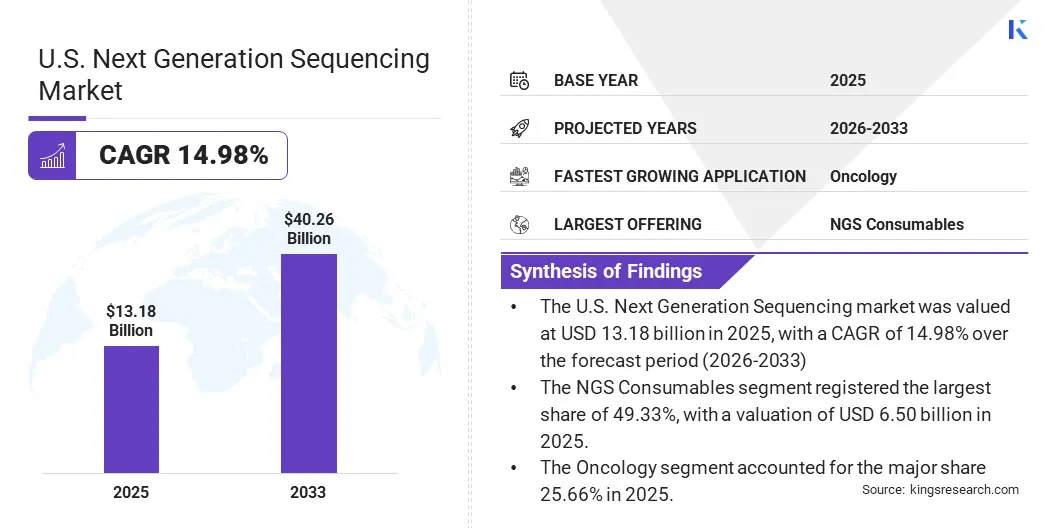
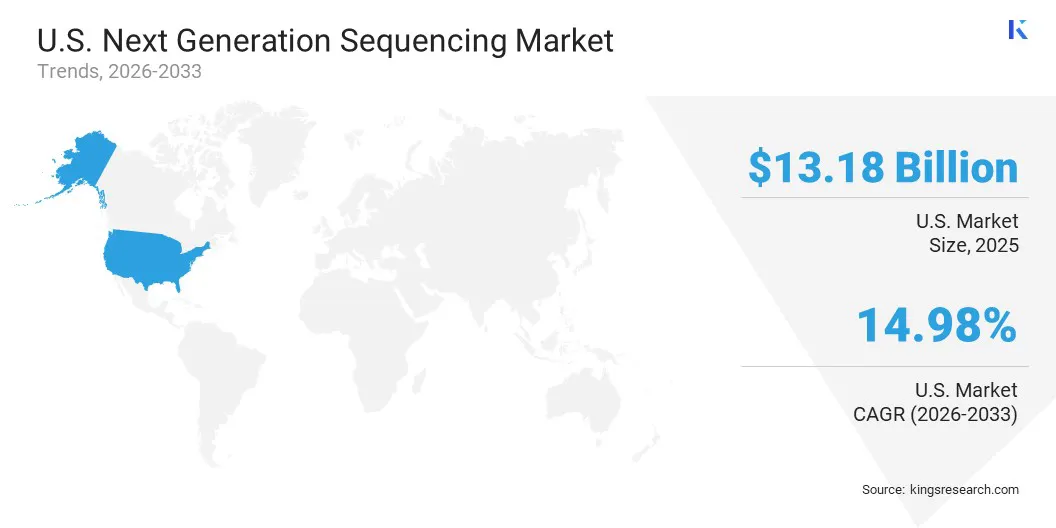
The U.S. next generation sequencing market size was valued at USD 13.18 billion in 2025 and is projected to reach USD 40.26 billion by 2033, exhibiting a CAGR of 14.98% during the forecast period. This significant growth is fueled by rapid advancements in sequencing technologies, increasing integration of NGS in clinical diagnostics, and rising demand for personalized medicine. The growth is also attributed to the expanding applications across oncology, rare disease detection, and reproductive health.
Major companies operating in the U.S. next generation sequencing market are Illumina, Inc., Agilent Technologies, Inc, DH Life Sciences, LLC., Bio-Rad Laboratories, Inc., BD (Becton, Dickinson and Company), Clear Labs, Inc., Ultima Genomics, Inc., Element Biosciences, Twist Bioscience, Oxford Nanopore Technologies plc., GENEWIZ, Thermo Fisher Scientific, Inc., 10x Genomics, QIAGEN, and Roche Diagnostics.
Additionally, supportive regulatory policies and ongoing investments in genomics research are further propelling market expansion. The entry of innovative players and the adoption of AI-driven sequencing workflows are expected to further accelerate the market’s evolution.
The increasing use of next generation sequencing (NGS) in routine clinical decision making is fueling the growth of the U.S. NGS market. Physicians can examine the patient’s genetic profile to determine disease risk, identify mutations, and select targeted therapies, instead of relying on symptoms to make a diagnosis, especially in oncology and rare disease treatment.
This shift toward precision medicine is driven by expanding test menus, improving reimbursement for clinical applications, and increasing physician confidence in genomic data. The use of NGS as a standard part of diagnosis and treatment planning, rather than just a research tool, results in a steady, recurring demand for sequencing instruments, reagents, and consumables. Clinical adoption is one of the most consistent long-term growth engines for the market.
The increasing use of sequencing is outpacing the ability of laboratories and healthcare organizations to store, integrate and analyze data, particularly where sophisticated bioinformatics infrastructure has not been established. This disconnects the collection of genetic information from its translation into clinically-driven insights.
The industry is addressing this challenge through better software and AI-enabled analysis platforms. The integration of advanced genomic intelligence tools into existing software suites and improvements to genomics analysis platforms are helping to make data interpretation easier and readily usable. The bioinformatics landscape is constantly innovating to help mitigate this challenge and ensure that data complexity does not sustain as a limiting factor for the market’s growth.
One of the most important trends in the U.S. NGS market is the increasing adoption of AI in the sequencing workflow. AI is being integrated into NGS to streamline workflows and data analysis, enhancing efficiency and accuracy across applications like oncology, drug discovery, and clinical diagnostics. By automating data interpretation, AI helps labs manage the massive volumes of genomic information generated during sequencing, easing the data complexity challenges the market faces today.
This shift is also evident in cloud and AI analytics that shorten sample-to-report times and improve data quality. As sequencing platforms continue to evolve alongside smarter software, AI is becoming integral and is transitioning from a supplementary tool to a core component of how NGS data is processed, interpreted, and applied in real-world clinical and research settings.
|
Segmentation |
Details |
|
By Offering |
NGS Consumables, NGS Platforms/Instruments, NGS Services, and Bioinformatics Software & Solutions |
|
By Workflow |
Pre-Sequencing, Sequencing, and Data Analysis |
|
By Technology |
WGS, Whole Exome Sequencing, Targeted Sequencing & Resequencing, and Others |
|
By Application |
Oncology, Reproductive Health, Infectious Disease, Rare Genetic Disorders, Pharmacogenomics & Drug Discovery, Agriculture & Animal Research, Consumer Genomics, and Others |
|
By End User |
Academic & Government Research Institutes, Clinical Laboratories & Hospitals, Pharmaceutical Companies, Biotechnology Companies, and Others |
|
By Region |
U.S. |
Next generation sequencing is finding applications across a wide range of real-world settings in the United States, reflecting its growing versatility beyond research environments. In oncology, NGS is being used through liquid biopsy to sequence circulating tumor DNA, enabling non-invasive, real-time monitoring of cancer progression and supporting early detection. Notably, in March 2026, Illumina and Labcorp expanded their partnership to advance precision oncology by increasing access to NGS and developing new genomic profiling solutions. They will also co-commercialize FDA-approved tissue and liquid biopsy test kits to provide more timely, equitable cancer care and support targeted therapies. Beyond oncology, NGS is increasingly applied in newborn genetic screening, pharmacogenomics, infectious disease surveillance, and rare disease diagnosis across the U.S.
The U.S. NGS market is moderately consolidated, with a mix of established life sciences giants and emerging innovators competing for market share. Leading players maintain dominance through extensive product portfolios spanning instruments, reagents, and bioinformatics software, while smaller and newer entrants compete by focusing on niche applications such as long-read sequencing, single-cell analysis, or portable benchtop platforms.
Strategic mergers, acquisitions, and partnerships remain central to growth, as companies seek to expand their technological capabilities, multiomics offerings, and clinical applications. Increasing collaboration between sequencing platform providers, software developers, and healthcare institutions is also reshaping the competitive environment, pushing companies to innovate with respect to speed, accuracy, and affordability to maintain their market position.
Frequently Asked Questions

Aswathi holds cross-domain expertise, translating market trends and competitive intelligence into decision-ready insights. Her work helps clients interpret evolving market conditions and identify growth opportunities. She brings a focused, insight-led approach to research execution. She translates these findings into clear, prioritized action plans that align with client capabilities. Her research often includes scenario modeling to test growth strategies under varying economic conditions. She maintains a rigorous validation process, cross-checking primary and secondary sources to ensure reliability. Clients value her ability to synthesize noisy data into concise executive summaries that drive board-level discussions. Her sector-specific lens, combined with a pragmatic focus on execution, consistently delivers high-impact, commercially sound recommendations. Her structured yet flexible research frameworks adapt to client timelines without compromising depth. She is known for distilling complex trade-offs into straightforward, defensible positions that facilitate confident decision-making.
With many years of consulting experience across global pharma, biotech, and MedTech markets, Minaz brings deep domain expertise, strategic clarity, and analytical rigor to every engagement. She has led 130+ consulting assignments spanning market entry, competitive landscaping, and portfolio prioritization, helping clients navigate complex, high-stakes decisions with confidence. Known for her ability to synthesize primary and secondary research into executive-ready recommendations, Minaz has built forecasting models and market sizing frameworks that have informed multi-million dollar investment decisions in oncology, diagnostics, and peptide therapeutics. Beyond her analytical strength, Minaz is a trusted client partner, translating complex datasets into clear, actionable insights for senior stakeholders. She currently leads a team of research analysts, driving business expansion, and shaping client engagement strategy.