
Inquire Now
Key Strategic Points
According to Kings Research, the market for loan origination software in the U.S. was valued at USD 2,199 million in 2025 and is projected to grow from USD 2,387.3 million in 2026 to reach USD 4,643 million in 2033, registering a CAGR of 9.79% over the forecast period (2026 to 2033).
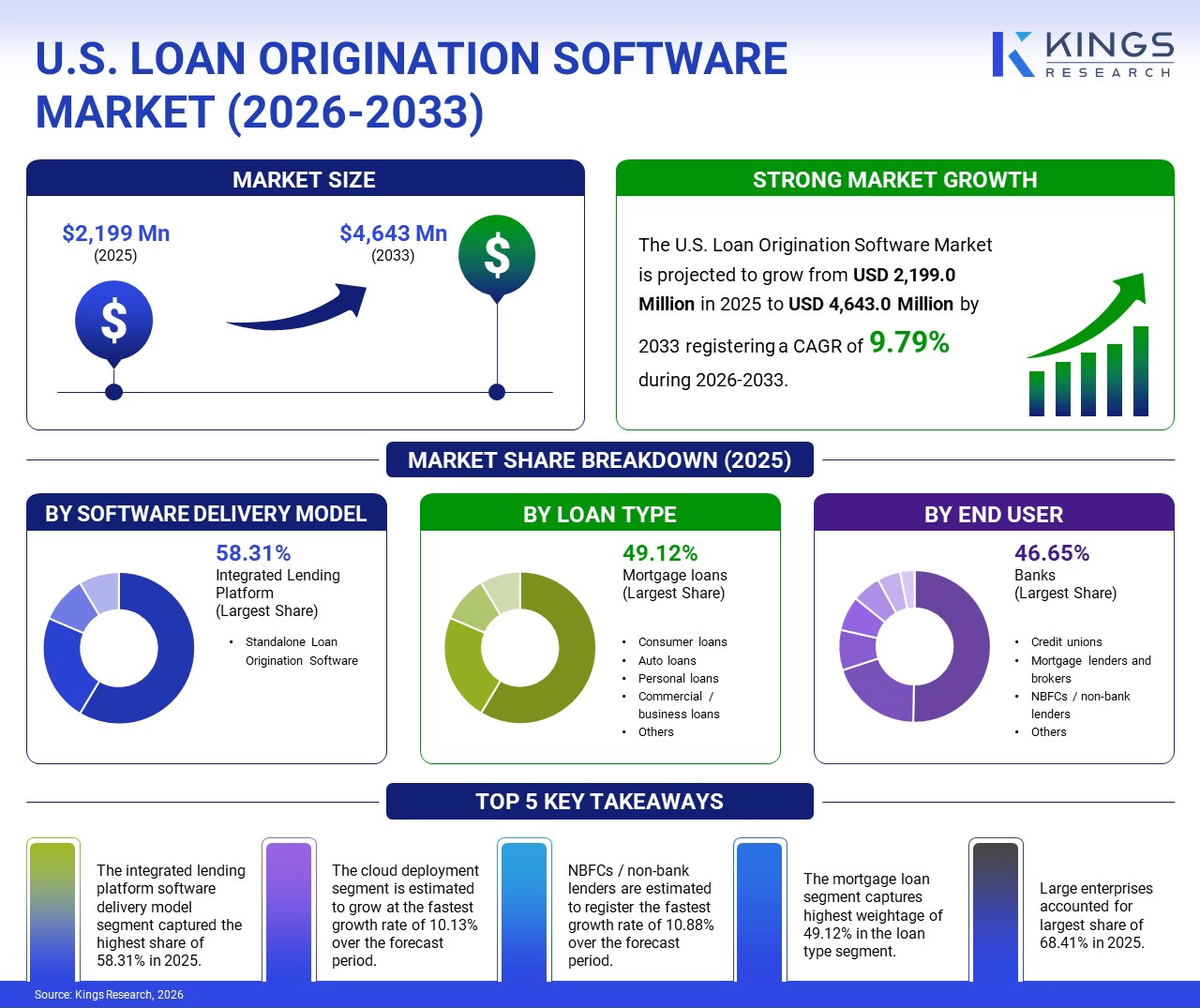
The U.S. loan origination software (LOS) market is witnessing steady growth as banks, credit unions, mortgage lenders, and other financial institutions modernize lending operations to deliver faster, more efficient, and customer-centric loan experiences. The rapid adoption of cloud-native platforms, AI-powered underwriting, and digital onboarding solutions is driving market growth by enhancing operational efficiency and reducing processing times. As a result, growing borrower expectations for seamless digital experiences and increasing competition from fintech lenders are pushing traditional financial institutions to replace legacy systems with scalable, data-driven loan origination platforms that support omnichannel lending.
Key Insight: The U.S. market for loan origination software is evolving from traditional workflow automation to intelligent, AI-driven lending platforms that enable faster credit decisions, improved risk management, and superior borrower experiences.
|
Segmentation |
Details |
|
By Software Delivery Model
|
Standalone Loan Origination Software Integrated Lending Platform |
|
By Deployment |
Cloud On-premise |
|
By Loan Type
|
Mortgage loans Consumer loans Auto loans Personal loans Commercial / business loans Others |
|
By Enterprise Size |
Large Enterprise Small & Medium Enterprise |
|
By End User |
Banks Credit unions Mortgage lenders and brokers NBFCs / non-bank lenders Others |
|
By Country |
U.S. |
U.S. financial institutions spanning Tier-1 banks, regional lenders, and credit unions are strategically replacing legacy, conventional systems with digital-first platforms, thereby automating the entire loan lifecycle from application and underwriting to approval and funding. The process is viewed as part of broader digital transformation initiatives, which enable LOS platforms to deliver faster processing, greater data accuracy, seamless integration with banking systems, regulatory compliance, scalability, and enhanced customer experiences across online and mobile channels, driving sustained market growth.
Additionally, the transition to cloud-native platforms by end users further offers enhanced flexibility, scalability, and cost efficiency, thereby eliminating the need for extensive on-premises infrastructure. Digitization thus enables seamless integration with third-party services, supports real-time data processing, and empowers lenders to rapidly introduce new lending products, boosting market growth.
Integration of legacy systems with advanced LOS restrains adoption across a diverse end-user base. Financial institutions operate with varying degrees of legacy platforms that were not designed for modern, API-driven solutions. Attempting to integrate legacy systems with advanced technologies results in delays, incompatibility issues, and additional costs. Additionally, migrating vast amounts of data from legacy systems to new platforms further hinders LOS adoption due to poor data quality, duplicate records, and inconsistent formatting, which can lead to errors and delays in system go-live timelines.
To address this challenge, mortgage lenders are integrating POS origination platforms, automated underwriting systems (AUS), income verification tools, mortgage servicing platforms, and new AI-driven credit decisioning technologies.
The integration of artificial intelligence (AI) and machine learning (ML) is shifting from basic rule-based automation to agentic and autonomous workflow orchestration in U.S. loan origination.
Lenders are embedding generative AI and automated document processing (ADP) to enhance decision-making, risk assessment, and fraud detection; analyze large volumes of borrower and alternative data to improve credit evaluations; automate underwriting; and identify potential risks. Moreover, the adoption of machine learning models that continuously improve performance by learning from historical lending patterns is enabling faster and more informed credit decisions, thereby creating new growth opportunities.
Additionally, the inclusion of conversational AI virtual assistants, intelligent document analysis, real-time compliance validation, and autonomous workflow orchestration is further empowering lenders to automate end-to-end loan origination while maintaining human oversight for critical decisions. This evolution is transforming loan origination into a more intelligent, data-driven, and customer-centric process, enhancing operational efficiency, regulatory compliance, and borrower engagement.
Key Insight: Accelerated by cloud-native architectures and agentic AI, the U.S. loan origination software market is significantly reducing lending cycle times and enhancing operational automation. However, legacy core integration bottlenecks continue to limit rapid adoption, thereby driving vendor consolidation around data migration solutions.
The U.S. loan origination software market is driven by technology providers offering configurable, AI-enabled, and cloud-native platforms to automate underwriting, document processing, and compliance. Industry leaders are emphasizing strategic mergers and acquisitions to expand digital banking and embedded finance capabilities while expanding market reach. Companies are further advancing product innovation by deploying predictive analytics and low-code workflows, alongside expanding API ecosystems to seamlessly integrate core banking systems with third-party verification tools. Recent strategic developments by key market players highlight ongoing consolidation and integration trends:
Key Insight: Competitive advantage in the U.S. market for loan origination software is shifting from speed of digitization to the ability to deliver auditable and explainable AI-driven credit decisions at scale within regulatory frameworks. This capability gap is increasingly driving strategic partnerships, API integrations, and acquisition activity across the sector, as providers seek to strengthen their digital lending platforms and ensure regulatory compliance.
Regulatory pathway forecasting evaluates how evolving regulatory guidance is likely to transition into mandatory compliance requirements, enabling financial institutions to proactively prepare their lending operations. Across the U.S., the regulatory environment is steadily shifting from voluntary best practices toward enforceable standards in areas such as open banking data access, AI-driven decision governance, and real-time AML/KYC verification. Loan origination software (LOS) that incorporates these capabilities in advance allows lenders to adapt to future regulatory changes while minimizing costly system upgrades and operational disruptions.
Financial institutions in the U.S. operate within a highly regulated lending environment governed by federal regulations such as the Truth in Lending Act (TILA), the Fair Credit Reporting Act (FCRA), and the evolving Section 1071 reporting requirements, alongside state-specific lending regulations. Managing compliance manually is increasingly impractical, particularly for lenders with multi-state operations and diverse loan portfolios, highlighting the need for loan origination software. It helps embed regulatory rules directly into lending workflows, automate compliance checks, maintain accurate documentation, and support consistent regulatory reporting.
Evolving regulatory developments further emphasize the critical role of compliance-centric loan origination solutions in supporting evolving regulatory obligations across the U.S. lending sector.
Key Insight: As U.S. lending regulations shift toward strict, enforceable privacy and reporting standards, manual compliance management is no longer viable. Financial institutions must increasingly adopt loan origination software with automated rules and real-time auditability to navigate evolving legal mandates without causing operational disruption.
LOS platforms do not operate in isolation; instead, they function at the intersection of core banking systems, cloud and data-center infrastructure, third-party data and identity vendors, and a growing network of fintech partnerships. Kings Research maps this ecosystem across four dimensions:
Key Insight: API dependency risk is an underappreciated vulnerability. Lenders that rely heavily on a limited number of providers for credit-bureau, identity-verification, and fraud-scoring face elevated operational risk if any single provider experiences an outage or policy change.
Kings Research evaluates loan origination software (LOS) market sensitivity across five macroeconomic and industry-specific risk factors that could influence growth over the forecast period in the U.S..
Key Insight: The ability to remain resilient across multiple economic and regulatory scenarios is becoming a key evaluation criterion for investors, lenders, and technology decision-makers. Consequently, U.S. financial institutions are increasingly prioritizing LOS platforms that offer configurable workflows, scalable architecture, and rapid regulatory adaptability rather than solutions optimized for a single operating environment.
Patent filings and R&D activity across the loan origination software (LOS) market indicate a strong focus on five key innovation areas:
Key Insight: Patent activity and R&D investments provide an early indicator of vendor innovation, highlighting companies advancing AI-driven underwriting, workflow automation, and explainable decision-making to meet evolving lender and regulatory expectations.
How We Gather This Information
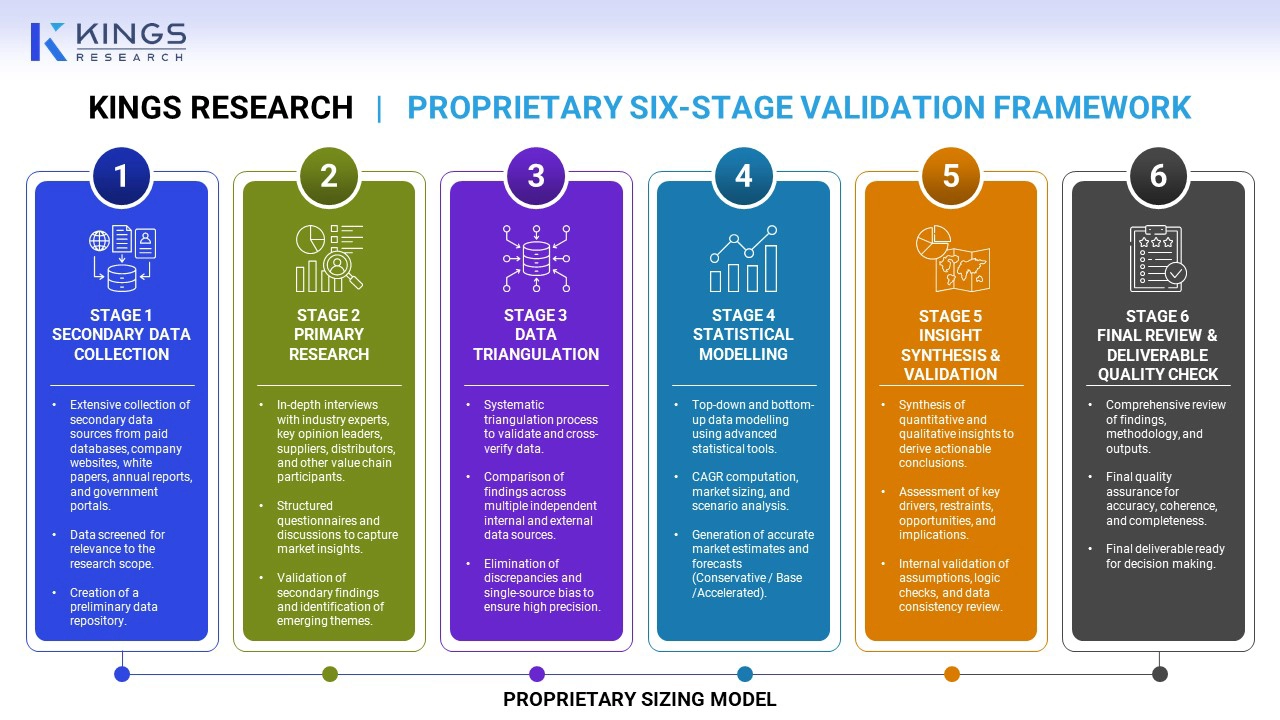
Our methodology triangulates findings across independent and publicly available research databases, which is further validated against regulatory filings and public company disclosures. No single-source estimates are presented without cross checking.
Frequently Asked Questions

Faizy brings over four years of experience in market research and consulting, with a proven ability to support strategic engagements across diverse industries and business environments. His work focuses on understanding complex market structures, identifying emerging opportunities, and translating research findings into clear, commercially relevant insights. With strong analytical capabilities and a structured approach to problem-solving, he evaluates industry trends, competitive landscapes, customer dynamics, and evolving business models. His expertise encompasses market research, competitive intelligence, market sizing and forecasting, industry assessment, company benchmarking, and strategic analysis. Faizy combines technical proficiency with a strong research orientation, enabling him to interpret both qualitative and quantitative information effectively. He has contributed to projects that help organizations assess growth potential, strengthen market positioning, and evaluate strategic priorities. His adaptable approach allows him to work across sectors while maintaining a consistent focus on accuracy, relevance, and delivering insights that support informed decision-making for clients and stakeholders.
Habi is a seasoned research and consulting leader with renowned experience in guiding clients on strategic growth and transformation initiatives across global markets. He has led high-performing research teams that deliver actionable insights on market expansion, M&A strategies, opportunity assessment, new business development, and product launches. His project portfolio spans large petrochemical producers, electronic device manufacturers, lubricants companies, and other leading enterprises across diverse industrial and consumer sectors. He currently heads the research department at Kings Research, where he is responsible for setting the research agenda, mentoring analysts, and ensuring client-ready deliverables that support executive decision-making. With extensive experience in market intelligence, strategic research, and consulting, Habi brings a strong understanding of evolving industry dynamics, competitive landscapes, emerging opportunities, and business growth challenges. His expertise includes developing research frameworks, translating complex market data into actionable strategic recommendations, and working closely with senior stakeholders to address critical business questions. He has also contributed to building research capabilities, strengthening analytical methodologies, and driving a culture of quality and insight-led decision-making within research teams. His cross-industry exposure enables him to connect market trends with broader business implications and provide perspectives that help organizations identify opportunities, mitigate risks, and make informed strategic decisions.