
Inquire Now
Key Strategic Points
The insurtech market refers to the ecosystem of technology-driven insurance solutions that enhance the distribution, underwriting, and servicing of insurance products. The U.S. insurtech market involves multiple distribution models, including direct-to-consumer digital platforms, comparison aggregators, digital brokers, managing general agents (MGAs), embedded insurance channels, and traditional agent- or broker-assisted networks. These models cater to the end users across small and medium-sized enterprises, large enterprises, the public sector, or individuals.
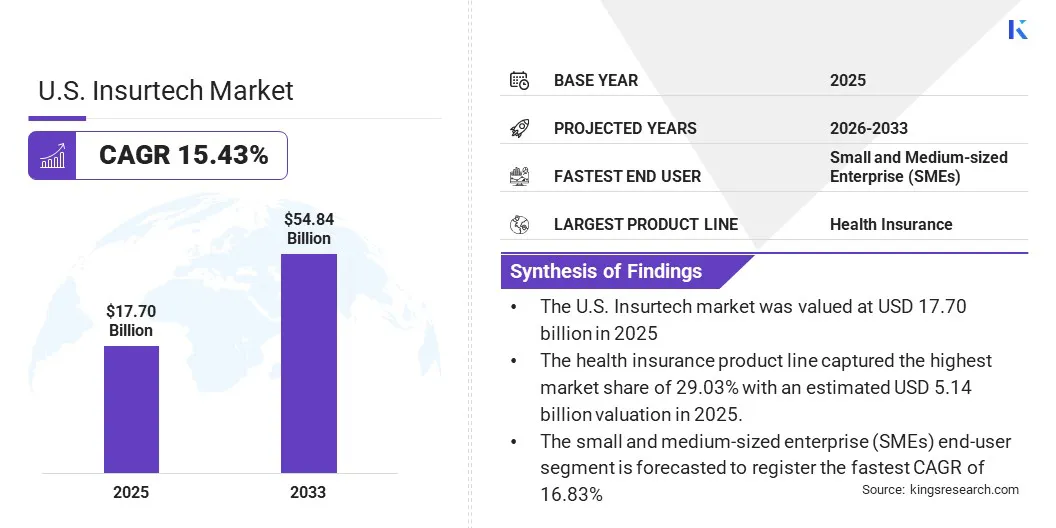
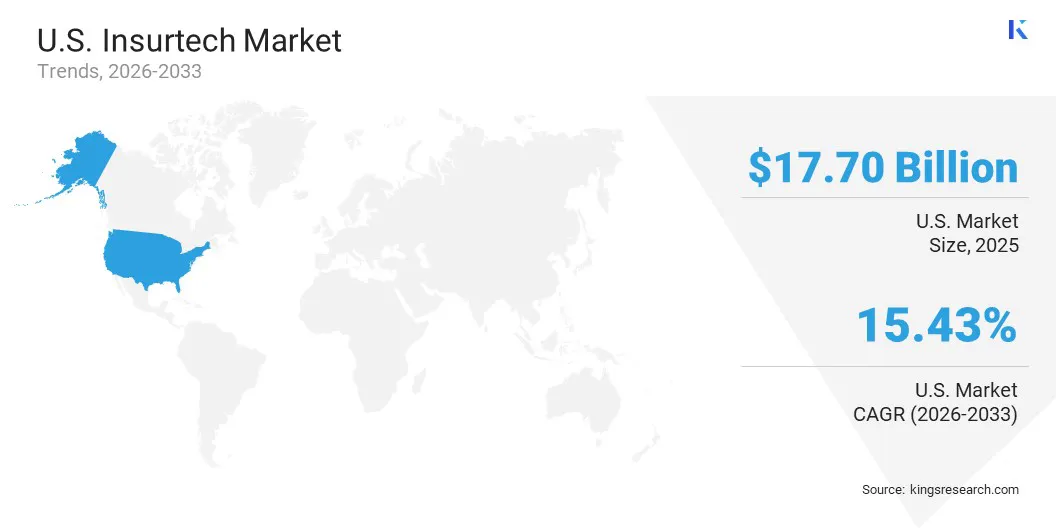
The U.S. insurtech market size was valued at USD 17.70 billion in 2025 and is projected to reach USD 54.84 billion by 2033, representing a CAGR of 15.43% over the forecast period. The market is driven by rising demand for faster, digital, and personalized insurance services. Additionally, the adoption of artificial intelligence in underwriting, claims automation, and customer-centric digital services is propelling growth in the U.S. insurtech market.
Key players in the market include Guidewire Software, Inc., Root Inc., Ethos Technologies Inc., Hippo Holdings Inc., Duck Creek Technologies, Acrisure, LLC, AgentSync Inc., Snapsheet, EvolutionIQ, Pie Group Holdings, Inc., and others. These companies are upgrading their technology platforms by integrating advanced technologies such as artificial intelligence and advanced analytics to offer personalized insurance products and services. The offerings include underwriting, claims automation, usage-based insurance, data-driven risk assessment, and real-time customer support to increase efficiency and consumer convenience. Additionally, rising consumer expectations, competition from tech-savvy entrants, and mobile adoption drive insurers to invest in digital-led solutions.
Artificial intelligence (AI) and machine learning utilize large amounts of data to outperform manual tasks, including statistical analysis, admin tasks, and processing claims in the insurance sector. LLMs accelerate claims management workflow by processing, extracting, and summarizing large unstructured text to help with claims triaging, litigation detection, claims evaluation, and subrogation and claims closure. Moreover, the deployment of machine learning enables efficient fraud detection during first notice of loss (FNOL), predicts claims complexities, supports cost predictions, and enhances the customer experience by predicting claims re-openings.
According to the Insurance AI Use Case Tracker by Evident, nearly 68% of publicly disclosed insurance AI deployments were generative or agentic, with agentic AI accounting for 21% of deployments, thereby indicating the implementation of AI in insurance as increasingly operational. Additionally, the inclusion of an AI chatbot to address customer grievances and claim settlement issues further fuels the adoption of AI in the U.S. insurtech market.
Legacy systems comprise outdated frameworks that are generally incompatible with modern technologies such as AI, blockchain, and cloud computing, which are crucial for scaling. The migration from conventional insurtech systems to advanced ones makes traditional firms vulnerable to agile Insurtech competition. The upgrade further acts as a massive drain on enterprise resources, as a significant portion of the IT budget in traditional insurance firms is spent on maintaining systems that are incompatible with modern technology.
To address the challenge, market players are transitioning their focus from maintaining legacy technology to building scalable, AI-enabled operations. Conventional insurers are identifying operational costs, profitability, expense ratios, and growth as their highest priorities. The players are further adopting cloud-native platforms, advanced data analytics, and AI-driven scalable operating models to accelerate innovation.
Advancements in blockchain technologies and smart contracts offer transformative solutions to industry pain points comprising manual processes, excessive paperwork, fraudulent activities, and lack of transparency. Blockchain provides a decentralized, transparent, and auditable record of all transactions and modifications, which enables users to validate insurance policies, claims, and payments. Furthermore, the property of blockchain to reduce the risk of data manipulation, unauthorized changes and the elimination of intermediaries comprising brokers or third-party administrators, drive its adoption in the U.S. insurtech market.
Additionally, smart contracts (self-executing digital contracts) complement blockchain technology by enabling automated and tamper-proof agreements. This results in streamlined operations, reduced expenditure, and trust enhancement in insurance transactions. This also reduces operational costs, fraud risk, and settlement times while improving transparency, accuracy, and trust in insurance transactions.
|
Segmentation |
Details |
|
By Product Line |
Life Insurance, Health Insurance, Property Insurance, Casualty Insurance, Specialty Insurance |
|
By Distribution Model |
Direct-to-Consumer Digital, Aggregators / Comparison Platforms, Digital Brokers, MGAs, Embedded Insurance, Bancassurance, Agent/Broker Assisted |
|
By End User |
Individual Consumers, SMEs, Large Enterprises, Government & Public Sector |
|
By Country |
U.S. |
The U.S. is designated as a premier hub for insurance and its vast software development ecosystem, which fosters the adoption of technology in the insurtech sector to develop customer-oriented offerings. Innovations in the market are occurring across the entire insurance value chain, ranging from distribution, marketing, product design, underwriting, to claims management including all lines of insurance-property and casualty, life and health. The distribution is capturing the highest focus as insurtech market players are acquiring new customers through novel distribution mediums where AI analyzes and provides custom insurance offerings on the basis of individual requirements. This transition is attributed to the generational shifts in how people communicate, access information, and make purchase decisions, while complementing rather than replacing traditional distribution channels.
Market players are further operationalizing artificial intelligence to transition beyond pilot projects towards embedding AI directly into core insurance business processes. Insurtech companies in the U.S. are enabling AI-enabled software development, real-time AI-enhanced operational support, and AI-powered business applications.
Key players operating in the market are incorporating strategic mergers, acquisitions, and technical partnerships to capture a wider share. The players in the U.S. insurtech market are prioritizing the development of multi-agent systems and AI copilots that improve decision-making, operational efficiency, and scalability across business functions. According to Financial Technology Partners, Insurtech financing volume reached USD 7.2 billion across 304 transactions, with mergers and acquisitions recording their highest-ever deal count of 190 transactions with over USD 22 billion in total volume. 45% of the total insurtech funding was acquired by AI-native companies in 2025, where financing was received from companies including CyberCube, Nirvana, Quantexa, and Angle Health. Notable acquisition partners in the market were American Family Ventures with nine total investments, followed by MTech Capital and Greenlight Re, General Catalyst, and Clocktower Technology Ventures with eight investments.
Frequently Asked Questions

Faizy brings over four years of experience in market research and consulting, with a proven ability to support strategic engagements across diverse industries and business environments. His work focuses on understanding complex market structures, identifying emerging opportunities, and translating research findings into clear, commercially relevant insights. With strong analytical capabilities and a structured approach to problem-solving, he evaluates industry trends, competitive landscapes, customer dynamics, and evolving business models. His expertise encompasses market research, competitive intelligence, market sizing and forecasting, industry assessment, company benchmarking, and strategic analysis. Faizy combines technical proficiency with a strong research orientation, enabling him to interpret both qualitative and quantitative information effectively. He has contributed to projects that help organizations assess growth potential, strengthen market positioning, and evaluate strategic priorities. His adaptable approach allows him to work across sectors while maintaining a consistent focus on accuracy, relevance, and delivering insights that support informed decision-making for clients and stakeholders.
Habi is a seasoned research and consulting leader with renowned experience in guiding clients on strategic growth and transformation initiatives across global markets. He has led high-performing research teams that deliver actionable insights on market expansion, M&A strategies, opportunity assessment, new business development, and product launches. His project portfolio spans large petrochemical producers, electronic device manufacturers, lubricants companies, and other leading enterprises across diverse industrial and consumer sectors. He currently heads the research department at Kings Research, where he is responsible for setting the research agenda, mentoring analysts, and ensuring client-ready deliverables that support executive decision-making. With extensive experience in market intelligence, strategic research, and consulting, Habi brings a strong understanding of evolving industry dynamics, competitive landscapes, emerging opportunities, and business growth challenges. His expertise includes developing research frameworks, translating complex market data into actionable strategic recommendations, and working closely with senior stakeholders to address critical business questions. He has also contributed to building research capabilities, strengthening analytical methodologies, and driving a culture of quality and insight-led decision-making within research teams. His cross-industry exposure enables him to connect market trends with broader business implications and provide perspectives that help organizations identify opportunities, mitigate risks, and make informed strategic decisions.