
Inquire Now
Key strategic points
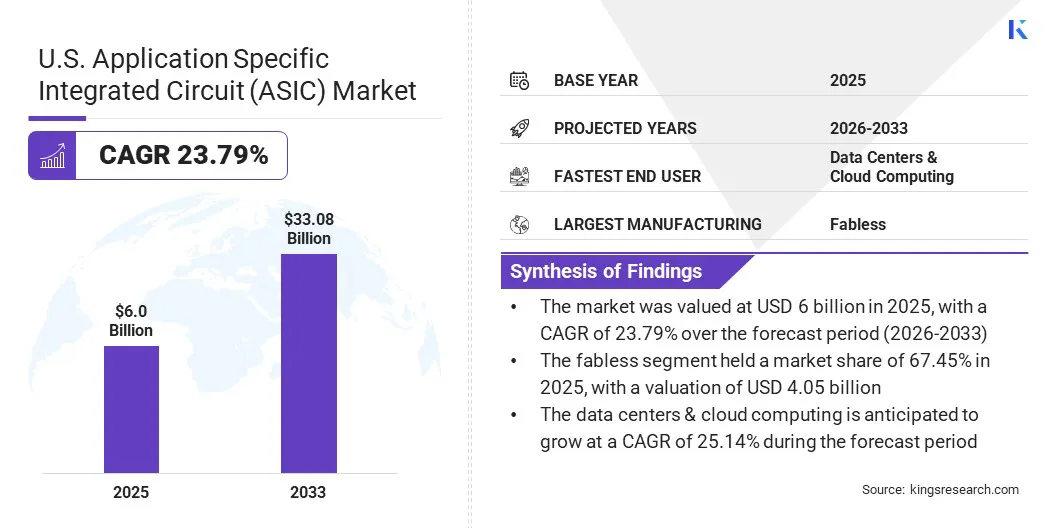
According to Kings Research, the U.S. application specific integrated circuit market is projected to grow from USD 6 billion in 2025 to USD 33.08 billion by 2033, registering a CAGR of 23.79% from 2026 to 2033. An application specific integrated circuit (ASIC) is a custom-designed semiconductor chip, engineered for dedicated functions within electronic devices. Unlike general purpose integrated circuits, ASICs are optimized for efficiency, speed, and performance in specific applications, making them critical for advanced technologies such as AI accelerators, automotive electronics, telecommunications infrastructure, and IoT devices.
The U.S. market is being shaped by several factors driving ASIC adoption. The push for digital transformation across industries is increasing the demand for tailored, high-performance solutions. Widespread deployment of 5G networks, growth in electric and autonomous vehicles, and rapid advancements in AI are highlighting the need for specialized, efficient chipsets. Additionally, a growing focus on supply chain security and domestic semiconductor innovation is prompting companies to invest in U.S.-based ASIC design and manufacturing capabilities.
Key Insight: The U.S. ASIC market is shifting from niche applications to a foundational pillar of technological competitiveness, underscored by a projected CAGR of 23.79%. This momentum is propelled by sustained investments in semiconductor R&D, IoT expansion, EV adoption, and AI-driven applications, indicating long-term market growth through 2033.
|
SEGMENTATION |
DETAILS |
|
By Product Type |
Full Custom ASIC, Semi-Custom ASIC, and Programmable ASIC |
|
By Function |
Training and Inference |
|
By Manufacturing Model |
Fabless and IDM (Integrated Device Manufacturer) |
|
By End User |
Consumer Electronics, Telecommunications, Automotive, Data Centers & Cloud Computing, Healthcare & Medical Devices, Industrial Automation, and Others |
The fabless manufacturing model leads the U.S. ASIC market, accounting for approximately USD 4.05 billion in revenue and a 67.45% share in 2025. Fabless companies focus on chip design while outsourcing fabrication to specialized foundries, enabling greater innovation and access to advanced process technologies without the capital intensity of owning fabrication facilities. This business model has gained prominence due to its scalability and ability to respond rapidly to evolving customer requirements.
Data centers and cloud computing represent the fastest-growing end-user segment in the U.S. ASIC market, with a projected CAGR of 25.24%. This surge is fueled by rapid adoption of AI workloads, exponential data growth, and demand for high-performance, energy-efficient custom ASICs that power hyperscale operations, advanced storage, and next-generation networking.
In June 2026, Advantest Corporation and OpenLight announced a partnership to develop scalable, high-volume test solutions for silicon photonics devices. This collaboration supports efficient production and deployment of next-generation optical interconnect technologies, addressing the needs of data centers and high-speed AI computing.
Key insight: The growing adoption of the fabless model, combined with the rapid expansion of the data center and cloud computing segment, reflects an industry focus on design innovation, scalable production, and high-performance computing to meet evolving AI and digital infrastructure requirements.
Advancements in digital technologies and growing demand for custom hardware are prompting U.S. companies to accelerate the adoption of ASICs. Federal initiatives such as the CHIPS and Science Act are promoting local semiconductor design, manufacturing, and supply chain security, while regulatory bodies, including the U.S. Department of Commerce and the FCC, are incentivizing innovation.
The growing proliferation of connected devices, widespread deployment of 5G networks, and increased adoption of artificial intelligence are boosting demand for specialized, energy-efficient chips. Additionally, the expansion of electric vehicles and autonomous systems is fostering collaborations on next-generation ASICs for ADAS, battery management, and real-time data processing.
Within the industry, companies are focusing on advanced ASIC designs for AI workloads, cryptography, and edge computing, while others are scaling production for consumer and industrial applications. Improved chip architectures, including FinFET and FD-SOI, enable U.S. manufacturers to produce smaller, faster, and more energy-efficient ASICs. In February 2023, Fortinet introduced FortiSP5, a fifth-generation custom ASIC, designed to converge networking and security across network edges. The chip delivers high-performance, power-efficient processing for applications such as 5G, edge computing, and operational technology while reducing power consumption by 88% compared to standard CPUs.
Key Insight: The focus of ASIC demand is shifting from standardized, off-the-shelf solutions to highly customized, application-specific designs that serve as the backbone of transformative technologies. This shift positions U.S. firms that invest in R&D, forge strategic partnerships, and prioritize security, performance, and supply chain resilience at a competitive advantage.
As the demand for custom, high-performance ASICs continues to accelerate across AI, telecommunications, automotive, and industrial applications, U.S. manufacturers face significant technical, operational, and economic hurdles. Industry leaders are responding with targeted innovations to overcome these challenges and maintain their competitive edge.
|
CHALLENGE |
INDUSTRY RESPONSE |
|
Design scalability limits |
Investment in modular and configurable ASIC architectures to address increased application complexity and enable rapid customization. |
|
Yield degradation |
Adoption of advanced manufacturing processes and in-line defect monitoring to improve yield and reduce production variability. |
|
High manufacturing costs |
Increased automation, process optimization, and partnerships with domestic foundries to improve cost efficiency. |
|
Security and IP risks |
Integration of robust security features and enhanced IP protection across the ASIC design and production lifecycle. |
Key insight: The ability to effectively manage design complexity, cost pressures, and yield challenges through targeted innovation is emerging as a key differentiator in the U.S. ASIC market. Companies that leverage advanced design tools, efficient manufacturing, and robust security measures will gain a competitive edge as custom ASIC demand continues to rise across critical technology sectors.
The U.S. application specific integrated circuit (ASIC) market is led by major semiconductor and technology companies, including Broadcom, Marvell, NVIDIA Corporation, Intel Corporation, Microchip Technology Inc., and Semiconductor Components Industries, LLC (ON Semiconductor). Emerging companies such as Zero ASIC, Jariet Technologies, Triad Semiconductor, and Sigenics, Inc. are further shaping the market through custom design capabilities and advanced solutions for diverse end-use sectors.
Collaborations between design houses and foundries, strategic acquisitions, and significant new investments continue to reshape the competitive landscape. For instance, in April 2026, OpenLight secured USD 50 million in Series A-1 funding to expand its platform for custom photonic ASICs, supporting applications across AI, telecom, sensing, and quantum computing.
Innovation strategies prioritize faster time-to-market, enhanced energy efficiency, and advanced security features. Companies are placing strong emphasis on domestic manufacturing and secure supply chains in response to federal initiatives such as the CHIPS and Science Act. As ASICs become integral to advanced technologies, market leaders are engaging in co-development partnerships, expanding IP portfolios, and scaling production capabilities to meet evolving customer needs.
Key Insight: Competitive advantage in the U.S. ASIC market is shifting from high-volume standardization toward expertise in custom design, rapid innovation, and secure, scalable manufacturing capabilities, driving strategic alliances, investment flows, and competitive positioning.
|
GROWTH CATALYSTS |
KEY RISKS |
|
AI and Advanced Computing: Rising adoption of artificial intelligence, machine learning, and data analytics is fueling demand for high-performance, application-specific chips across cloud, edge, and enterprise environments. |
Supply Chain Disruptions: Ongoing global semiconductor supply chain challenges, including material shortages and logistics delays, continue to impact production and delivery schedules. |
|
Next-Generation Connectivity: The rollout of 5G networks, IoT expansion, and advancements in automotive electronics are highlighting the need for custom ASICs capable of low-latency, high-reliability processing at scale. |
Geopolitical Factors: Export controls, trade disputes, and international competition restrict access to critical manufacturing technologies and key markets. |
|
Data Center Evolution: Modern data centers increasingly rely on specialized ASICs to manage data growth, boost server performance, and enhance energy efficiency. |
Innovation Demands: Rapid technological change necessitates sustained R&D investment and a highly skilled engineering workforce. |
|
Government Initiatives: Federal investments, including CHIPS Act funding, are strengthening domestic ASIC development, incentivizing onshore manufacturing, and fostering public-private collaborations. |
Market Volatility: Fluctuating demand in sectors like cloud computing, automotive, and consumer electronics introduces cyclical uncertainty. |
Key Insight: The U.S. ASIC market is entering a strong growth phase, propelled by the rapid adoption of AI, the evolution of cloud infrastructure, and advancements in next-generation connectivity. While supply chain disruptions and geopolitical complexities present ongoing challenges, robust structural demand and continued innovation are expected to support long-term market expansion through 2033.
Frequently Asked Questions

Aswathi holds cross-domain expertise, translating market trends and competitive intelligence into decision-ready insights. Her work helps clients interpret evolving market conditions and identify growth opportunities. She brings a focused, insight-led approach to research execution. She translates these findings into clear, prioritized action plans that align with client capabilities. Her research often includes scenario modeling to test growth strategies under varying economic conditions. She maintains a rigorous validation process, cross-checking primary and secondary sources to ensure reliability. Clients value her ability to synthesize noisy data into concise executive summaries that drive board-level discussions. Her sector-specific lens, combined with a pragmatic focus on execution, consistently delivers high-impact, commercially sound recommendations. Her structured yet flexible research frameworks adapt to client timelines without compromising depth. She is known for distilling complex trade-offs into straightforward, defensible positions that facilitate confident decision-making.
Habi is a seasoned research and consulting leader with renowned experience in guiding clients on strategic growth and transformation initiatives across global markets. He has led high-performing research teams that deliver actionable insights on market expansion, M&A strategies, opportunity assessment, new business development, and product launches. His project portfolio spans large petrochemical producers, electronic device manufacturers, lubricants companies, and other leading enterprises across diverse industrial and consumer sectors. He currently heads the research department at Kings Research, where he is responsible for setting the research agenda, mentoring analysts, and ensuring client-ready deliverables that support executive decision-making. With extensive experience in market intelligence, strategic research, and consulting, Habi brings a strong understanding of evolving industry dynamics, competitive landscapes, emerging opportunities, and business growth challenges. His expertise includes developing research frameworks, translating complex market data into actionable strategic recommendations, and working closely with senior stakeholders to address critical business questions. He has also contributed to building research capabilities, strengthening analytical methodologies, and driving a culture of quality and insight-led decision-making within research teams. His cross-industry exposure enables him to connect market trends with broader business implications and provide perspectives that help organizations identify opportunities, mitigate risks, and make informed strategic decisions.