
Inquire Now
Key Strategic Points
Topical drug delivery refers to administering drugs directly onto the skin or mucous membranes to achieve targeted therapeutic effects. It uses creams, gels, ointments, sprays, and patches to treat localized conditions or deliver systemic therapy efficiently. The market encompasses development, manufacturing, and commercialization of formulations for dermatology, pain management, and other therapeutic areas.
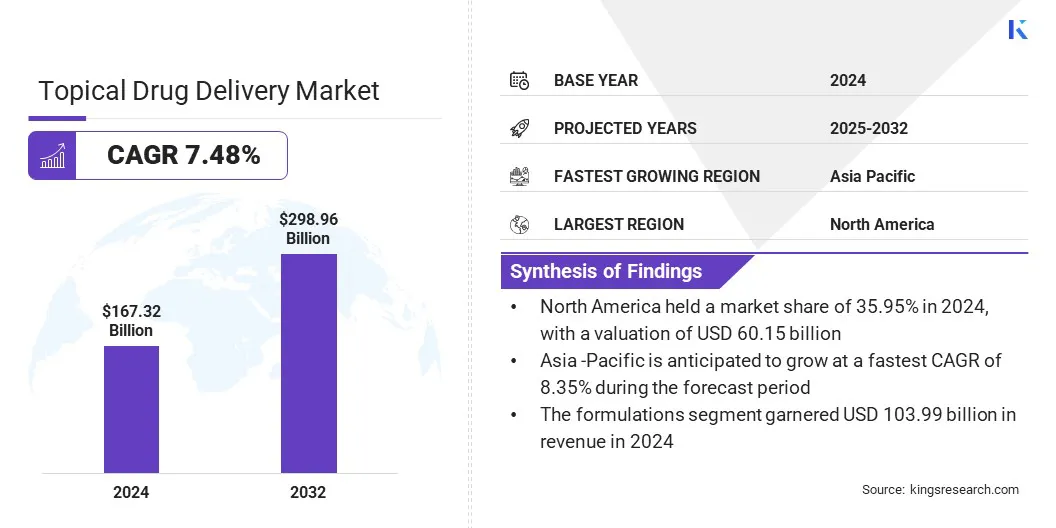
The global topical drug delivery market size was valued at USD 167.32 billion in 2024 and is projected to grow from USD 179.50 billion in 2025 to USD 298.96 billion by 2032, exhibiting a CAGR of 7.48% over the forecast period.
Market growth is driven by the rising prevalence of skin disorders and chronic conditions, creating strong demand for localized therapies such as creams, ointments, gels, and sprays. The increasing adoption of transdermal patches for controlled and systemic drug delivery is further supporting their use across dermatology, pain management, and chronic disease treatment.
Major companies operating in the topical drug delivery market are Bayer AG, Galderma SA, Novartis AG, Glenmark Pharmaceuticals Ltd, Johnson & Johnson, Almirall S.A., AbbVie Inc., GlaxoSmithKline plc, Bausch Health Companies Inc., Hisamitsu Pharmaceutical Co., Inc., Cipla Limited, Viatris Inc., Solventum, Organon & Co., and Teva Pharmaceuticals USA, Inc.
Growing concerns over UV exposure and environmental factors are boosting demand for topical treatments such as sunscreens and targeted therapies. Additionally, the rising prevalence of skin cancer is creating increased demand for advanced topical chemotherapeutics and targeted treatment options.
Increasing Prevalence of Dermatological Conditions
A key factor propelling the growth of the topical drug delivery market is the increasing prevalence of dermatological conditions such as acne, eczema, psoriasis, and rosacea. Pharmaceutical companies are focusing on the development of targeted and effective topical therapies to manage these skin disorders.
Dermatologists and healthcare providers are recommending non-invasive topical treatments to improve patient outcomes and minimize systemic side effects. This rising focus on skin health is accelerating demand for advanced topical formulations and driving market growth.
High Development and Manufacturing Costs
A key challenge limiting the growth of the topical drug delivery market is the high development and manufacturing costs of advanced formulations. Developing transdermal patches, nanocarriers, and controlled-release systems requires specialized equipment and extensive preclinical and clinical testing. Moreover, strict quality control and regulatory compliance further increase production expenses, thereby limiting market growth.
To address this challenge, market players are investing in advanced manufacturing technologies and automation to improve efficiency and reduce production expenses.
They are adopting modular and scalable platforms for transdermal patches, nanocarriers, and controlled-release systems to accelerate development timelines. They are forming strategic collaborations with contract research and manufacturing organizations (CROs and CMOs) to accelerate development timelines and improve production efficiency.
Development of Novel Topical Formulations
A key trend influencing the topical drug delivery market is the development of novel topical formulations. Manufacturers are creating advanced gels, creams, and transdermal systems that are improving drug stability, enhancing skin penetration, and limit the amount of drug entering the bloodstream thereby reducing systemic side effects.
These innovations are targeting chronic and complex conditions such as neuropathic pain, inflammatory skin disorders, and viral infections. These formulations are enabling localized and precise therapy while enhancing patient adherence and optimizing therapeutic outcomes.
|
Segmentation |
Details |
|
By Product |
Formulations (Solid, Semi-Solid, Liquid), Devices (Transdermal Patches, Inhalers & Nebulizers, Metered-Dose Sprayers, Others) |
|
By Route of Administration |
Dermal, Ophthalmic, Nasal, Rectal, Others |
|
By End User |
Hospitals, Specialty Clinics & Dermatology Centers, Ambulatory Surgical Centers, Home-Care Settings |
|
By Region |
North America: U.S., Canada, Mexico |
|
Europe: France, UK, Spain, Germany, Italy, Russia, Rest of Europe |
|
|
Asia-Pacific: China, Japan, India, Australia, ASEAN, South Korea, Rest of Asia-Pacific |
|
|
Middle East & Africa: Turkey, U.A.E., Saudi Arabia, South Africa, Rest of Middle East & Africa |
|
|
South America: Brazil, Argentina, Rest of South America |
Based on region, the market has been classified into North America, Europe, Asia Pacific, Middle East & Africa, and South America.
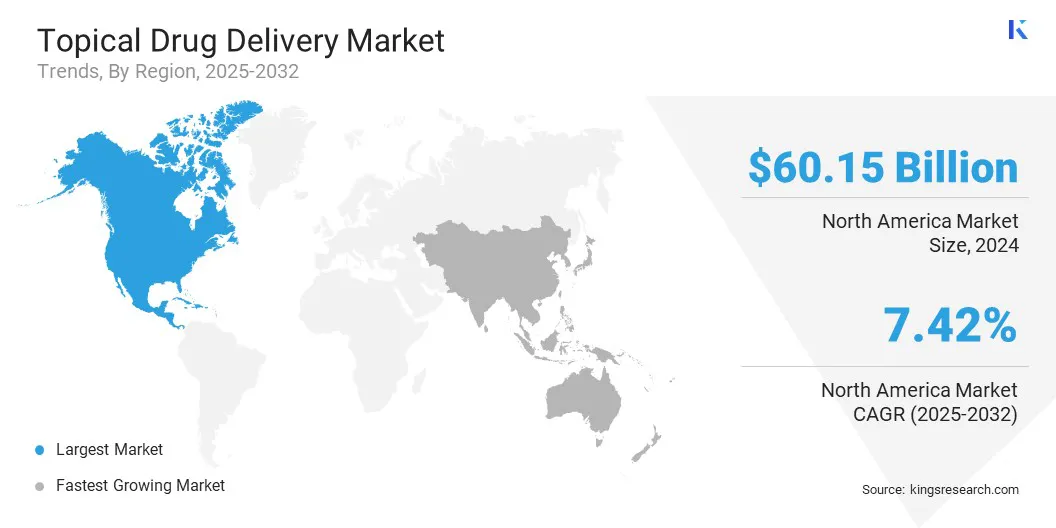
North America topical drug delivery market share stood at 35.95% in 2024, valued at USD 60.15 billion. This dominance is driven by the high prevalence of dermatological conditions such as acne, eczema, and psoriasis in the U.S., coupled with strong healthcare access in the region. Increasing cases of skin cancer are fueling demand for advanced topical chemotherapeutics to provide targeted treatment and improve patient outcomes.
The surge in chronic diseases such as diabetes is further boosting the need for specialized topical therapies to manage complications and enhance patient care. Additionally, the presence of well-established contract development and manufacturing organizations (CDMOs) in the region is driving faster development of innovative topical and transdermal products.
Asia Pacific is set to grow at a CAGR of 8.35% over the forecast period. This growth is attributed to the increasing prevalence of skin disorders and rapid population growth across the region. Rising consumer awareness about sun protection and skincare is encouraging the adoption of sunscreens and dermal treatments.
Growing awareness of skin cancer prevention is creating demand for advanced topical chemotherapeutics. Additionally, regional players are expanding pharmaceutical R&D infrastructure, enabling the development of innovative topical formulations, thereby boosting market growth.
Companies operating in the topical drug delivery industry are actively developing innovative formulations such as sustained-release gels, liposomal creams, and medicated transdermal patches to improve efficacy and patient compliance.
They are expanding research and development capabilities to create advanced therapies such as hormone-based gels and localized analgesic formulations for dermatological conditions. Additionally, players are focusing on strategic collaborations to accelerate the development of specialized topical treatments for rare and complex skin disorders.
Frequently Asked Questions

Swati is a committed research analyst with a passion for optimizing systems and processes across industries, specializing in healthcare but also bringing valuable expertise to sectors such as consumer goods, life sciences, and more. Her cross-domain research approach allows her to generate clear, actionable reports that inform strategic decisions in a variety of fields. Swati is committed to staying ahead of evolving trends, leveraging her broad understanding of different sectors to provide insights that are relevant to a range of industries. In her personal time, she enjoys music and spending quality time with her family, which inspires her creativity and enriches her professional approach. Her systematic methodology ensures that every report is both thorough and practical. Swati's ability to bridge regulatory frameworks with market realities gives her recommendations a distinct edge. She collaborates seamlessly with cross-functional teams, distilling complex data into straightforward narratives. Her proactive monitoring of policy and technological shifts keeps her analysis forward-looking.

Ganapathy Subramaniam Suresh
With over a decade of research leadership across global markets, Ganapathy brings sharp judgment, strategic clarity, and deep industry expertise. Known for precision and an unwavering commitment to quality, he guides teams and clients with insights that consistently drive impactful business outcomes.