
Inquire Now
Key Strategic Points
Structural adhesive tapes are pressure-sensitive bonding solutions that provide high-strength adhesion for permanent or semi-permanent applications across materials such as metals, plastics, and composites.
The market has a wide range of products categorized by resin type into acrylic, epoxy, and silicone, and by backing materials into foam, film, and non-woven substrates. It is used in automotive, electronics, construction, and industrial sectors, covering both standard and customized solutions that meet specific performance requirements, such as temperature resistance, shear strength, and chemical stability.
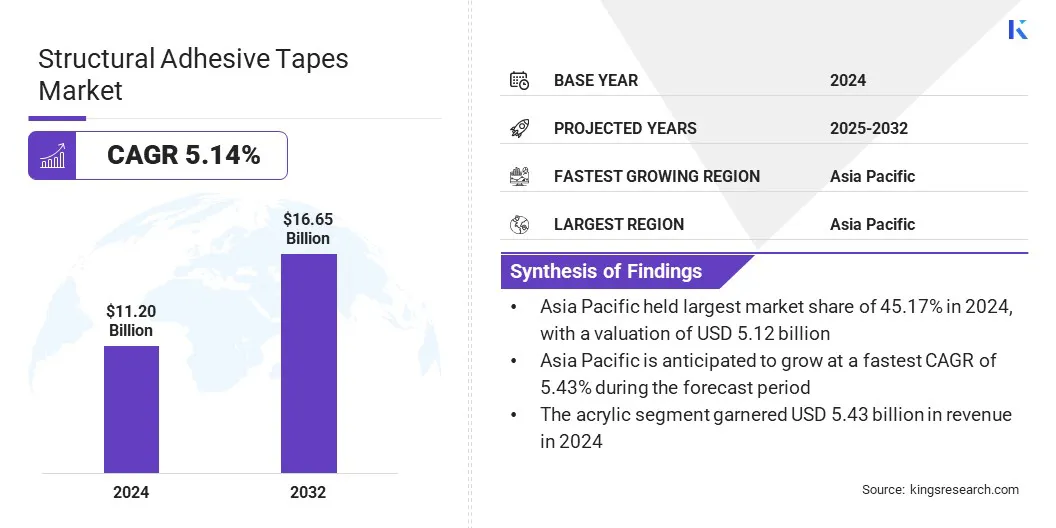
According to Kings Research, the global structural adhesive tapes market size was valued at USD 11.20 billion in 2024 and is projected to grow from USD 11.72 billion in 2025 to USD 16.65 billion by 2032, exhibiting a CAGR of 5.14% over the forecast period.
The market is growing as industries use high-performance bonding solutions instead of mechanical fasteners. Increasing demand for lightweight, durable, and temperature-resistant tapes in the automotive and electronics sectors boosts efficiency and encourages their use in automated manufacturing processes, thereby supporting global market expansion.
Major companies operating in the structural adhesive tapes market are 3M, AVERY DENNISON CORPORATION, H.B. Fuller Company, Sika AG, Huntsman, Henkel AG & Co. KgaA, Wacker Chemie AG, Amcor plc, Arkema, LINTEC Corporation, Pidilite Industries Ltd., Bron Tapes, General Sealants, TOAGOSEI (THAILAND) CO., LTD., and NANPAO RESINS CHEMICAL GROUP.
Manufacturers are developing debonding technologies that allow adhesives to be removed cleanly, enhancing repairability, recyclability, and sustainability. These adhesives can now be used across automotive, electronics, and industrial sectors, boosting growth in the market.
The structural adhesive tapes market is driven by the shift toward lightweight and fuel-efficient designs in the aerospace industry. Manufacturers are replacing mechanical fasteners with high-performance adhesive tapes that maintain structural integrity while reducing component weight.
Lighter aircraft components improve fuel efficiency, increase range, and lower emissions. Additionally, the growing use of automated assembly in aircraft manufacturing is boosting the demand for structural adhesive materials.
The structural adhesive tapes market faces challenges due to limited recyclability and repairability. Conventional adhesive tapes create permanent bonds, making disassembly, maintenance, and recycling difficult, particularly in automotive, electronics, and industrial applications.
This leads to a higher amount of waste, raises material costs, and reduces sustainability across supply chains. To address this, manufacturers are adopting advanced solutions such as AI-designed adhesives, conductive and safety coatings, and debonding technologies.
The use of structural adhesive tapes is increasing in renewable energy systems. Solar panels, wind turbines manufacturers are using high-performance tapes for their lightweight, durable, and temperature-resistant properties.
These tapes simplify assembly, improve structural integrity, and enhance energy efficiency. The shift toward advanced bonding solutions over traditional mechanical fasteners reflects changing product preferences and technological innovation within the industry.
|
Segmentation |
Details |
|
By Resin Type |
Acrylic, Epoxy, Silicone, Others |
|
By Backing Material |
Foam Tapes, Film Tapes, Paper Tapes, Others |
|
By End-Use Industry |
Automotive & Transportation, Electronics & Electricals, Building & Construction, Industrial Manufacturing, Aerospace, Healthcare, Others |
|
By Region |
North America: U.S., Canada, Mexico |
|
Europe: France, UK, Spain, Germany, Italy, Russia, Rest of Europe |
|
|
Asia-Pacific: China, Japan, India, Australia, ASEAN, South Korea, Rest of Asia-Pacific |
|
|
Middle East & Africa: Turkey, U.A.E., Saudi Arabia, South Africa, Rest of Middle East & Africa |
|
|
South America: Brazil, Argentina, Rest of South America |
The market has been classified into North America, Europe, Asia Pacific, Middle East & Africa, and South America, by region.
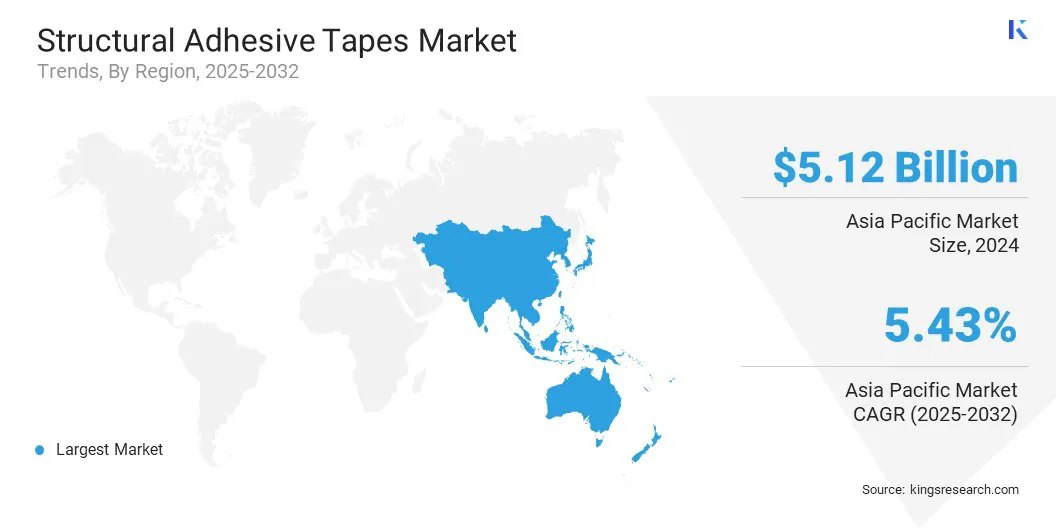
Asia Pacific structural adhesive tapes market share stood at around 45.71% in 2024, with a valuation of USD 5.12 billion. The region’s growth is driven by the expanding automotive industry, where rising production creates demand for lightweight, durable, and temperature-resistant bonding solutions.
Rapid development in electronics manufacturing and industrial sectors further increases the usage of structural adhesive tapes for assembly and component bonding. The high concentration of automotive and industrial hubs, along with growing production volumes, positions Asia Pacific as the largest market globally.
The structural adhesive tapes industry in North America is expected to register the fastest growth with a projected CAGR of 5.16% over the forecast period. This growth is fueled by the expansion of local manufacturing facilities, improving access to high-performance structural adhesive tapes for industrial and specialty applications.
Investments in advanced production plants, such as solvent-free adhesive facilities, shorten lead times and strengthen supply chains to meet the rising demand from automotive, aerospace, electronics, and construction sectors.
Key players in the structural adhesive tapes industry are actively pursuing product innovation and mergers to strengthen their competitive positions. Companies are developing advanced adhesive formulations and high-performance tapes that offer high-strength bonding, temperature and chemical resistance, lightweight construction, and durability for automotive, electronics, and industrial applications.
Companies are also focusing on mergers and acquisitions to expand their global footprint, integrate complementary technologies, and enhance operational efficiency.
Frequently Asked Questions

Swati is a committed research analyst with a passion for optimizing systems and processes across industries, specializing in healthcare but also bringing valuable expertise to sectors such as consumer goods, life sciences, and more. Her cross-domain research approach allows her to generate clear, actionable reports that inform strategic decisions in a variety of fields. Swati is committed to staying ahead of evolving trends, leveraging her broad understanding of different sectors to provide insights that are relevant to a range of industries. In her personal time, she enjoys music and spending quality time with her family, which inspires her creativity and enriches her professional approach. Her systematic methodology ensures that every report is both thorough and practical. Swati's ability to bridge regulatory frameworks with market realities gives her recommendations a distinct edge. She collaborates seamlessly with cross-functional teams, distilling complex data into straightforward narratives. Her proactive monitoring of policy and technological shifts keeps her analysis forward-looking.

Ganapathy Subramaniam Suresh
With over a decade of research leadership across global markets, Ganapathy brings sharp judgment, strategic clarity, and deep industry expertise. Known for precision and an unwavering commitment to quality, he guides teams and clients with insights that consistently drive impactful business outcomes.