
Inquire Now
Key Strategic Points
Stroke post processing software is a specialized medical imaging solution designed to analyze and enhance diagnostic data from stroke-related scans, such as CT, MRI, and perfusion imaging. It assists clinicians in identifying stroke type, severity, and affected brain regions by providing automated image processing, advanced visualization, and quantitative analysis.
The market encompasses software tools that integrate with imaging systems, offer AI-powered decision support, and support more accurate stroke diagnosis and treatment planning in hospitals and diagnostic centers.
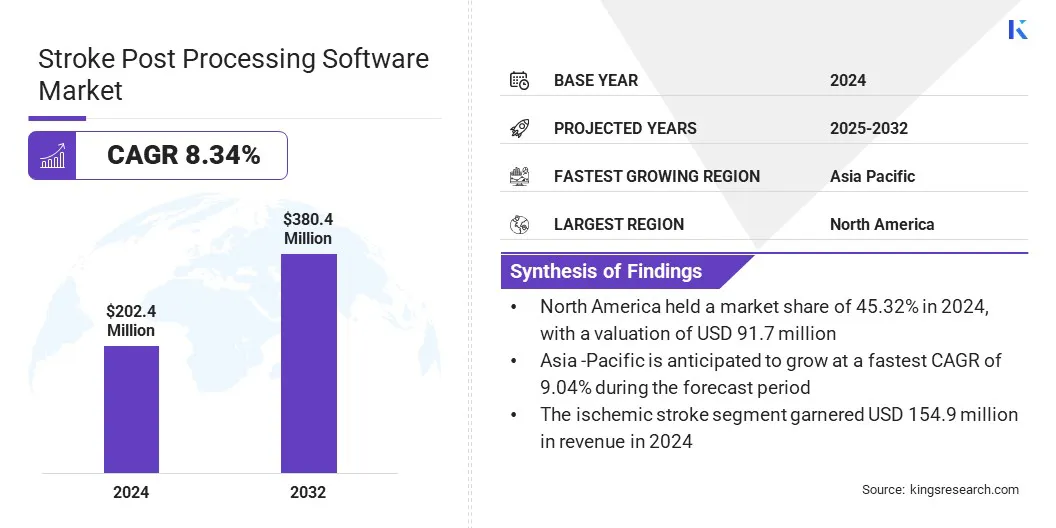
The global stroke post processing software market size was valued at USD 202.4 million in 2024 and is projected to grow from USD 217.1 million in 2025 to USD 380.4 million by 2032, exhibiting a CAGR of 8.34% over the forecast period.
Market growth is driven by the adoption of AI-enabled automated imaging analysis, which enhances diagnostic accuracy, accelerates data interpretation, prioritizes critical cases, and reduces time-to-treatment. The rising demand for precision medicine and real-time clinical decision support in stroke care is further fueling adoption, as healthcare providers use advanced analytics and AI tools to personalize treatment pathways and improve outcomes.
Major companies operating in the stroke post processing software market are Brainomix Limited, iSchemaView, Inc, Nicolab B.V, Terarecon, Inc, Viz.ai, Inc, icometrix NV, CEREBRA.AI LTD, Aidoc Medical Ltd, Qure.ai Technologies Private Limited, General Electric Company, Siemens, Koninklijke Philips N.V, Canon Medical Informatics, Inc, Medtronic Inc, and Avicenna.AI.
The expansion of hospital infrastructure and adoption of advanced imaging systems is creating greater access to modern stroke diagnostic tools. Additionally, the growing focus on improving stroke care access in low‑ and middle‑income countries is boosting the adoption of advanced imaging and stroke post processing software solutions.
Rising Global Stroke Incidence
A key factor driving the growth of the stroke post-processing software market is the rising global prevalence of stroke. Rising incidence of stroke, driven by aging populations and growing lifestyle-related risk factors such as hypertension, diabetes, and obesity is driving the demand for faster and more accurate diagnosis.
This is influencing healthcare providers to adopt advanced imaging and analytical tools, enabling early detection, improving patient outcomes, and supporting efficient stroke care management.
Limited Interoperability with Existing Imaging Equipment and Hospital Systems
A key challenge impeding the growth of the stroke post processing software market is limited interoperability with existing imaging equipment and hospital systems. Many healthcare facilities operate on legacy systems that lack compatibility with advanced software solutions, creating integration difficulties. This results in inefficient data exchange, workflow delays, and increased operational complexity.
To address this challenge, market players are developing software solutions with enhanced compatibility and standardized integration protocols. Companies are developing vendor-neutral platforms that support multiple imaging formats and integrate seamlessly with hospital information systems (HIS) and picture archiving and communication systems (PACS).
They are also investing in cloud-based solutions and API-driven architectures to ensure seamless integration, improve workflow efficiency, and accelerate the adoption of stroke post processing software.
Increasing Integration of Artificial Intelligence and Machine Learning in Stroke Analysis
A key trend in the stroke post processing software market is the increasing integration of artificial intelligence (AI) and machine learning (ML) in stroke analysis. AI-driven platforms are enabling faster, more accurate interpretation of imaging data, supporting real-time decision-making for stroke diagnosis and treatment. Healthcare providers are adopting these technologies to enhance workflow efficiency, improve patient outcomes, and reduce time-to-treatment.
|
Segmentation |
Details |
|
By Stroke Type |
Ischemic Stroke, Hemorrhagic Stroke, Others |
|
By Installation Type |
Desktop-Based Software, Mobile Phones & Tablets |
|
By Imaging Modality |
CT-Scan, MRI |
|
By End-User |
Hospitals & Clinics, Specialty Centers, Others |
|
By Region |
North America: U.S., Canada, Mexico |
|
Europe: France, UK, Spain, Germany, Italy, Russia, Rest of Europe |
|
|
Asia-Pacific: China, Japan, India, Australia, ASEAN, South Korea, Rest of Asia-Pacific |
|
|
Middle East & Africa: Turkey, U.A.E., Saudi Arabia, South Africa, Rest of Middle East & Africa |
|
|
South America: Brazil, Argentina, Rest of South America |
Market Segmentation:
Based on region, the Market has been classified into North America, Europe, Asia Pacific, Middle East & Africa, and South America.
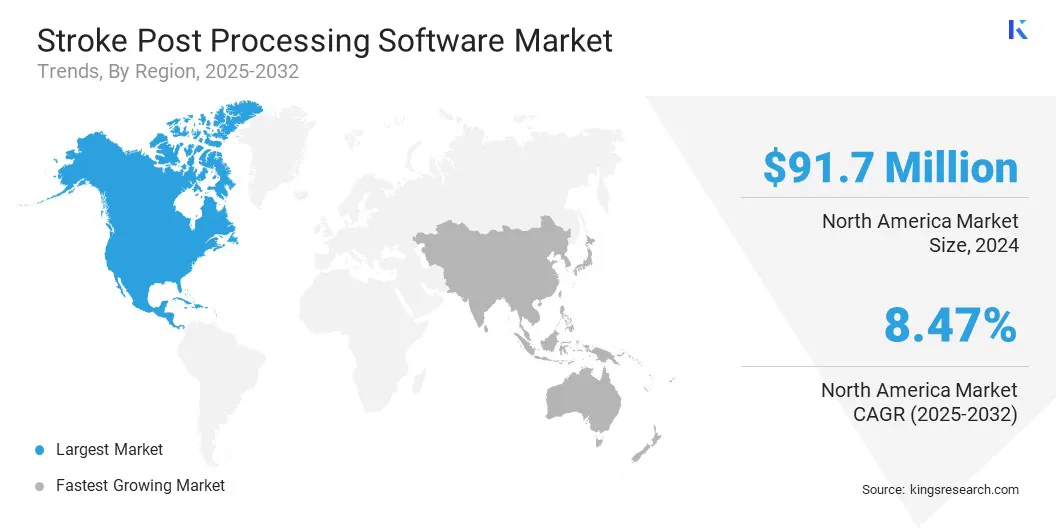
North America stroke post processing software market share stood at 45.32% in 2024 in the global market, valued at USD 91.7 million. This dominance is driven by the increasing prevalence of stroke among aging populations, which is creating greater demand for rapid and accurate diagnosis. The growing adoption of AI and ML in medical imaging is further accelerating market expansion by enabling real-time analysis and improving diagnostic accuracy.
Rising healthcare investments by governments and private healthcare providers in advanced imaging infrastructure are supporting market expansion. Additionally, regional players are focusing on strategic partnerships to enhance technology integration, expand service offerings, and improve stroke care delivery.
Asia Pacific is set to grow at a CAGR of 9.04% over the forecast period. This growth is attributed to the rising burden of stroke driven by increasing geriatric populations and a high prevalence of lifestyle-related risk factors.
Expanding healthcare infrastructure by governments and private healthcare providers is accelerating the adoption of stroke post processing software by improving access to advanced imaging systems and enhancing diagnostic capabilities. Additionally, growing focus on regional collaborations to improve efficiency and access to advanced stroke diagnosis and treatment is further propelling market growth.
Major players in the stroke post processing software industry are actively enhancing their software by integrating advanced AI and ML capabilities to improve diagnostic accuracy. They are expanding their presence through strategic partnerships and collaborations with healthcare providers and technology firms to enhance service delivery.
Companies are also investing in developing scalable, interoperable platforms that can seamlessly integrate with existing healthcare systems, enabling faster workflows. Additionally, they are focusing on creating integrated care models that combine imaging, analytics, and treatment coordination to streamline stroke management and improve patient outcomes across diverse healthcare settings.
Frequently Asked Questions

Swati is a committed research analyst with a passion for optimizing systems and processes across industries, specializing in healthcare but also bringing valuable expertise to sectors such as consumer goods, life sciences, and more. Her cross-domain research approach allows her to generate clear, actionable reports that inform strategic decisions in a variety of fields. Swati is committed to staying ahead of evolving trends, leveraging her broad understanding of different sectors to provide insights that are relevant to a range of industries. In her personal time, she enjoys music and spending quality time with her family, which inspires her creativity and enriches her professional approach. Her systematic methodology ensures that every report is both thorough and practical. Swati's ability to bridge regulatory frameworks with market realities gives her recommendations a distinct edge. She collaborates seamlessly with cross-functional teams, distilling complex data into straightforward narratives. Her proactive monitoring of policy and technological shifts keeps her analysis forward-looking.

Ganapathy Subramaniam Suresh
With over a decade of research leadership across global markets, Ganapathy brings sharp judgment, strategic clarity, and deep industry expertise. Known for precision and an unwavering commitment to quality, he guides teams and clients with insights that consistently drive impactful business outcomes.