
Inquire Now
Key strategic points
Sintered steel is a type of powdered metal product formed by compressing and heating steel powders below their melting point. This process creates a solid, dense, and durable material with desired porosity and mechanical properties.
It is used in automotive components (gears, bearings, bushings), industrial machinery, filtration systems, and construction tools, where precision, wear resistance, and cost-effective manufacturing are critical. The market encompasses the production, processing, and supply of steel powders, sintering equipment, and finished sintered steel components across automotive, industrial, and engineering sectors.
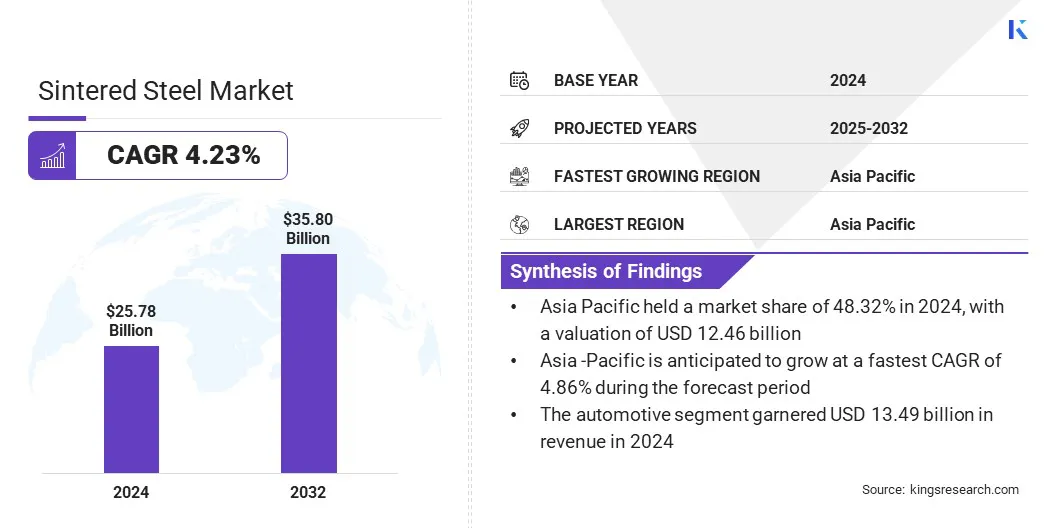
The global sintered steel market size was valued at USD 25.78 billion in 2024 and is projected to grow from USD 26.78 billion in 2025 to USD 35.80 billion by 2032, exhibiting a CAGR of 4.23% over the forecast period. This growth is attributed to the increasing use of sintered steel in precision engineering applications across automotive, industrial, and aerospace sectors.
Additionally, expansion of powder metallurgy technology and advancements in sintering techniques are enabling efficient production of complex, high-performance sintered steel parts.
Major companies operating in the sintered steel market are GKN Powder Metallurgy, Inc., Miba AG, Höganäs AB, Sintercom Limited, AMES Group Sintering, SA, Atlantic Sintered, Atlas Pressed Metals, Sintex a/s, Porous Metal Filters Inc., Dalon Machinery Co., Ltd, Baoji Saga Porous Filter Co., Ltd, Sandvik AB, Keystone Powdered Metal Company, BEARING TECHNOLOGIES S.R.L., and Allied Sinterings, Inc.
The increasing demand for lightweight, high-strength, and precision-engineered automotive components driven by the adoption of electric vehicles is primarily driving this market. For instance, the International Energy Agency (IEA) reports that global electric car sales surpassed 17 million units in 2024, a 25% increase from 2023. Sintered steel offers superior material properties, dimensional accuracy, and durability in various applications.
Manufacturers are improving production techniques, and optimizing designs to efficiently produce high-performance sintered steel components for the automotive sector. These advancements enable the efficient manufacture of complex components, enhance vehicle performance, and support broader adoption of sintered steel across the automotive sector.
A major driver in the sintered steel market is the growing demand for lightweight and high-strength automotive components for improving fuel efficiency and performance. For instance, the U.S. Department of Energy (DOE) reported that a 10% reduction in vehicle weight can result in a 6–8% improvement in fuel economy.
The demand for durable, precision-engineered parts, such as gears, and structural components, has fueled the need for sintered steel due to its superior strength-to-weight ratio. This is prompting advancements in material properties, production techniques, and component design of sintered steel automotive parts. It is also enabling automakers to meet fuel efficiency and emission targets.
The high initial investment required for establishing sintered steel production facilities poses significant challenges to the market for new entrants and smaller manufacturers. Specialized equipment, such as powder presses, high-temperature furnaces, and precision quality-control systems, demands substantial capital expenditure. The high upfront costs create entry barriers, slow the adoption of advanced technologies, and hinder market growth.
To address this challenge, market players are adopting partnership, merger, and acquisition strategies to share resources and expand production capabilities. Companies are also investing in modular and scalable production systems to increase efficiency, manage costs, and expand production capacity. Additionally, manufacturers are adopting advanced automation and process optimization to reduce operational expenses and improve efficiency.
A key trend in the sintered steel market is the increased focus on sustainable and energy-efficient sintering processes. Manufacturers are adopting advanced furnace technologies, optimized thermal management, and environmentally friendly fuel alternatives to reduce energy consumption, and operational costs.
These improvements enhance process efficiency, material quality, and consistency, while supporting compliance and corporate sustainability goals. The integration of these technologies enables producers to manufacture high-performance sintered steel components more efficiently with a lower environmental footprint.
|
Segmentation |
Details |
|
By Type |
Stainless Steel, Carbon Steel, Alloy Steel, Tool Steel |
|
By Manufacturing Process |
Metal Injection Molding, Additive Manufacturing, Conventional Manufacturing, Powder Forging Manufacturing |
|
By Application |
Automotive, Machinery & Equipment, Consumer Electronics, Medical Devices, Others |
|
By Region |
North America: U.S., Canada, Mexico |
|
Europe: France, UK, Spain, Germany, Italy, Russia, Rest of Europe |
|
|
Asia-Pacific: China, Japan, India, Australia, ASEAN, South Korea, Rest of Asia-Pacific |
|
|
Middle East & Africa: Turkey, U.A.E., Saudi Arabia, South Africa, Rest of Middle East & Africa |
|
|
South America: Brazil, Argentina, Rest of South America |
Market Segmentation:
Based on region, the market has been classified into North America, Europe, Asia Pacific, the Middle East & Africa, and South America.
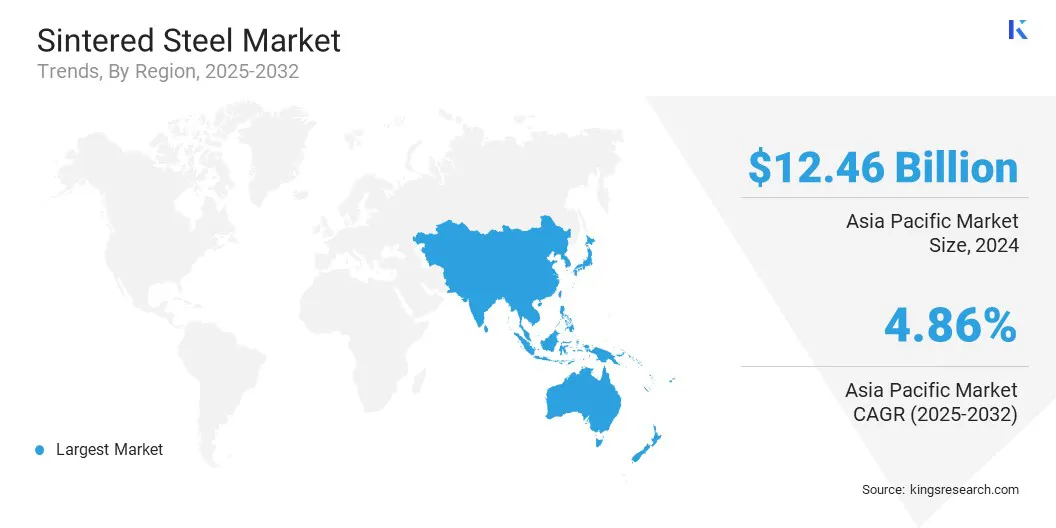
Asia Pacific sintered steel market share stood at 48.32% in 2024, valued at USD 12.46 billion in the global market. This growth is due to the rapid expansion of the automotive manufacturing sector across the region. The growing demand for affordable yet high-performance industrial equipment in emerging economies, such as India and Indonesia, is boosting the use of sintered steel components in fluid control and electrical systems.
Increasing aftermarket demand and replacement of industrial machinery and automotive parts are fueling continuous consumption of sintered steel products. Continuous investments in local production facilities and technical expertise by regional players are enhancing manufacturing capacity and supply chain efficiency across Asia Pacific.
North America sintered steel industry is set to grow at a robust CAGR of 3.99% over the forecast period. This growth is driven by increasing demand for lightweight and high-strength automotive components across the region. The rapid adoption of electric vehicles is further propelling the need for precision-engineered, durable parts for high-performance automotive systems.
Advancements in additive manufacturing and powder metallurgy technologies are enabling the production of complex components with superior material properties. Additionally, strategic acquisitions and capacity expansions by regional players are enhancing technical expertise and production capabilities, supporting market growth in the region.
Key players in the sintered steel industry are actively expanding and upgrading production capabilities to meet growing regional demand for high-performance components. They are developing advanced steel powders and alloys with improved hardness to support additive manufacturing and the production of complex parts.
They are also integrating advanced manufacturing technologies, such as precision powder metallurgy and optimized sintering processes, to improve efficiency and reduce material waste. Additionally, players are introducing versatile materials that combine mechanical performance with process adaptability, catering to automotive and consumer electronics applications.
Frequently Asked Questions

Over the years, Versha brings over 15 years of experience managing consulting assignments across industries, including Food and Beverage, Consumer Goods, ICT, Aerospace, and more. Her work has spanned diverse sectors. Her cross-domain expertise and adaptability make her a versatile and dependable professional. She is known for her keen business insight and foresight. With sharp analytical skills and a curious mindset, Versha excels at transforming complex data into actionable insights. She has a proven track record of unraveling market dynamics, identifying trends, and delivering tailored solutions to meet client needs. As a skilled leader, Versha has successfully mentored research teams and directed projects with precision, ensuring high-quality outcomes. Her collaborative approach and strategic vision enable her to turn challenges into opportunities and consistently deliver impactful results. Whether analyzing markets, engaging stakeholders, or crafting strategies, Versha draws on her deep expertise and industry knowledge to drive innovation and deliver measurable value.

With over a decade of research leadership across global markets, Ganapathy brings sharp judgment, strategic clarity, and deep industry expertise. Known for precision and an unwavering commitment to quality, he guides teams and clients with insights that consistently drive impactful business outcomes.



.webp&w=128&q=75&dpl=dpl_3pUwJtNgpk6oXgXnK9PBcvvUhHi3)