
Inquire Now
Key Strategic Points
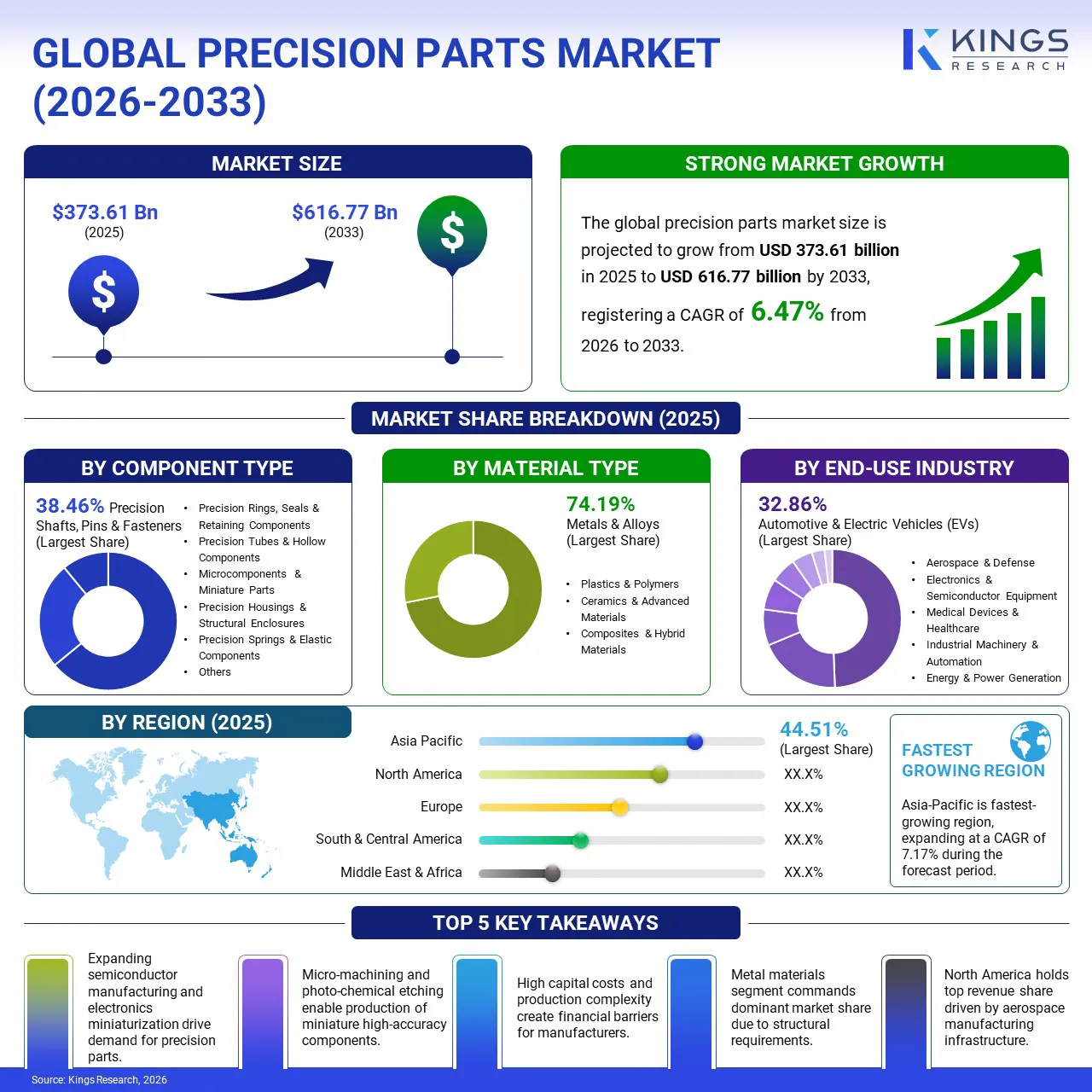
According to Kings Research, the global precision parts market size was estimated at USD 373.61 billion in 2025 and is projected to reach USD 616.77 billion by 2033, exhibiting a CAGR of 6.47% during the forecast period (2026-2033). This research analysis synthesizes primary research interviews, industrial supply chain disclosures, and component trade databases across major precision manufacturing hubs.
The market encompasses Precision Shafts, Pins & Fasteners, Microcomponents & Miniature Parts, Machined Enclosures, Valves, and Custom Components engineered for automotive, electric vehicles, electronics, semiconductor equipment, aerospace, and medical device applications. The report explores key drivers of market development, offering detailed regional analysis and a comprehensive overview of the competitive landscape shaping future opportunities.
The market is expanding steadily, driven by rapid automotive electrification, expanding semiconductor equipment manufacturing, and ongoing miniaturization across consumer electronics and medical devices. Advanced CNC machining, Swiss turning, and multi-axis automated manufacturing processes enable producers to deliver tight-tolerance components required for high-reliability systems.
Major companies operating in the precision parts market include AccuRounds Inc., Aequs Private Ltd., Anton Häring KG, Barnes Group Inc., Linamar Corporation, NN, Inc., Renishaw plc, Schweizer Group GmbH, Teconnex Ltd., and Voestalpine AG.
For instance, in March 2025, SiCarrier, a Chinese semiconductor equipment manufacturer, expanded its domestic precision part supplier network to secure critical high-purity components for advanced wafer fabrication tools.
The global precision parts market is experiencing robust expansion, driven primarily by the rapid transition toward electric vehicles (EVs), expanding semiconductor fabrication infrastructure, and continuous advancements in multi-axis CNC machining technology. Electric vehicles require high-precision powertrain components, thermal management valves, and battery connector pins engineered to strict dimensional tolerances.
Furthermore, Boeing, Lockheed Martin, and Raytheon rely on precision parts for aircraft engines, navigation systems, and defense equipment. Collaborations enable firms to scale advanced manufacturing processes, improve demand forecasting, and align production with complex OEM product development cycles.
For Instance, in November 2024, Hexagon's Manufacturing Intelligence division unveiled ProPlanAI, an AI-driven CAM solution designed to streamline precision component programming and machining efficiency.
In March 2025, SiCarrier expanded its localized precision component sourcing to accelerate domestic semiconductor equipment manufacturing.
A primary restraint facing the precision parts market involves price volatility in high-grade raw materials, including titanium alloys, stainless steel, specialty copper, and engineering ceramics. Fluctuations in metal and alloy pricing directly impact component manufacturing margins.
Additionally, acquiring advanced 5-axis CNC machines, Swiss-type lathes, and automated coordinate measuring machines (CMM) requires heavy capital expenditure. Shortages of skilled CNC programmers and precision machinists across North America and Europe also constrain operational scaling and increase labor overhead.
The market is undergoing a significant technological transformation driven by component miniaturization, increased adoption of technical ceramics, and AI-guided computer-aided manufacturing (CAM). Miniaturization across medical implants, surgical robotics, and wearable electronics drives high demand for micro-components manufactured to micron-level tolerances.
Simultaneously, ceramics & advanced materials exhibit the highest growth rate in the market due to their exceptional heat resistance, electrical insulation, and wear properties in semiconductor processing chambers and harsh aerospace environments. Continuous innovation in CNC capabilities drives growth across aerospace, defense, and electronics sectors.
In June 2026, Siemens enhanced its NX for Manufacturing software with new generative AI capabilities that provide history-free machining suggestions and automatically create parametric tools based on part geometry. The update is designed to help manufacturers identify alternative machining strategies, improve surface finishes, reduce tool wear, and optimize cycle times for complex components. Siemens also expanded closed-loop CAM capabilities by integrating probing, measurement, tool control, and adaptive machining into the workflow, supporting more autonomous and precision-oriented CNC manufacturing.
|
Segmentation |
Details |
|
By Component Type |
Precision Shafts, Pins & Fasteners, Microcomponents & Miniature Parts, Machined Enclosures, Valves & Fittings, and Custom Components |
|
By Material Type |
Metals & Alloys, Plastics, Ceramics & Advanced Materials, and Others |
|
By End-use Industry |
Automotive & Electric Vehicles, Electronics & Semiconductor Equipment, Aerospace & Defense, Healthcare & Medical Devices, Consumer Packaged Goods, and Others |
|
By Sales Channel |
Direct Sales and Distribution Channels |
|
By Region |
North America: U.S., Canada, Mexico |
|
Europe: France, UK, Spain, Germany, Italy, Russia, Rest of Europe |
|
|
Asia-Pacific: China, Japan, India, Australia, ASEAN, South Korea, Rest of Asia-Pacific |
|
|
Middle East & Africa: Turkey, U.A.E., Saudi Arabia, South Africa, Rest of Middle East & Africa |
|
|
South and Central America: Brazil, Argentina, Rest of South and Central America |
Based on component type, the market is categorized into precision shafts, pins & fasteners, micro components & miniature parts, machined enclosures, valves & fittings, and custom components.
Precision shafts, pins & fasteners command the largest share of 38.46% in 2025, driven by continuous demand across automotive transmissions, industrial motors, and heavy machinery. Micro components & miniature parts represent the fastest-growing sub-segment, propelled by rapid adoption in surgical instruments, hearing aids, and compact consumer electronics.
Based on material type, the market is categorized into metals & alloys, plastics, ceramics & advanced materials, and others.
Metals & alloys account for the largest market share of 74.19% in 2025 due to their high mechanical strength, structural integrity, and versatility. Ceramics & advanced materials exhibit the highest growth rate in the market, supported by demand for non-conductive, wear-resistant, and high-temperature parts in semiconductor chambers and aerospace propulsion systems.
Based on end-use industry, the market is categorized into automotive & electric vehicles, electronics & semiconductor equipment, aerospace & defense, healthcare & medical devices, consumer packaged goods, and others.
Automotive & EVs maintain the largest share of 32.86% in 2025, driven by high component volumes required for ICE engines, hybrid transmissions, and electric drive units. Electronics & semiconductor equipment represents the fastest-growing end-use sector, driven by global fab expansions and high demand for ultra-precise wafer-handling mechanical components.
Based on sales channel, the market is categorized into direct sales and distribution channels.
Direct sales generate the largest revenue share in 2025, as Tier-1 automotive, aerospace, and medical OEMs establish long-term contract manufacturing agreements with specialized precision machine shops to ensure strict quality compliance and custom engineering alignment.
Based on region, the market has been classified into North America, Europe, Asia Pacific, Middle East & Africa, and South and Central America.
Asia-Pacific commands 44.51% of total global market value in 2025, with a valuation of USD 166.29 billion, and is projected to expand at a CAGR of 7.17% through 2033. According to Kings Research, regional dominance is supported by massive automotive manufacturing hubs, expanding semiconductor foundries in China, Taiwan, South Korea, and Japan, and extensive CNC machining infrastructure. High investments in EV production lines and industrial automation further solidify Asia-Pacific's leading position.
According to Kings Research, North America accounts for a prominent revenue share, driven by strong defense and aerospace manufacturing (supported by Boeing, Lockheed Martin, and Raytheon), advanced medical device innovation, and reshoring of precision machining facilities across the United States and Canada.
Europe represents a major revenue hub, driven by high-end automotive engineering in Germany, Italy, and France, advanced industrial machinery manufacturing, and stringent quality certification standards across regional supply chains. The Middle East & Africa region is witnessing steady growth in precision parts demand, supported by industrial diversification programs, expanding oilfield equipment maintenance, and aerospace defense investments across GCC economies. South and Central America is experiencing gradual market expansion, led by Brazil and Mexico, propelled by automotive assembly plant expansions, nearshoring of industrial manufacturing, and regional aerospace supplier growth.
Major players in the precision parts market are focusing on strategic partnerships and collaborations to strengthen their production capabilities and expand their reach in high-growth sectors.
These alliances allow companies to combine technological strengths and respond to the rising demand for complex, high-precision components. Collaboration enables firms to scale advanced manufacturing processes, improve part quality, and meet the specific needs of industries such as aerospace, defense, and medical.
How We Gather This Information
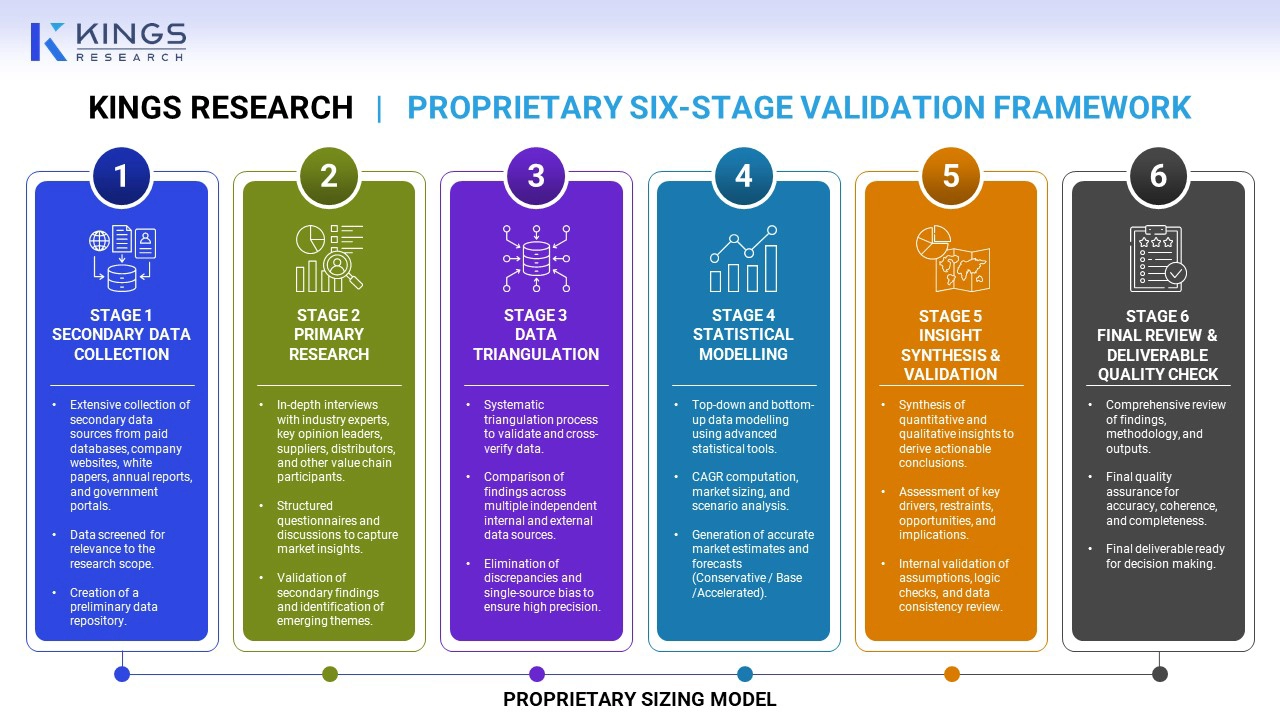
Our methodology triangulates insights from multiple independent and publicly available research databases and is further validated against regulatory filings and public company disclosures. All estimates are cross-verified; no single-source data is presented without validation.
Our custom offerings deliver tailored, data-driven intelligence and strategic guidance to help organizations identify, evaluate, and capitalize on key market opportunities.
Frequently Asked Questions

Over the years, Versha brings over 15 years of experience managing consulting assignments across industries, including Food and Beverage, Consumer Goods, ICT, Aerospace, and more. Her work has spanned diverse sectors. Her cross-domain expertise and adaptability make her a versatile and dependable professional. She is known for her keen business insight and foresight. With sharp analytical skills and a curious mindset, Versha excels at transforming complex data into actionable insights. She has a proven track record of unraveling market dynamics, identifying trends, and delivering tailored solutions to meet client needs. As a skilled leader, Versha has successfully mentored research teams and directed projects with precision, ensuring high-quality outcomes. Her collaborative approach and strategic vision enable her to turn challenges into opportunities and consistently deliver impactful results. Whether analyzing markets, engaging stakeholders, or crafting strategies, Versha draws on her deep expertise and industry knowledge to drive innovation and deliver measurable value.
Habi is a seasoned research and consulting leader with renowned experience in guiding clients on strategic growth and transformation initiatives across global markets. He has led high-performing research teams that deliver actionable insights on market expansion, M&A strategies, opportunity assessment, new business development, and product launches. His project portfolio spans large petrochemical producers, electronic device manufacturers, lubricants companies, and other leading enterprises across diverse industrial and consumer sectors. He currently heads the research department at Kings Research, where he is responsible for setting the research agenda, mentoring analysts, and ensuring client-ready deliverables that support executive decision-making. With extensive experience in market intelligence, strategic research, and consulting, Habi brings a strong understanding of evolving industry dynamics, competitive landscapes, emerging opportunities, and business growth challenges. His expertise includes developing research frameworks, translating complex market data into actionable strategic recommendations, and working closely with senior stakeholders to address critical business questions. He has also contributed to building research capabilities, strengthening analytical methodologies, and driving a culture of quality and insight-led decision-making within research teams. His cross-industry exposure enables him to connect market trends with broader business implications and provide perspectives that help organizations identify opportunities, mitigate risks, and make informed strategic decisions.


