
Inquire Now
Key Strategic Points
The polymer bearing market encompasses the global trade of engineered plastic components designed for mechanical motion. It includes a wide range of configurations like flange, mounted, thrust, and sleeve bearings. The sector spans advanced materials such as PTFE, POM, PEEK, PPS, and Nylon. It caters to industrial, automotive, and textile industries across B2B and B2C platforms.
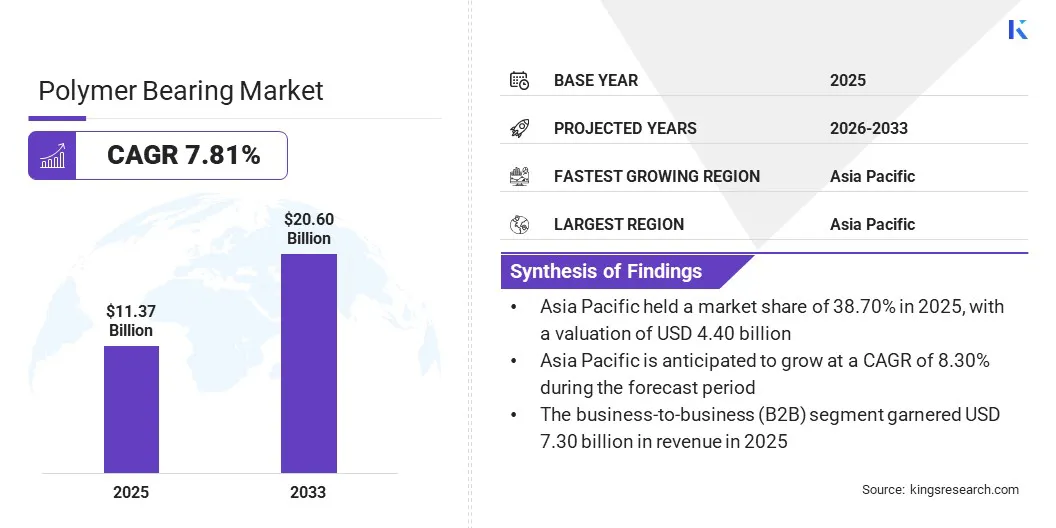
The global polymer bearing market size was valued at USD 11.37 billion in 2025 and is projected to grow from USD 12.17 billion in 2026 to USD 20.60 billion by 2033, exhibiting a CAGR of 7.81% during the forecast period. This growth is mainly driven by the rising demand for low-maintenance and cost-effective bearing solutions across various industries. Advancements in high-temperature-resistant and energy-efficient designs are improving mechanical longevity and reducing energy losses.
Major companies operating in the global polymer bearing industry are PBC Linear, SKF, Kashima Bearings, Saint-Gobain, GGB, igus SE & Co. KG, Trelleborg Group, NSK Ltd., KMS Bearings Inc., Nachi Technology India Private Limited, Schaeffler India Limited, RBC, OILES CORPORATION, The Timken Company, and JTEKT Corporation.
Companies are engineering self-lubricating elastomeric polymer propeller shaft bearings designed specifically for marine vessel propulsion to enhance operational reliability. This innovation assists shipbuilders in replacing traditional oil-lubricated systems with water-lubricated polymer bearing alternatives to prevent environmental contamination.
Utilizing advanced elastomeric compounds in these bearings improves mechanical damping and ensures that the propulsion system remains resilient against underwater debris and harsh saline conditions. It also allows maritime fleets to last longer by minimizing shaft wear and removing the requirement for intricate external sealing and lubrication equipment.
This market is growing because of the increasing demand for durable components that eliminate the need for manual lubrication and frequent technical servicing. This technology helps manufacturers ensure smooth operations by using self-lubricating materials that perform well in highly abrasive or debris-laden conditions. It also helps improve maintenance scheduling and optimize operational budgets by decreasing the need for specialized labor.
Polymer bearings may also reduce long-term hardware costs and provide predictable equipment performance, while improving mechanical reliability. The technology promotes higher operational availability and reduces the overall cost of ownership, and serves as a key driver of modern industrial activity.
The use of polymer bearings in heavy-duty systems has technical constraints in terms of thermal expansion and load deformation, which may be limiting for high-intensity industrial processes. These performance limitations tend to reduce the pace of plastic bearing solution adoption in industries where components made of high-strength steel have long been used.
A solution to this is the integration of advanced composite reinforcements and fiber-matrix structures into the bearing design. This approach enables manufacturers to enhance the structural rigidity and thermal stability of the component, thereby reducing maintenance requirements and facilitating the transition to grease-free systems in the long run.
It is also common for organizations to utilize precision-engineered hybrids or prioritize specific low-load assemblies first to validate performance before extending use across entire production lines.
The market is witnessing a significant trend toward the development of specialized polymer bearings that facilitate stable performance in extreme thermal environments and improve mechanical efficiency. These bearings utilize advanced engineering plastics, which help them maintain their structure when operating at high speeds. This design reduces frictional heat and energy loss.
This ability helps manufacturers respond quickly to the demands of high-intensity production environments while improving machine longevity and overall productivity. The move toward energy-efficient polymer designs reflects a focus on developing more intelligent and adaptive manufacturing systems that reduce the need for cooling infrastructure and improve operational outcomes.
|
Segmentation |
Details |
|
By Type |
Flange Bearings, Mounted Bearings, Thrust Bearings, Sleeve Bearings, Others |
|
By Material |
Polytetrafluoroethylene (PTFE), Nylon, Polyoxymethylene (POM), Polyethylene (PE), Polyether Ether Ketone (PEEK), Polyphenylene Sulfide (PPS), Others |
|
By Distribution Channel |
Business-to-Business (B2B), Business-to-Consumer (B2C) |
|
By End-Use Industry |
Industrial, Automotive, Food and Beverage, Textile, Others |
|
By Region |
North America: U.S., Canada, Mexico |
|
Europe: France, UK, Spain, Germany, Italy, Russia, Rest of Europe |
|
|
Asia-Pacific: China, Japan, India, Australia, ASEAN, South Korea, Rest of Asia-Pacific |
|
|
Middle East & Africa: Turkey, U.A.E., Saudi Arabia, South Africa, Rest of Middle East & Africa |
|
|
South America: Brazil, Argentina, Rest of South America |
Based on region, the market has been classified into North America, Europe, Asia Pacific, Middle East & Africa, and South America.
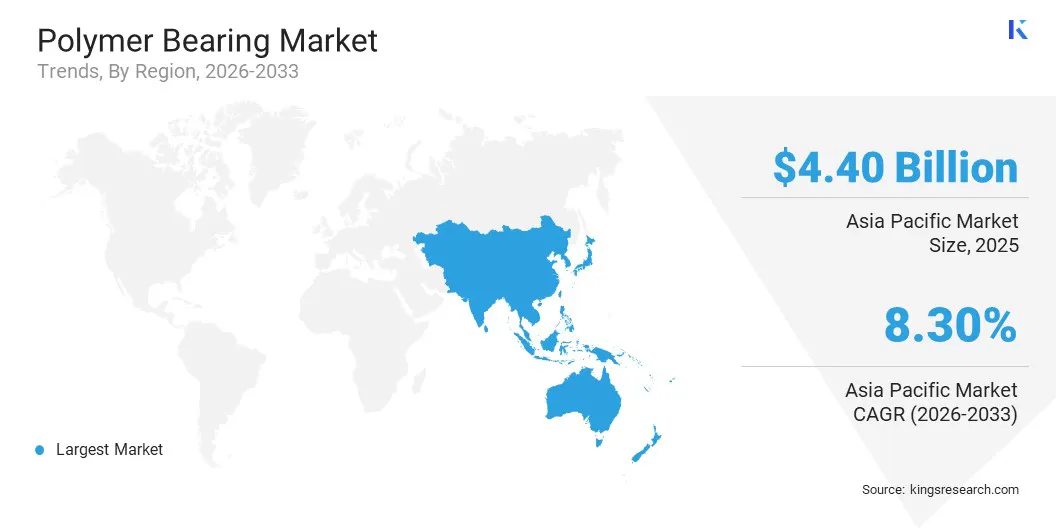
The Asia-Pacific polymer bearing market accounted for a substantial share of 38.70% in 2025, valued at USD 4.40 billion. This dominance is attributed to the large manufacturing base and the booming electric vehicle (EV) industry in China, Japan, and India.
The automobile manufacturing sector is shifting toward lightweight and low-friction products, which has greatly boosted the demand for high-performance polymer rollers. Moreover, the availability of a vast industrial infrastructure in textile and electronics production contributes to the extensive incorporation of cost-efficient and self-lubricating bearing solutions.
The North America polymer bearing market is expected to register the fastest CAGR of 7.96% over the forecast period. This growth is propelled by the early adoption of advanced automation and a strong focus on high-precision engineering in the medical and aerospace industries. Organizations in the U.S. and Canada are moving toward using engineered plastics to substitute traditional metal components in order to lower maintenance costs and enhance operational span.
Additionally, large amounts of investment in specialized manufacturing technologies are hastening the shift toward grease-free and corrosion-resistant bearing systems.
The major players operating in the polymer bearing market are focusing on the creation of high-performance roller technologies that are grease-free. They are also developing high-level self-lubricating composite materials, which do not require external lubricants and oils.
They are concentrating on products that transfer microscopic films of lubricants to mating surfaces to minimize friction and maintenance. This transition helps in cleaner operating conditions and boosts sustainability in the range of industrial applications.
Industry players are also combining specialized fiber reinforcements, as well as solid lubricants, into polymer matrices to enhance load-bearing abilities. These producers are fine-tuning the surface geometries to achieve uniform performance at high speed and high temperature. By focusing on wear-resistant and corrosion-proof solutions, these companies are responding to the increasing demand for durable components in sensitive processing environments.
Frequently Asked Questions

Tejasv specializes in secondary research and data validation, transforming complex information into clear market insights. He supports multi-industry research initiatives by delivering reliable intelligence that informs planning and strategic direction. With a disciplined and detail-focused approach, he emphasizes analytical clarity and practical application. His interest in geopolitics and history informs his broader market perspective. This unique lens allows him to contextualize industry shifts within larger socio-political frameworks, adding depth to his analyses. He maintains rigorous documentation standards, making his findings auditable and easily reproducible. His ability to distill vast amounts of secondary data into concise, decision-ready summaries has earned him the trust of project leads across multiple verticals. Tejasv actively tracks regulatory changes and economic indicators, which he incorporates into his research to enhance its forward-looking relevance. His methodical work ethic, combined with a calm demeanor under tight deadlines, ensures that his contributions remain both timely and impactful.

Ganapathy Subramaniam Suresh
With over a decade of research leadership across global markets, Ganapathy brings sharp judgment, strategic clarity, and deep industry expertise. Known for precision and an unwavering commitment to quality, he guides teams and clients with insights that consistently drive impactful business outcomes.