
Inquire Now
Key strategic points
Polyester fiber is a synthetic textile fiber made from polyethylene terephthalate (PET) that offers durability, strength, and versatility. Polyester fiber is widely used in apparel, home textiles, industrial fabrics, technical textiles, and blended materials with natural or other synthetic fibers. The market encompasses the production, distribution, and sale of polyester fibers for various commercial, industrial, and consumer applications.
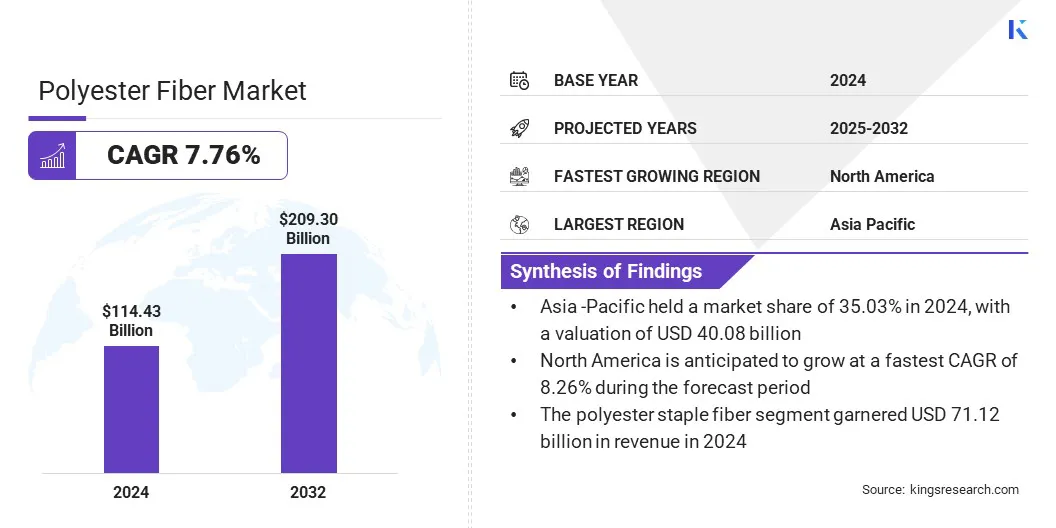
The global polyester fiber market size was valued at USD 114.43 billion in 2024 and is projected to grow from USD 122.92 billion in 2025 to USD 209.30 billion by 2032, exhibiting a CAGR of 7.76% over the forecast period.
This growth is attributed to the increasing demand for durable, low-maintenance, and cost-effective fabrics in apparel and home textiles. The increasing use of polyester fiber in industrial and technical textiles, along with its expanding applications in the automotive sector, is further fueling market growth.
Major companies operating in the polyester fiber market are Reliance Industries Limited, Indorama Ventures, SINOPEC YIZHENG CHEMICAL FIBRE LIMITED LIABILITY COMPANY, TORAY INDUSTRIES, INC, Tongkun Holding Group, Alpek Polyester, TEIJIN FRONTIER CO., LTD, Xin Feng Ming Group, Bombay Dyeing & Manufacturing Company Ltd, NAN YA PLASTICS CORPORATION, Hengli Group Co., Ltd, Aditya Birla Group, Huvis Corp, Far Eastern Group, and UNIFI, Inc.
The growing focus on sustainable polyester production is driving the market by increasing the availability of recycled fibers and promoting circular manufacturing. Additionally, the development of recycled polyester fibers is advancing sustainable manufacturing by converting post-consumer waste into high-quality fibers. It is also enhancing resource efficiency and encouraging broader adoption of eco-friendly polyester fibers across apparel, home textiles, and industrial applications.
Increasing Demand for Sustainable and Eco-friendly Products
The growth of the polyester fiber market is propelled by the increasing demand for sustainable and eco-friendly products. Recycled, renewable, and bio-based polyester fibers offer reduced environmental impact while maintaining durability and versatility.
The emphasis on circularity and environmental responsibility is prompting manufacturers to adopt sustainable production processes and develop eco-friendly fiber solutions. This is enabling brands to meet consumer demand and regulatory requirements for greener textile products across apparel, home furnishings, and industrial applications such as automotive textiles, filtration materials, industrial ropes and nets, geotextiles, and protective fabrics.
Fluctuating raw material prices
A key challenge in the polyester fiber market is the fluctuating cost of raw materials. Polyester production relies heavily on petroleum-derived inputs such as purified terephthalic acid (PTA) and monoethylene glycol (MEG). Volatility in global crude oil prices directly impacts the availability and pricing of these inputs. This instability increases production costs and hampers supply chain planning for manufacturers.
To address this challenge, market players are investing in backward integration in PTA and MEG production internalizing the supply of these critical feedstocks to ensure continuity and reduce reliance on external suppliers Players are also focusing on recycled polyester production to reduce dependence on petroleum-based raw materials and meet sustainability requirements.
Development of Recycled and Eco-Friendly Polyester Fibers
A key trend influencing the polyester fiber market is the growing development of recycled and eco-friendly fibers. Manufacturers are producing polyester fibers from post-consumer plastic waste, discarded textiles, and bio-based inputs to reduce environmental impact and promote circularity.
These fibers maintain durability, softness, and performance comparable to virgin polyester while meeting sustainability goals. This trend supports the adoption of sustainable polyester solutions across apparel, home textiles, and industrial applications, enabling brands to offer eco-friendly products and improve the sustainability of their supply chains.
|
Segmentation |
Details |
|
By Type |
Polyester Staple Fiber, Polyester Filament Yarn |
|
By Form |
Solid, Hollow |
|
By Grade |
PET Polyester, PCDT Polyester |
|
By Application |
Textile & Apparel, Home Furnishing, Automotive, Industrial, Others |
|
By Region |
North America: U.S., Canada, Mexico |
|
Europe: France, UK, Spain, Germany, Italy, Russia, Rest of Europe |
|
|
Asia-Pacific: China, Japan, India, Australia, ASEAN, South Korea, Rest of Asia-Pacific |
|
|
Middle East & Africa: Turkey, U.A.E., Saudi Arabia, South Africa, Rest of Middle East & Africa |
|
|
South America: Brazil, Argentina, Rest of South America |
Based on region, the market has been classified into North America, Europe, Asia Pacific, Middle East & Africa, and South America.
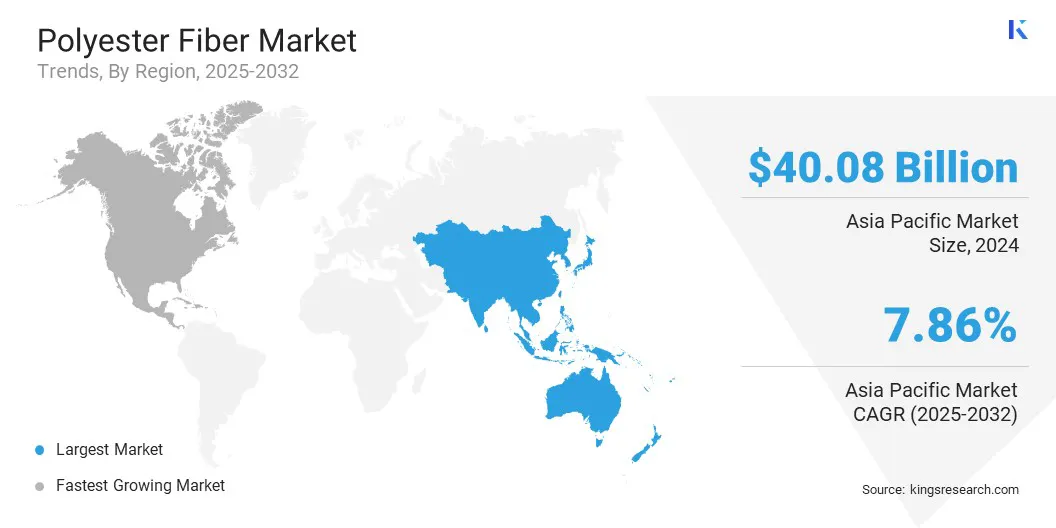
Asia Pacific polyester fiber market share stood at 35.03% in 2024, valued at USD 40.08 billion. This dominance is driven by the rapid expansion of the textile and apparel manufacturing industry across the region.
Increasing investment by regional players in recycled polyester and sustainable fiber manufacturing is enhancing production capacity and supporting the adoption of eco-friendly polyester solutions. Additionally, increasing adoption of polyester in technical textiles, including automotive and construction, is further fueling market growth across the region.
North America is poised for significant growth at a CAGR of 8.26% over the forecast period. This growth is driven by the increasing demand for durable, cost-effective, and low-maintenance fabrics in apparel and home textiles in the region. The rising popularity of blended fabrics that combine polyester with cotton, wool, or other fibers to enhance fabric performance and versatility is supporting market expansion.
Growing application of polyester in industrial and technical textiles, due to its strength, chemical resistance, and durability, further fuels market growth. Additionally, technological advancements by regional players in recycled, biodegradable, and high-performance polyester fibers are improving product quality and sustainability, thereby driving broader adoption of polyester fibers across the region.
Major players in the polyester fiber industry are actively expanding production capacities to meet the growing demand for polyester fibers across apparel, home textiles, and industrial applications. They are investing in technological advancements to develop high-performance and sustainable fibers, including recycled and biodegradable options.
Additionally, players are focusing on strategic partnerships and collaborations to scale circular polyester fiber production, strengthen supply chains, and increase the availability of high-quality and sustainable fibers.
Frequently Asked Questions

Swati is a committed research analyst with a passion for optimizing systems and processes across industries, specializing in healthcare but also bringing valuable expertise to sectors such as consumer goods, life sciences, and more. Her cross-domain research approach allows her to generate clear, actionable reports that inform strategic decisions in a variety of fields. Swati is committed to staying ahead of evolving trends, leveraging her broad understanding of different sectors to provide insights that are relevant to a range of industries. In her personal time, she enjoys music and spending quality time with her family, which inspires her creativity and enriches her professional approach. Her systematic methodology ensures that every report is both thorough and practical. Swati's ability to bridge regulatory frameworks with market realities gives her recommendations a distinct edge. She collaborates seamlessly with cross-functional teams, distilling complex data into straightforward narratives. Her proactive monitoring of policy and technological shifts keeps her analysis forward-looking.

With over a decade of research leadership across global markets, Ganapathy brings sharp judgment, strategic clarity, and deep industry expertise. Known for precision and an unwavering commitment to quality, he guides teams and clients with insights that consistently drive impactful business outcomes.