
Inquire Now
Key Strategic Points
The photonics market includes the design, development, manufacturing, and marketing of products and technologies that use photons (light) for various applications. It comprises products such as lasers, optical fibers, light-emitting diodes (LEDs), photodetectors, and imaging systems, as well as materials and integrated systems for generating, controlling, and detecting light. Photonics technologies are critical to industries such as telecommunications, healthcare, manufacturing, defense, and consumer electronics markets, where they support data communications, imaging, lighting, and sensing applications.
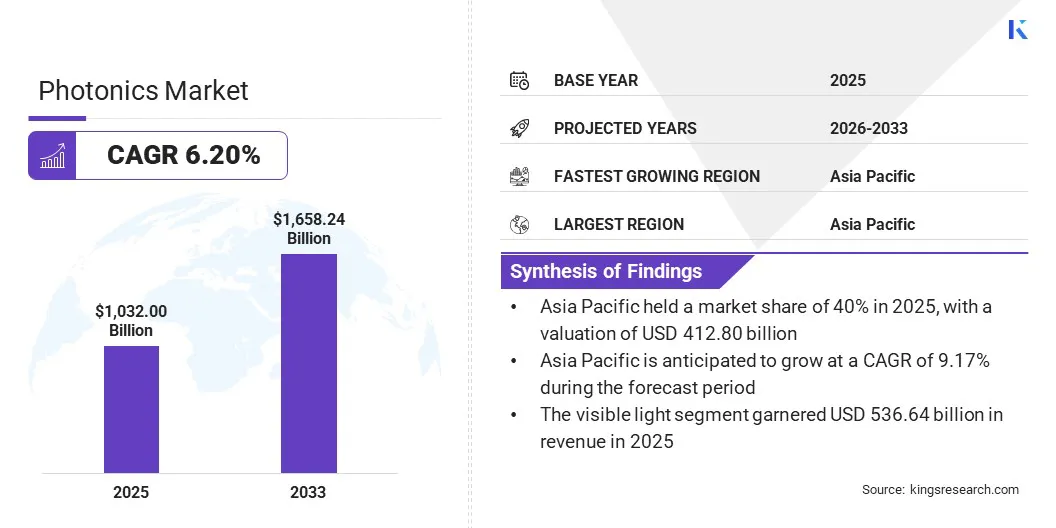
The global photonics market size was valued at USD 1,032 billion in 2025 and is projected to grow from USD 1,088.47 billion in 2026 to USD 1,658.24 billion by 2033, exhibiting a CAGR of 6.20% over the projection period. This growth is attributed to the increasing demand for high-speed data communication, growing applications in the healthcare sector, and rising adoption of photonics technologies in the telecommunications, manufacturing, and defense sectors.
Major companies operating in the global market are Broadcom, Canon Inc., Corning Incorporated, Coherent Corp, Nikon Corporation, TRUMPF, Hamamatsu Photonics K.K., IPG Photonics Corporation, Lumentum Operations LLC, ams-OSRAM AG, Intel Corporation, Cisco Systems, Inc., Marvell, GlobalFoundries, and STMicroelectronics.
Advancements in integrated photonics and quantum technologies are further fostering innovation and market expansion. As industries focus on finding smarter, more precise, and sustainable ways to operate, photonics is likely to become a key part of how digital infrastructure and new technologies develop around the world.
Rapid growth in internet usage, cloud computing, and the increasing number of connected devices has led a strong demand for high-speed data transmission. As businesses and consumers require faster and more reliable communication, photonic technologies such as optical fibers, transceivers, and multiplexers have become essential for supporting high-bandwidth data transfer across long distances with minimal signal loss.
The need for high-speed networks continues to grow as data centers, streaming services, and a wide range of connected devices become more common and essential. Consequently, investments in photonic infrastructure are accelerating, enabling advancements in the telecommunications and information technology sectors.
Complex manufacturing and integration present a significant challenge to the development of the photonics market. Manufacturing photonic components like lasers, optical fibers, and integrated circuits demands specific materials, specialized production technologies, and stringent process control. The integration of these components into a wide range of systems, including telecommunications, medical devices, and consumer electronics, can require addressing complex compatibility and performance requirements. Furthermore, the miniaturization and increasing functionality of photonic devices add additional layers of complexity to design and assembly.
To overcome these challenges, companies are investing in automation, advanced manufacturing technologies, and industry collaborations. Adopting standardization and forming alliances throughout the supply chain can also facilitate integration and drive innovation in the photonics sector.
Advancements in quantum photonics are emerging as a significant trend, reshaping the landscape of the photonics industry. Quantum photonics uses the principles of quantum mechanics to control light at the level of individual photons. This approach is leading to new possibilities in quantum computing, secure communication, and highly sensitive sensing technologies. Recent progress in developing integrated quantum photonic circuits and scalable quantum networks is attracting increased interest and investment from businesses in this field.
These advances are set to improve data security by introducing quantum encryption and expand computing capabilities beyond what is possible with conventional technologies. As research and collaboration in quantum photonics increase, the transition of these technologies into practical applications is expected to open up new possibilities and support ongoing progress in the market.
|
Segmentation |
Details |
|
By Product Type |
Photo Detectors, LEDs (Lighting + Display), Lasers, Optical Modulators, Optical Interconnects, Waveguides, WDM Filters, Amplifiers, and Others |
|
By Wavelength |
Visible Light, Infrared, Ultraviolet, and Terahertz |
|
By Application |
Display (LCD, OLED, micro-LED), Information & Communication Technology (ICT), Lighting, Production Technology (Industrial / Manufacturing), Medical & Life Sciences, Measurement & Automated Vision, Photovoltaics, and Others (Defense, AR/VR, etc.) |
|
By End-Use Industry |
Consumer Electronics, Telecom & IT, Industrial Manufacturing, Healthcare, Defense & Aerospace, Automotive (LiDAR, ADAS), and Others |
|
By Region |
North America: U.S., Canada, Mexico |
|
Europe: France, UK, Spain, Germany, Italy, Russia, Rest of Europe |
|
|
Asia-Pacific: China, Japan, India, Australia, ASEAN, South Korea, Rest of Asia-Pacific |
|
|
Middle East & Africa: Turkey, U.A.E., Saudi Arabia, South Africa, Rest of Middle East & Africa |
|
|
South America: Brazil, Argentina, Rest of South America |
Based on region, the global photonics market has been classified into North America, Europe, Asia Pacific, Middle East & Africa, and South America.
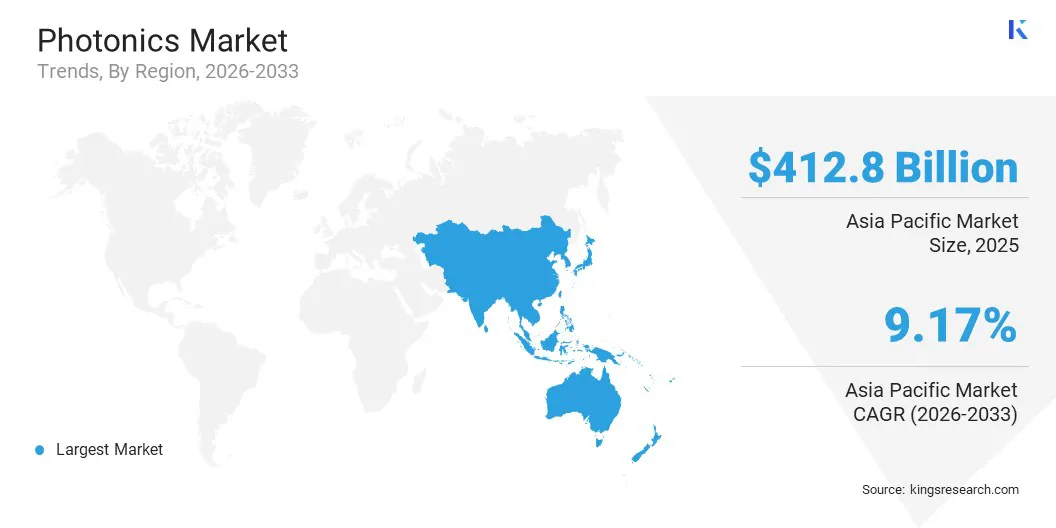
Asia Pacific photonics market share stood at 40% in 2025, with a valuation of USD 412.80 billion. This notable growth is driven by rapid industrialization, infrastructure development, and a strong presence of electronics and semiconductor companies. Ongoing improvements in telecommunications, the rollout of new display technologies, and increased investment in renewable energy are leading to the strong demand for photonic products.
Supportive incentive policies for innovation and high-tech industry development are also aiding segmental market growth. Additionally, a strong talent base and increasing research and development efforts are ensuring ongoing innovation, supporting regional market expansion.
The Middle East & Africa photonics market is set to grow at a CAGR of 7.33% over the forecast period. This growth is propelled by increasing investments in infrastructure development, the rising adoption of advanced communication technologies, and expanding applications of photonics in sectors such as oil and gas, healthcare, and security. Fiber optic networks and modern imaging technologies are increasingly being used across the region, supporting the rollout of smart city projects and new digital services.
Furthermore, the deployment of modern healthcare technologies and the adoption of photonics in industrial automation are aiding regional market growth. As more industries in the region adopt new technologies and innovative ways of working, the photonics market in the Middle East & Africa is likely to witness strong growth and greater diversification in its applications.
Competitive Landscape
The photonics market is highly competitive, with the presence of both established companies and startups. Established firms usually rely on their broad product offerings, cutting-edge R&D resources, and robust distribution networks to maintain their market share. At the same time, smaller companies and startups are leading the way in innovation, especially in emerging areas such as integrated photonics and quantum technologies.
The market is competitive in terms of technology, quality, reliability, and customer support. As the industry continues to grow rapidly, companies are teaming up, merging, and increasing their investment in research to stay competitive. These efforts enable them to expand their offering and strengthen their market standing.
Frequently Asked Questions

Aswathi holds cross-domain expertise, translating market trends and competitive intelligence into decision-ready insights. Her work helps clients interpret evolving market conditions and identify growth opportunities. She brings a focused, insight-led approach to research execution. She translates these findings into clear, prioritized action plans that align with client capabilities. Her research often includes scenario modeling to test growth strategies under varying economic conditions. She maintains a rigorous validation process, cross-checking primary and secondary sources to ensure reliability. Clients value her ability to synthesize noisy data into concise executive summaries that drive board-level discussions. Her sector-specific lens, combined with a pragmatic focus on execution, consistently delivers high-impact, commercially sound recommendations. Her structured yet flexible research frameworks adapt to client timelines without compromising depth. She is known for distilling complex trade-offs into straightforward, defensible positions that facilitate confident decision-making.

Ganapathy Subramaniam Suresh
With over a decade of research leadership across global markets, Ganapathy brings sharp judgment, strategic clarity, and deep industry expertise. Known for precision and an unwavering commitment to quality, he guides teams and clients with insights that consistently drive impactful business outcomes.