
Inquire Now
Key Strategic Points
Outboard engines are compact propulsion systems that combine the engine, gearbox, and propeller into a single external unit mounted on the boat’s transom. They enable precise navigation and simplified maintenance across various marine environments.
The market covers engines powered by gasoline, diesel, and electric fuels across 2-stroke, 4-stroke, and electric configurations. These systems are widely used in recreational, commercial, and military vessels to ensure efficient power delivery and dependable performance.
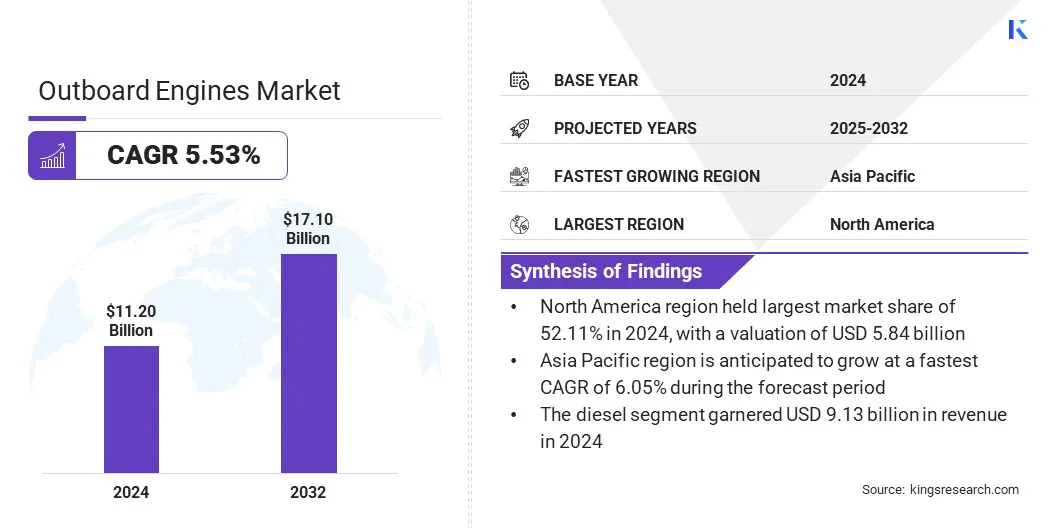
The global outboard engines market size was valued at USD 11.20 billion in 2024 and is projected to grow from USD 11.74 billion in 2025 to USD 17.10 billion by 2032, exhibiting a CAGR of 5.53% during the forecast period.
This growth is fuelled by the rising popularity of recreational boating and water sports, which has increased demand for efficient and dependable propulsion systems. Additionally, the market is witnessing a notable shift toward sustainable and low-emission marine solutions, with a growing focus on electric and hybrid engines.
Major companies operating in the outboard engines market are Yamaha Motor Co., Ltd., Mercury Marine (Brunswick Corporation), Suzuki Motor Corporation, Honda India Power Products Ltd., Tohatsu Corporation, Suzhou Parsun Power Machine Co., Ltd., Hidea outboard motors, Selva S.p.A., OXE Marine, Torqeedo GmbH, ePropulsion, LEHR LLC, Zhejiang Anqidi Power Machinery Co.,Ltd., Hangzhou Seatan, and Hangkai.
Companies are developing high-horsepower premium outboard engines with improved fuel efficiency, higher torque, and integrated electronic control systems. These innovations aim to meet the growing demand for powerful and reliable marine propulsion systems in recreational and commercial sectors.
Manufacturers are also adding hybrid and electric options to offer low-emission options without compromising performance, supporting broader adoption of premium outboard engines across diverse applications.
Rising popularity of recreational boating and water sports activities is leading to increased participation in leisure and adventure experiences. This is creating a strong demand for boats equipped with reliable and efficient outboard engines.
Regions with expanding tourism and rising disposable income are witnessing greater adoption of recreational vessels. Manufacturers are responding by providing engines with enhanced performance, ease of use, and durability, which is actively contributing to the growth of the market.
High upfront costs for advanced 4-stroke and electric outboard engines significantly restrict their adoption, particularly among small recreational users and emerging commercial operators. These buyers often operate with limited budgets, making it difficult to justify the higher initial investment despite the long-term efficiency benefits. .
To address this challenge, manufacturers are introducing flexible financing options, leasing models, and bundled service packages to reduce the immediate financial burden on buyers. Furthermore, companies are improving production efficiency and leveraging technological innovations to reduce manufacturing costs and enhance price competitiveness.
The outboard engines market is witnessing a notable trend toward the widespread adoption of electric propulsion systems, as manufacturers and operators prioritize sustainable, low-emission marine solutions. Rising environmental concerns and regulatory pressure are accelerating the transition from conventional diesel and gasoline engines to electric alternatives.
Electric propulsion systems are gaining traction due to improvements in battery capacity, motor performance, and overall system integration, which enhance reliability and operational efficiency. This shift highlights the rising focus on clean, efficient, and technologically advanced marine propulsion solutions.
|
Segmentation |
Details |
|
By Engine Type |
4 Stroke, 2 Stroke, Electric |
|
By Fuel Type |
Diesel, Electric, Gasoline |
|
By Application |
Commercial, Recreational, Military |
|
By Region |
North America: U.S., Canada, Mexico |
|
Europe: France, UK, Spain, Germany, Italy, Russia, Rest of Europe |
|
|
Asia-Pacific: China, Japan, India, Australia, ASEAN, South Korea, Rest of Asia-Pacific |
|
|
Middle East & Africa: Turkey, U.A.E., Saudi Arabia, South Africa, Rest of Middle East & Africa |
|
|
South America: Brazil, Argentina, Rest of South America |
North America outboard engines market share stood at 52.11% in 2024, valued at USD 5.84 billion. This dominance is reinforced by a well-established recreational boating sector and strong consumer spending on marine activities. Ongoing collaborations among major companies to develop advanced engines and enhance overall boating experience are further boosting demand. Continued innovation and emphasis on user experience are expected to support regional market growth.
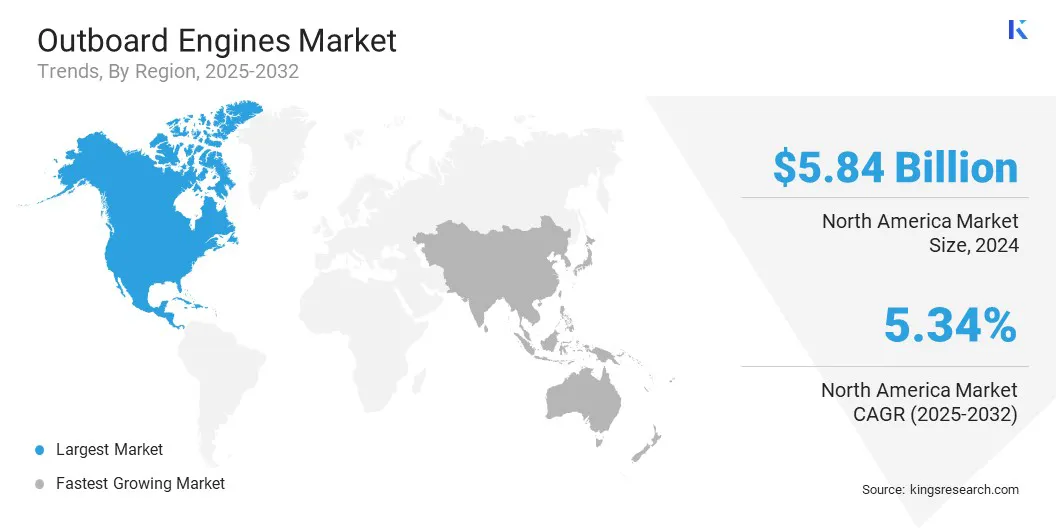
The Asia-Pacific outboard engines industry is poised to grow at a significant CAGR of 6.05% over the forecast period. This growth is propelled by rising commercial marine operations, including fishing, transport, and logistics, along with increasing recreational boating in emerging economies such as India, Indonesia, and Thailand.
Expanding coastal infrastructure and favourable government support for maritime development are further generating a strong demand for reliable outboard engines. This expansion is expected to accelerate adoption and position Asia Pacific as the fastest-growing market globally.
Key players operating in the outboard engines industry are enhancing their competitive positions through technological innovation and product development. They are incorporating high-performance engine configurations, including V6 models, to deliver higher torque and improved operational efficiency across diverse marine applications.
Companies are advancing fuel injection systems, optimizing engine weight, and refining electronic control units to boost performance and reliability. They are also developing hybrid and electric powertrains, implementing smart engine management systems, and upgrading connectivity features to meet evolving performance standards and regulatory requirements to maintain competitiveness.
Frequently Asked Questions

Swati is a committed research analyst with a passion for optimizing systems and processes across industries, specializing in healthcare but also bringing valuable expertise to sectors such as consumer goods, life sciences, and more. Her cross-domain research approach allows her to generate clear, actionable reports that inform strategic decisions in a variety of fields. Swati is committed to staying ahead of evolving trends, leveraging her broad understanding of different sectors to provide insights that are relevant to a range of industries. In her personal time, she enjoys music and spending quality time with her family, which inspires her creativity and enriches her professional approach. Her systematic methodology ensures that every report is both thorough and practical. Swati's ability to bridge regulatory frameworks with market realities gives her recommendations a distinct edge. She collaborates seamlessly with cross-functional teams, distilling complex data into straightforward narratives. Her proactive monitoring of policy and technological shifts keeps her analysis forward-looking.

With over a decade of research leadership across global markets, Ganapathy brings sharp judgment, strategic clarity, and deep industry expertise. Known for precision and an unwavering commitment to quality, he guides teams and clients with insights that consistently drive impactful business outcomes.