
Inquire Now
Key Strategic Points
A battery management system (BMS) is an integrated electronic solution that monitors, controls, and protects rechargeable batteries to ensure safety, performance, and longevitiy. The market encompasses a wide range of hardware and software solutions designed for diverse battery chemistries, including lithium-ion and lead-acid.
It includes both standalone and embedded systems used in electric vehicles, stationary energy storage, industrial machinery, and portable devices. Key functionalities include voltage and temperature regulation, state-of-charge estimation, fault detection, and cell balancing for efficient and reliable battery operation.
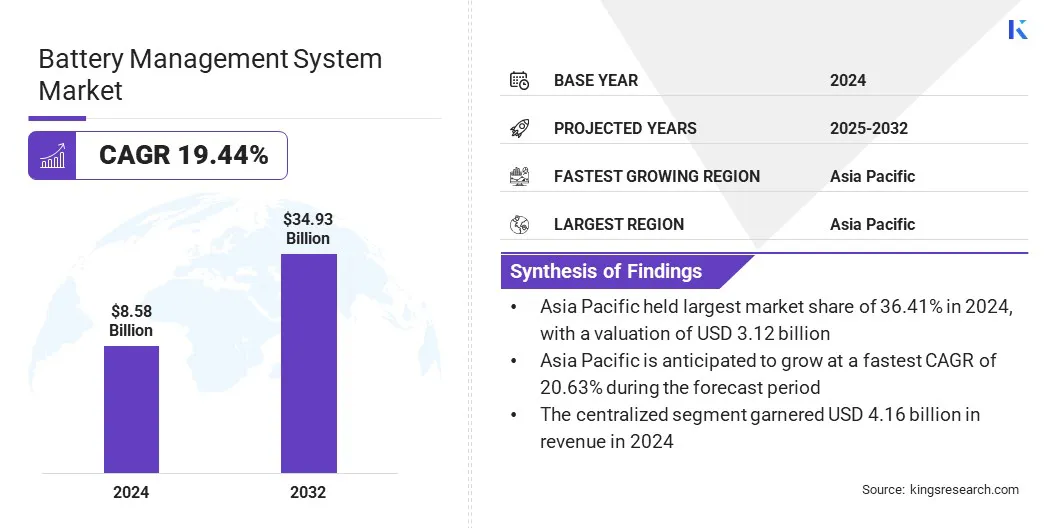
The global battery management system market size was valued at USD 8.58 billion in 2024 and is projected to grow from USD 10.07 billion in 2025 to USD 34.93 billion by 2032, exhibiting a CAGR of 19.44% during the forecast period.
The market is experiencing strong growth, driven by the global shift toward electric mobility and the rapid deployment of renewable energy storage systems. The rising production of electric vehicles (EVs), supported by government incentives and emissions regulations, is significantly boosting demand for advanced BMS solutions.
Major companies operating in the market are Contemporary Amperex Technology Co., Limited, Sensata Technologies, Inc., Analog Devices, Inc., Texas Instruments Incorporated, NXP Semiconductors, Infineon Technologies AG, Continental Engineering Services, Renesas Electronics Corporation, LG Energy Solution, Panasonic Holdings Corporation, SAMSUNG, Nuvation Energy, Gridstor, Eberspächer, and STARTEC ENERGY.
The growing integration of grid-scale energy storage, supported by the rising share of solar and wind power in electricity generation, is increasing the need for battery management systems to regulate variable energy inputs and maintain grid stability.
Large-scale energy storage system (ESS) installations require robust battery management systems to ensure precise control over charge-discharge cycles, monitor system performance in real time, and maintain safety standards. As utility providers increasingly adopt grid-scale ESS, demand for advanced BMS platforms is rising.
Global Expansion of EV Manufacturing Infrastructure
The battery management system market is witnessing significant growth, primarily attributable to the rapid expansion of EV and battery manufacturing infrastructure on a global scale. The ongoing efforts by leading automotive manufacturers to scale up EV production have necessitated the development of integrated battery facilities, thereby increasing the demand for advanced BMS solutions.
These systems are critical for maintaining battery safety, ensuring operational efficiency, and enabling optimal performance through real-time monitoring and control functionalities. Furthermore, the localization of battery production and the integration of automation and data-driven technologies within manufacturing processes are reinforcing the requirement for intelligent BMS architectures.
This large-scale production of EV is boosting demand for robust, scalable battery management systems to ensure safety, performance optimization, and compliance with energy efficiency standards.
Integration With Diverse Energy Storage Applications
A key challenge hampering the development of the battery management system market is integrating BMS solutions with a wide range of energy storage systems used in industrial, grid-scale, and renewable energy applications.
These systems often vary in voltage, capacity, and environmental operating conditions, requiring highly adaptable and reliable BMS architectures. Additionally, ensuring real-time monitoring and fault-tolerant communication in remote or harsh environments remains a technical barrier.
To address this challenge, companies are developing platform-agnostic and highly modular BMS solutions that can be tailored for multiple ESS configurations. Edge computing-based BMS, which enables real-time analytics and decision-making at the battery site, is gaining traction. Moreover, cloud-integrated BMS platforms are being adopted for centralized monitoring and predictive maintenance across distributed storage assets, enhancing operational continuity and scalability in non-automotive applications.
These advancements are collectively enabling broader adoption of BMS technologies, ensuring reliable performance, improved asset management, and long-term system resilience across diverse energy storage applications.
Emergence of Wireless Battery Management Solutions
The battery management system market is witnessing a notable shift toward the increasing adoption of wireless battery management systems (wBMS) in electric vehicles. This trend is supported by the growing demand for more compact, energy-efficient, and cost-effective battery architectures, particularly in the high-volume EV manufacturing landscape.
By eliminating the need for extensive wiring harnesses, wireless BMS solutions reduce vehicle weight, simplify assembly, enhance energy density, and offer the flexibility needed to accelerate design cycles and streamline maintenance processes.
The introduction of advanced wireless communication technologies by leading semiconductor firms is accelerating the transition from traditional wired systems to wireless platforms in battery management systems (BMS). Consequently, wireless BMS (wBMS) is becoming a key component in the development of next-generation electric mobility solutions.
|
Segmentation |
Details |
|
By Battery Type |
Lithium-ion based, Lead-acid based, Nickel-based, Others |
|
By Topology |
Centralized, Modular, Distributed |
|
By End-user Industry |
Automotive, Renewable Energy, Consumer Electronics, Telecommunications, Aerospace & Defense, Others |
|
By Region |
North America: U.S., Canada, Mexico |
|
Europe: France, UK, Spain, Germany, Italy, Russia, Rest of Europe |
|
|
Asia-Pacific: China, Japan, India, Australia, ASEAN, South Korea, Rest of Asia-Pacific |
|
|
Middle East & Africa: Turkey, U.A.E., Saudi Arabia, South Africa, Rest of Middle East & Africa |
|
|
South America: Brazil, Argentina, Rest of South America |
Based on region, the market has been classified into North America, Europe, Asia Pacific, Middle East & Africa, and South America.
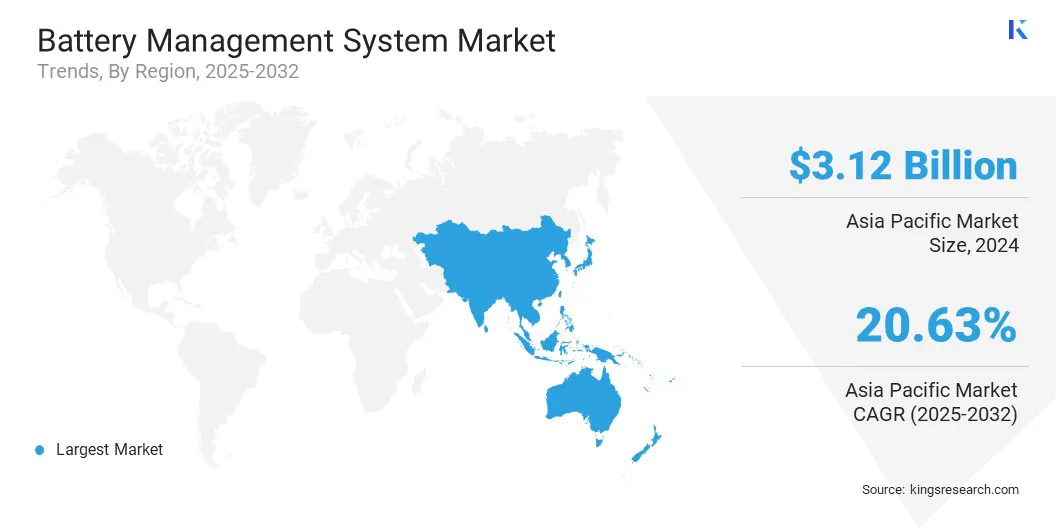
The Asia-Pacific battery management system market accounted for a substantial share of 36.41% in 2024, valued at USD 3.12 billion. The region’s dominance is reinforced by strong demand for electric vehicles, growing deployment of energy storage systems, and expanding industrial applications of lithium-ion batteries.
The rapid electrification of public transport fleets, including buses and last-mile delivery vehicles, is creating sustained demand for reliable battery systems equipped with intelligent management platforms that ensure safety, efficiency, and longer operational life.
Additionally, the increasing use of stationary storage solutions to support grid stability and renewable energy integration is highlighting the need for BMS technologies capable of managing high-capacity battery installations.
The shift toward digitalized energy infrastructure and the growing need for real-time diagnostics, fault detection, and predictive maintenance are accelerating the adoption of advanced BMS solutions across both mobile and stationary applications.
The North America battery management system industry is expected to register the fastest CAGR of 18.57% over the forecast period. A key factor contributing to this growth is the expansion of domestic manufacturing facilities dedicated to battery components, including battery management systems. Companies are increasingly localizing the production of battery modules, enclosures, thermal systems, and BMS hardware.
This shift toward regional manufacturing reduces dependence on global supply chains, lowers lead times, and ensures better integration of BMS solutions into energy storage systems tailored for the regional grid.
Additionally, localized production supports greater customization for specific utility and automotive applications and enhances responsiveness to market needs, positioning North America as a key hub for the development and deployment of high-performance, application-specific BMS technologies.
The battery management system industry is characterized by key players undertaking strategic initiatives to reinforce their market position and advance technological capabilities. Leading manufacturers are actively collaborating with automotive original equipment manufacturers (OEMs) to co-develop customized BMS solutions that align with the evolving requirements of electric vehicle architectures.
These partnerships facilitate long-term supply agreements, accelerate system integration, and strengthen market presence. Additionally, companies are engaging in targeted acquisitions to access advanced software for battery analytics, diagnostics, and monitoring, thereby enhancing their competitive edge.
These strategies are fostering innovation and expanding the adoption of BMS technologies across high-growth application areas.
Frequently Asked Questions

Over the years, Versha brings over 15 years of experience managing consulting assignments across industries, including Food and Beverage, Consumer Goods, ICT, Aerospace, and more. Her work has spanned diverse sectors. Her cross-domain expertise and adaptability make her a versatile and dependable professional. She is known for her keen business insight and foresight. With sharp analytical skills and a curious mindset, Versha excels at transforming complex data into actionable insights. She has a proven track record of unraveling market dynamics, identifying trends, and delivering tailored solutions to meet client needs. As a skilled leader, Versha has successfully mentored research teams and directed projects with precision, ensuring high-quality outcomes. Her collaborative approach and strategic vision enable her to turn challenges into opportunities and consistently deliver impactful results. Whether analyzing markets, engaging stakeholders, or crafting strategies, Versha draws on her deep expertise and industry knowledge to drive innovation and deliver measurable value.

Ganapathy Subramaniam Suresh
With over a decade of research leadership across global markets, Ganapathy brings sharp judgment, strategic clarity, and deep industry expertise. Known for precision and an unwavering commitment to quality, he guides teams and clients with insights that consistently drive impactful business outcomes.



.webp&w=128&q=75&dpl=dpl_DPva2LrvfsBdTJm1XZj67UTrvMHL)