
Inquire Now
Key Strategic Points
Military vetronics comprises integrated electronic systems designed to enhance the performance, safety, and situational awareness of military vehicles. It includes sensors, communication modules, control units, and display technologies that support operational efficiency and mission effectiveness.
Applications cover real-time battlefield data sharing, command and control, navigation, and surveillance, ensuring coordinated operations and strategic advantage. Defense forces deploy these systems across armored vehicles, tanks, combat support vehicles, and unmanned ground vehicles to improve combat readiness, vehicle functionality, and crew protection.
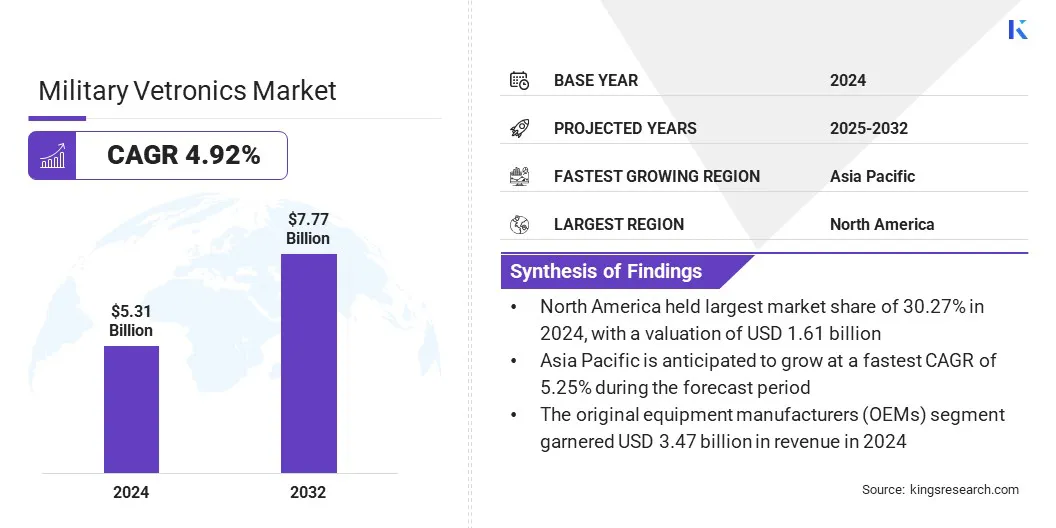
The global military vetronics market size was valued at USD 5.32 billion in 2024 and is projected to grow from USD 5.55 billion in 2025 to USD 7.77 billion by 2032, exhibiting a CAGR of 4.92% over the forecast period.
This growth is attributed to the rising demand for advanced electronic systems to enhance situational awareness, vehicle performance, and crew safety in military operations. Expanding adoption of integrated sensors, communication modules, and control units is enabling real-time data sharing, command and control, and battlefield management, thereby driving market expansion.
Major companies operating in the military vetronics market are Boeing, Lockheed Martin Corporation, General Dynamics Corporation, Elbit Systems Ltd., Rheinmetall AG, Saab, BAE Systems, Curtiss-Wright, Safran SA, Thales, Oshkosh Defense, LLC, TE Connectivity, Collins Aerospace, Northrop Grumman, and RTX.
The increasing focus of defense agencies on modernization, operational efficiency, and strategic readiness is driving the integration of military vetronics into armored vehicles, tanks, combat support vehicles, and unmanned ground vehicles. Additionally, ongoing technological advancements by solution providers, along with defense procurement initiatives and modernization programs, are accelerating market growth.
Rising Global Defense Expenditure
The growth of the military vetronics market is fueled by rising global defense expenditure and governments’ focus on modernizing armed forces. These systems integrate advanced sensors, communication modules, navigation tools, and control units to enhance vehicle performance, situational awareness, and crew safety.
Defense agencies are increasingly deploying these solutions to improve operational efficiency, battlefield management, and mission effectiveness. According to the United Nations, global military spending reached a record high in 2024, with expenditures exceeding USD 2.7 trillion. This increase underscores the growing emphasis on defense capabilities worldwide.
Complex System Integration
Complex system integration creates a significant barrier to the growth of the military vetronics market. Modern combat vehicles require seamless coordination of sensors, communication units, navigation modules, and control systems, which are developed by different suppliers and based on varying technical standards.
Integrating these subsystems requires custom engineering, rigorous testing, and specialized expertise, which extend development timelines and increase overall costs.
Older military vehicles that lack built-in support for modern electronics present further challenges, as retrofitting advanced electronics into older platforms requires major modifications. The shortage of skilled engineers and technicians capable of managing complex integration further complicates large-scale deployment.
To address these challenges, defense agencies and contractors are increasingly adopting standardized architectures, modular designs, and advanced simulation tools. These approaches aim to improve compatibility, reduce integration risks, and accelerate the deployment of advanced vetronics solutions across diverse vehicle fleets.
Adoption of Modular and Open Systems Architectures
The military vetronics market is experiencing a strong shift toward modular and open systems architecture, driven by the need for flexible, interoperable, and upgradeable electronic systems.
This approach allows seamless integration of sensors, communication modules, navigation tools, and control units, reducing compatibility challenges and supporting faster technology updates. These architectures are particularly valuable for defense agencies managing diverse vehicle fleets, where modernization and lifecycle extension are critical.
Organizations are increasingly implementing modular designs to simplify upgrades, enhance system interoperability, and accelerate deployment of advanced capabilities. Standardized and open architectures reduce development complexity, lower costs, and enable rapid incorporation of emerging technologies.
|
Segmentation |
Details |
|
By System |
Communication & Navigation Systems, Command, Control, Communications, and Computers (C4) Systems, Weapon Control Systems, Power & Control Systems, Display & Interface Systems, Vehicle Protection Systems, and Others |
|
By Platform |
Main Battle Tanks (MBTs), Light Armored Vehicles (LAVs), Infantry Fighting Vehicles (IFVs), Armored Personnel Carriers (APCs), Mine-Resistant Ambush Protected (MRAP) Vehicles, Unmanned Ground Vehicles (UGVs), Amphibious Vehicles, Logistics & Support Vehicles, and Others |
|
By End User |
Original Equipment Manufacturers (OEMs), and Aftermarket |
|
By Region |
North America: U.S., Canada, Mexico |
|
Europe: France, UK, Spain, Germany, Italy, Russia, Rest of Europe |
|
|
Asia-Pacific: China, Japan, India, Australia, ASEAN, South Korea, Rest of Asia-Pacific |
|
|
Middle East & Africa: Turkey, U.A.E., Saudi Arabia, South Africa, Rest of Middle East & Africa |
|
|
South America: Brazil, Argentina, Rest of South America |
Based on region, the market has been classified into North America, Europe, Asia Pacific, Middle East & Africa, and South America.
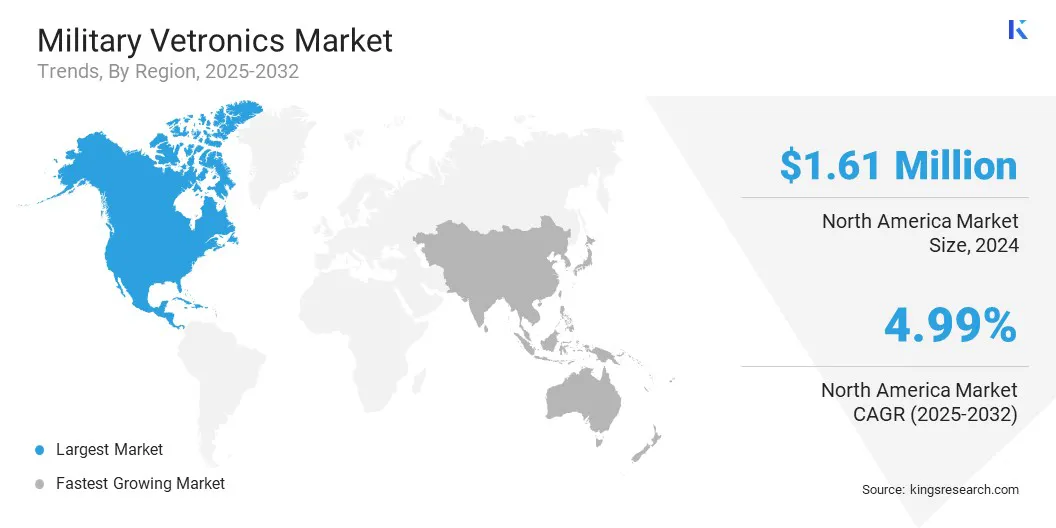
North America military vetronics market share stood at 30.27% in 2024, valued at USD 1.61 billion. This dominance is reinforced by substantial defense budgets, ongoing modernization programs, and the presence of advanced manufacturing and R&D capabilities.
The region benefits from the integration of cutting-edge vetronics technologies, including sensors, communication modules, and command and control systems, which are enhancing operational readiness and vehicle performance.
Supportive government procurement policies, collaborations between defense agencies and contractors, and continuous investment in autonomous and networked battlefield solutions are further driving market growth.
Asia Pacific military vetronics industry is set to grow at a CAGR of 5.25% over the forecast period. This growth is fueled by increasing investments by government defense agencies and domestic defense manufacturers in vehicle modernization programs and the expansion of local defense production capabilities across Asia Pacific.
The growing focus on unmanned ground vehicles, autonomous platforms, and integrated battlefield management solutions is driving a strong demand for advanced vetronics systems. Rapid adoption of cutting-edge sensors, secure communication networks, and modular architectures is driving innovation in military vetronics.
Companies operating in the military vetronics industry are maintaining competitiveness through investments in advanced sensors, communication modules, navigation systems, and modular system architectures. They are developing vetronics solutions for real-time battlefield management, command and control, and vehicle performance optimization to support operations across main battle tanks (MBTs), armored personnel carriers, and unmanned ground vehicles.
Market players are expanding their offerings with autonomous system integration, cybersecurity features, and advanced data analytics to meet evolving defense requirements. Moreover, they are establishing technical support centers and collaborating with defense agencies and technology partners to facilitate deployment and improve system interoperability.
Additionally, companies are providing training programs, maintenance services, and simulation-based testing to enhance operational reliability and sustain competitive positioning.
Frequently Asked Questions

Over the years, Versha brings over 15 years of experience managing consulting assignments across industries, including Food and Beverage, Consumer Goods, ICT, Aerospace, and more. Her work has spanned diverse sectors. Her cross-domain expertise and adaptability make her a versatile and dependable professional. She is known for her keen business insight and foresight. With sharp analytical skills and a curious mindset, Versha excels at transforming complex data into actionable insights. She has a proven track record of unraveling market dynamics, identifying trends, and delivering tailored solutions to meet client needs. As a skilled leader, Versha has successfully mentored research teams and directed projects with precision, ensuring high-quality outcomes. Her collaborative approach and strategic vision enable her to turn challenges into opportunities and consistently deliver impactful results. Whether analyzing markets, engaging stakeholders, or crafting strategies, Versha draws on her deep expertise and industry knowledge to drive innovation and deliver measurable value.

Ganapathy Subramaniam Suresh
With over a decade of research leadership across global markets, Ganapathy brings sharp judgment, strategic clarity, and deep industry expertise. Known for precision and an unwavering commitment to quality, he guides teams and clients with insights that consistently drive impactful business outcomes.



.webp&w=128&q=75&dpl=dpl_CJzjB6WVUAT19Reax6v8xwinTPW6)