
Inquire Now
Key Strategic Points
Hybrid printing is a printing technology that integrates digital and traditional printing methods and enables businesses to achieve high-quality output while maintaining flexibility and cost efficiency. Widely used in packaging, labels, and promotional materials, it offers an effective balance of quality and customization for diverse printing needs.
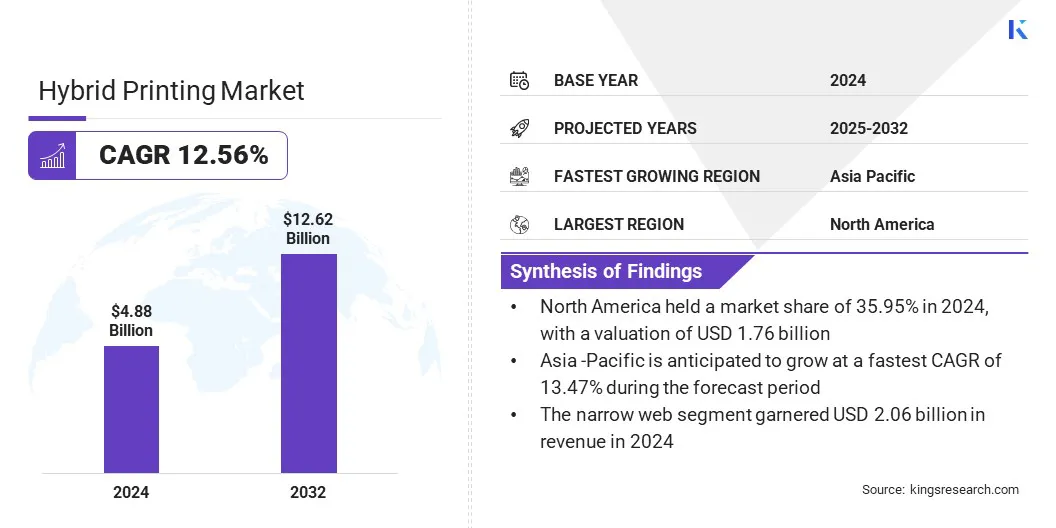
According to Kings Research, the global hybrid printing market size was valued at USD 4.88 billion in 2024 and is projected to grow from USD 5.49 billion in 2025 to USD 12.62 billion by 2032, exhibiting a CAGR of 12.56% during the forecast period.
This growth is driven by innovations in hybrid printing, including faster presses, improved digital-flexo integration, and smarter workflow software, which enable higher-quality, customizable prints with shorter turnaround times. The integration of AI further supports this growth by optimizing workflows, improving print quality, and accelerating customized production across packaging, labeling, and commercial printing.
Major companies operating in the hybrid printing market are HP Inc, Fujifilm Holdings Corporation, Ricoh, Inc, Konica Minolta Business Solutions, Inc, Electronics For Imaging, Inc, Seiko Epson Corporation, Koenig & Bauer AG, Heidelberger Druckmaschinen AG, MPS Systems B.V, Mark Andy Inc, Gallus Ferd. Rüesch AG, KOMORI-CHAMBON S.A.S, Kyocera Corporation, Memjet, and Xiamen Hanin Co., Ltd.
Rising demand for personalized products is fueling market expansion, as consumers increasingly seek customized packaging, labels, and promotional materials that reflect individuality and brand identity. Hybrid printing enables efficient.
Advancements in Printing Technology
The growth of the hybrid printing market is propelled by the continuous advancement of printing technologies that improve speed, accuracy, and versatility across packaging, labeling, and commercial printing applications.
These advancements also enable the use of multiple substrates, advanced ink systems, and automated workflows, making hybrid printing more scalable and cost-effective. The increasing availability of these innovative solutions is leading to the widespread adoption among printing firms of all sizes across packaging, labels, and promotional materials.
High Upfront Capital Investment
A key challenge restraining the progress of the hybrid printing market is the high upfront capital investment required for acquiring and integrating advanced hybrid printing systems.
These systems combine digital and traditional printing technologies, including sophisticated presses, automated workflow software, and quality control equipment, resulting in substantial implementation costs. The initial financial burden can deter small and medium-sized enterprises from adopting hybrid printing technology.
To address this challenge, market players are offering flexible financing options, leasing programs, and pay-per-use models to reduce upfront costs for businesses. They are also developing modular and scalable printing systems that allow gradual expansion based on demand for printing capacity, application diversity, and production volume.
Additionally, vendors provide comprehensive training and technical support to optimize system efficiency and reduce operational risks of equipment downtime, production errors, and workflow disruptions.
Rising Adoption of Automation and Smart Printing Technologies
A key trend influencing the hybrid printing market is the rising adoption of automation and smart printing technologies to streamline production workflows. Printing companies are integrating automated systems that manage pre-press tasks, control print operations, and reduce manual interventions.
Automation and smart printing technologies enable faster production and consistent quality, which in turn foster operational efficiency, reduce costs, and foster broader adoption of hybrid printing solutions across packaging, labels, and commercial printing sectors.
|
Segmentation |
Details |
|
By Technology |
Flexo + Inkjet, Offset + Inkjet, Gravure + Inkjet, Others |
|
By Ink |
UV Inkjet, Aqueous Dye Inkjet, Eco-Solvent Inkjet, Latex Inkjet, Others |
|
By Format |
Narrow Web, Mid Web, Wide Web |
|
By Substrate |
Paper & Cardboard, Films, Plastics, Others |
|
By End Use |
Food & Beverage, Cosmetics & Personal Care, Pharma & Healthcare, Chemicals, Industrial, Retail, Others |
|
By Region |
North America: U.S., Canada, Mexico |
|
Europe: France, UK, Spain, Germany, Italy, Russia, Rest of Europe |
|
|
Asia-Pacific: China, Japan, India, Australia, ASEAN, South Korea, Rest of Asia-Pacific |
|
|
Middle East & Africa: Turkey, U.A.E., Saudi Arabia, South Africa, Rest of Middle East & Africa |
|
|
South America: Brazil, Argentina, Rest of South America |
Based on region, the market has been classified into North America, Europe, Asia Pacific, Middle East & Africa, and South America.
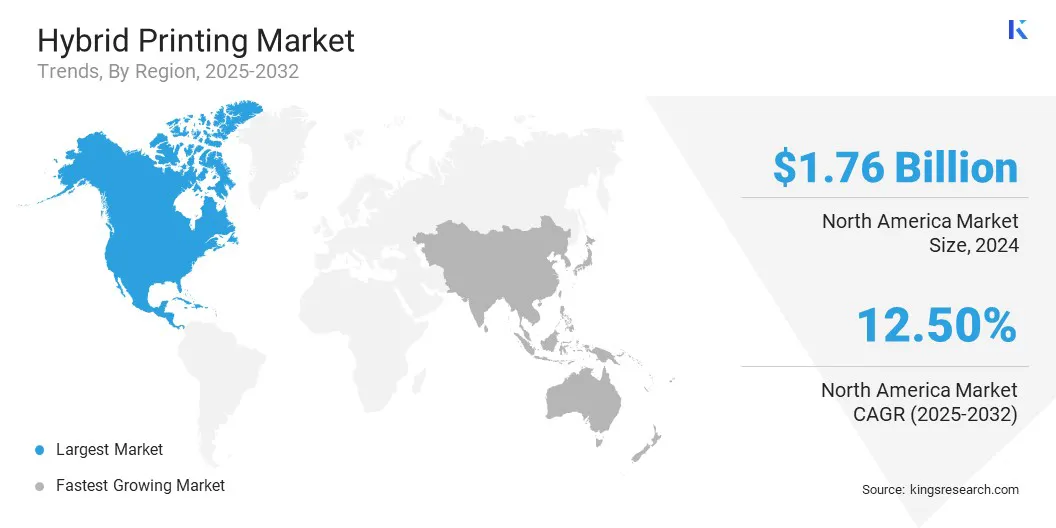
North America hybrid printing market share stood at around 35.95% in 2024, valued at USD 1.76 billion. This dominance is primarily reinforced by the rising demand for high-quality packaging and labeling across industries such as food, beverages, pharmaceuticals, and personal care. Increasing adoption of short-run and customized printing solutions is further accelerating the shift toward hybrid printing solutions.
Advancements in digital-flexographic integration are boosting the adoption of hybrid printing by reducing costs and turnaround times, enabling greater efficiency and flexibility. Additionally, ongoing investments by regional printing firms in advanced hybrid presses are enhancing production capabilities and contributing to regional market expansion.
The Asia-Pacific hybrid printing industry is set to grow at a robust CAGR of 13.47% over the forecast period. This growth is bolstered by the booming e-commerce and retail sectors, which are fueling demand for attractive, durable, and customized packaging solutions. Expanding textile and apparel industries in countries such as India, China, and Bangladesh are boosting the use of hybrid presses for high-volume and flexible production.
Rising investments from regional manufacturers in advanced hybrid printing technologies are further enhancing production capacities. Additionally, advancements in automation, including robotic material handling and inline quality inspection, are improving efficiency, thereby supporting regional market growth.
Major players operating in the hybrid printing industry are adopting high-resolution hybrid presses to enhance the label and packaging quality of products. They are focusing on increasing print speed and accuracy to handle rising demand efficiently and ensure consistent delivery of high-quality output.
Companies are streamlining workflows to improve operational efficiency and reduce downtime of hybrid printing processes. Additionally, they are delivering versatile, high-quality solutions that address the requirements of sectors such as food, beverages, and chemicals.
Frequently Asked Questions

Over the years, Versha brings over 15 years of experience managing consulting assignments across industries, including Food and Beverage, Consumer Goods, ICT, Aerospace, and more. Her work has spanned diverse sectors. Her cross-domain expertise and adaptability make her a versatile and dependable professional. She is known for her keen business insight and foresight. With sharp analytical skills and a curious mindset, Versha excels at transforming complex data into actionable insights. She has a proven track record of unraveling market dynamics, identifying trends, and delivering tailored solutions to meet client needs. As a skilled leader, Versha has successfully mentored research teams and directed projects with precision, ensuring high-quality outcomes. Her collaborative approach and strategic vision enable her to turn challenges into opportunities and consistently deliver impactful results. Whether analyzing markets, engaging stakeholders, or crafting strategies, Versha draws on her deep expertise and industry knowledge to drive innovation and deliver measurable value.

Ganapathy Subramaniam Suresh
With over a decade of research leadership across global markets, Ganapathy brings sharp judgment, strategic clarity, and deep industry expertise. Known for precision and an unwavering commitment to quality, he guides teams and clients with insights that consistently drive impactful business outcomes.



.webp&w=128&q=75&dpl=dpl_DPva2LrvfsBdTJm1XZj67UTrvMHL)