
Inquire Now
Key Strategic Points
Hexyl acetate is a colorless, flammable organic ester that emits a fruity odor and serves as a solvent and fragrance ingredient in food, cosmetic, and paint industries. The market covers the production, distribution, and application of this chemical across multiple sectors and includes industrial- and food-grade variants.
It addresses end-use industries such as coatings, adhesives, flavorings, and personal care products, while also analyzing regional demand, supply chain operations, and the competitive landscape to evaluate market positioning and growth potential.
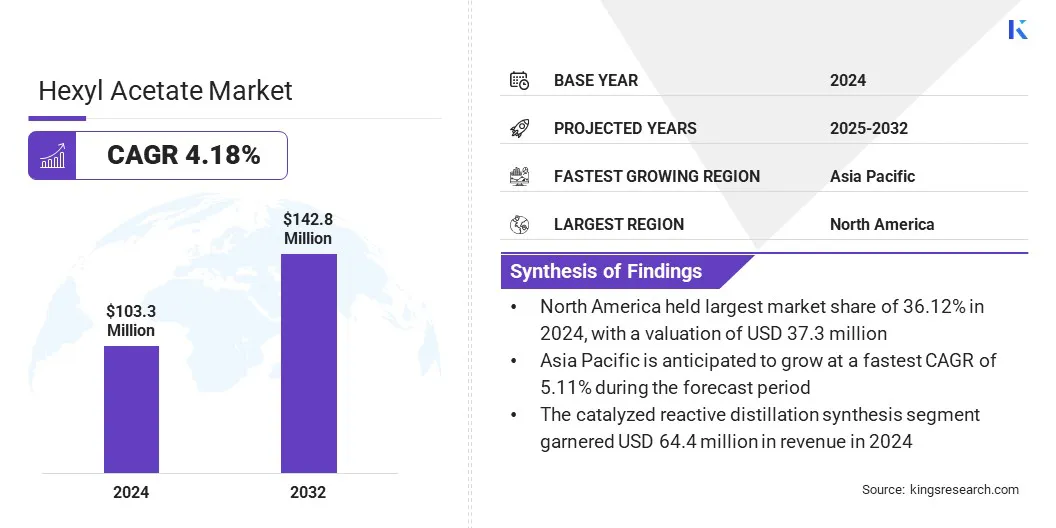
The global hexyl acetate market size was valued at USD 103.3 million in 2024 and is projected to grow from USD 107.2 million in 2025 to USD 142.8 million by 2032, exhibiting a CAGR of 4.18% during the forecast period.
The market grows as demand rises for natural flavors and fragrances in food, beverages, and personal care products. Its use as a solvent in coatings, adhesives, and paints strengthens industrial adoption. Increasing production of hexyl acetate for applications in coatings, adhesives, flavorings, and personal care products drives overall market growth.
Major companies operating in the hexyl acetate market are International Flavors & Fragrances Inc., Advanced Biotech, Augustus Oils Ltd., Merck KgaA, Elan Chemical, RXMARINE, Sihauli Chemicals Private Limited, VedaOils, BEIJING LYS CHEMICALS CO., LTD., Ungerer & Company, Frater Perfumes Ltd, vizagchemical.com, Symrise, Henan GP Chemicals Co.,Ltd, and Oman Chemical.
Key players are focusing on Research and Development (R&D) to optimize production processes, enhance sustainability, and improve product quality in the market. Their initiatives target efficient synthesis methods, reduced environmental impact, and consistent performance across flavoring, fragrance, and industrial applications.
Prioritizing R&D enables key players to meet evolving industry standards, maintain high-quality offerings, support long-term growth, and reinforce their presence in the global market.
The global hexyl acetate market is driven by growing utilization of fruity flavoring agents in the food and beverage industry. Hexyl acetate is increasingly applied to impart apple, pear, and pineapple notes, enhancing the sensory appeal of various products.
Expanding consumer preference for natural and appealing taste profiles supports higher adoption of hexyl acetate as a flavoring ingredient. Manufacturers rely on its consistent aroma and stability to improve product quality, strengthen brand differentiation, and meet evolving taste expectations, reinforcing its role as a primary factor fueling growth in the market.
A major challenge in the global hexyl acetate market is the growing availability of substitutes. Alternative esters and synthetic compounds can replace hexyl acetate in flavoring, fragrance, and industrial applications, which limits its demand and exerts pressure on pricing. This substitution risk can slow market growth in highly competitive segments where product differentiation remains low.
Key players are addressing this challenge through innovation in formulation. They develop customized blends and enhanced product solutions that leverage hexyl acetate’s unique aroma, stability, and performance characteristics. These innovations increase the difficulty for substitutes to match its effectiveness, strengthen adoption by end-use industries, and reinforce market presence despite competitive pressures.
The global hexyl acetate market shows consistent growth as fragrance manufacturers expand the use of fruity notes to strengthen product differentiation. Hexyl acetate is gaining importance because its pleasant fruity aroma makes it a primary ingredient in perfumes, particularly those formulated with apple-inspired scents.
The rising demand for refreshing and natural fragrance profiles continues to support higher utilization of hexyl acetate across both premium and mainstream perfume categories. Strong consumer preference for clean, nature-derived, and long-lasting aromas sustains its position in fragrance compositions and solidifies fruity accords as a significant growth factor in the market.
|
Segmentation |
Details |
|
By Type |
Catalyzed Reactive Distillation Synthesis, Lipase Catalyzed Ester Synthesis |
|
By Application |
Flavoring Agent, Fragrance Ingredient, Industrial Applications, Pharmaceutical Industry, Others |
|
By Region |
North America: U.S., Canada, Mexico |
|
Europe: France, UK, Spain, Germany, Italy, Russia, Rest of Europe |
|
|
Asia-Pacific: China, Japan, India, Australia, ASEAN, South Korea, Rest of Asia-Pacific |
|
|
Middle East & Africa: Turkey, U.A.E., Saudi Arabia, South Africa, Rest of Middle East & Africa |
|
|
South America: Brazil, Argentina, Rest of South America |
Based on region, the hexyl acetate market has been classified into North America, Europe, Asia Pacific, Middle East & Africa, and South America.
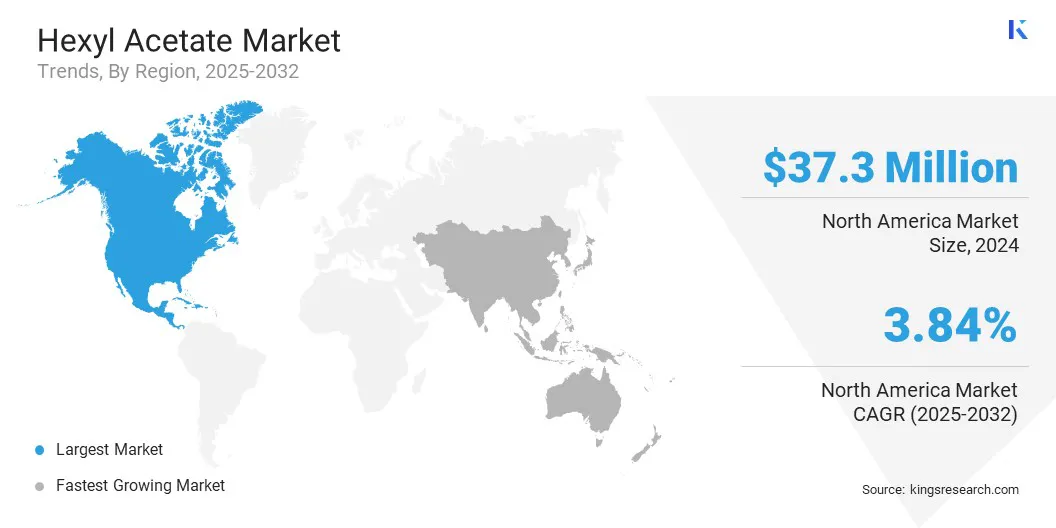
North America hexyl acetate market share stood at around 36.12% in 2024 in the global market, with a valuation of USD 37.3 million. This dominance is driven by strong demand for hexyl acetate as a solvent across industrial applications including resins, polymers, fats, and oils. Its solvency, stability, and compatibility with diverse chemical formulations establish it as a preferred choice in coatings, adhesives, and flavor and fragrance products.
Robust consumption in the food, beverage, and personal care industries strengthens market stability. Strong industrial infrastructure and consistent production capacity further consolidate North America’s leadership in the market.
The hexyl acetate industry in Asia Pacific is expected to register fastest growth in the market, with a projected CAGR of 5.11% over the forecast period. This expansion is supported by less stringent regulatory frameworks compared to North America and Europe, which enables faster industrial adoption and operational flexibility. Growing end-use industries, including food and beverage, personal care, and coatings, are driving increased consumption of hexyl acetate in the region.
Rising consumer preference for fruity flavors and natural aroma profiles further fuels demand. Favorable regulations, industrial development, and expanding consumption trends collectively position Asia Pacific as a rapidly growing market for hexyl acetate.
Key players in the hexyl acetate industry are strengthening their positions through strategies centered on product innovation and long-term supply agreements. Companies focus on product innovation to develop customized formulations, high-purity grades, and specialty blends that fulfill the specific requirements of flavoring, fragrance, and industrial applications.
This strategy enables differentiation from substitutes and maintains relevance across diverse end-use industries. Additionally, companies establish long-term supply agreements with raw material suppliers and strategic partners to ensure consistent availability, stabilize costs, and support uninterrupted production. These approaches improve operational resilience and reinforce market presence in a highly competitive environment.
Frequently Asked Questions

Swati is a committed research analyst with a passion for optimizing systems and processes across industries, specializing in healthcare but also bringing valuable expertise to sectors such as consumer goods, life sciences, and more. Her cross-domain research approach allows her to generate clear, actionable reports that inform strategic decisions in a variety of fields. Swati is committed to staying ahead of evolving trends, leveraging her broad understanding of different sectors to provide insights that are relevant to a range of industries. In her personal time, she enjoys music and spending quality time with her family, which inspires her creativity and enriches her professional approach. Her systematic methodology ensures that every report is both thorough and practical. Swati's ability to bridge regulatory frameworks with market realities gives her recommendations a distinct edge. She collaborates seamlessly with cross-functional teams, distilling complex data into straightforward narratives. Her proactive monitoring of policy and technological shifts keeps her analysis forward-looking.

With over a decade of research leadership across global markets, Ganapathy brings sharp judgment, strategic clarity, and deep industry expertise. Known for precision and an unwavering commitment to quality, he guides teams and clients with insights that consistently drive impactful business outcomes.