
Inquire Now
Key Strategic Points
The green data center market includes infrastructure that is designed to support sustainable computing, which includes energy-saving hardware, software, and services. It supports hyperscale, colocation, and edge operations among SMEs and large enterprises. This market provides IT, BFSI, and healthcare industries with the opportunity to reduce the carbon footprint of digital operations through the use of renewable energy and advanced cooling solutions.
The global market size was valued at USD 78.12 billion in 2024 and is projected to grow from USD 93.97 billion in 2025 to USD 411.12 billion by 2032, exhibiting a CAGR of 23.47% during the forecast period. This development is largely attributed to the increasing demand for energy-efficient data centers to support AI, since the intensive power consumption of machine learning workloads requires dedicated infrastructure to preserve performance and control electricity usage.
Major companies operating in the global green data center market are Schneider Electric, Sify Technologies, Digital Connexion, LITE-ON Technology Corporation, Gart Solutions, Adani Group, Green Revolution Cooling, Inc., greendatacenters.com, MITSUBISHI HEAVY INDUSTRIES, LTD., CTI, Princeton Digital Group, Eni.com, Toyota Tsusho Corporation, LARSEN & TOUBRO LIMITED, and NYK Line.
Companies are incorporating wind power stations to ensure a stable supply of electricity that is free of carbon across their global operations through large-scale renewable energy contracts and on-site turbine installations. This practice enables facilities to decouple their power consumption from fossil fuel-based utility grids, resulting in reduced exposure to price volatility and a substantial decrease in their carbon footprint, thereby supporting corporate sustainability objectives. In addition to emissions reduction, wind energy can support the development of microgrids and long-duration battery storage systems, enabling 24/7 operation of mission-critical loads without increasing environmental impact.
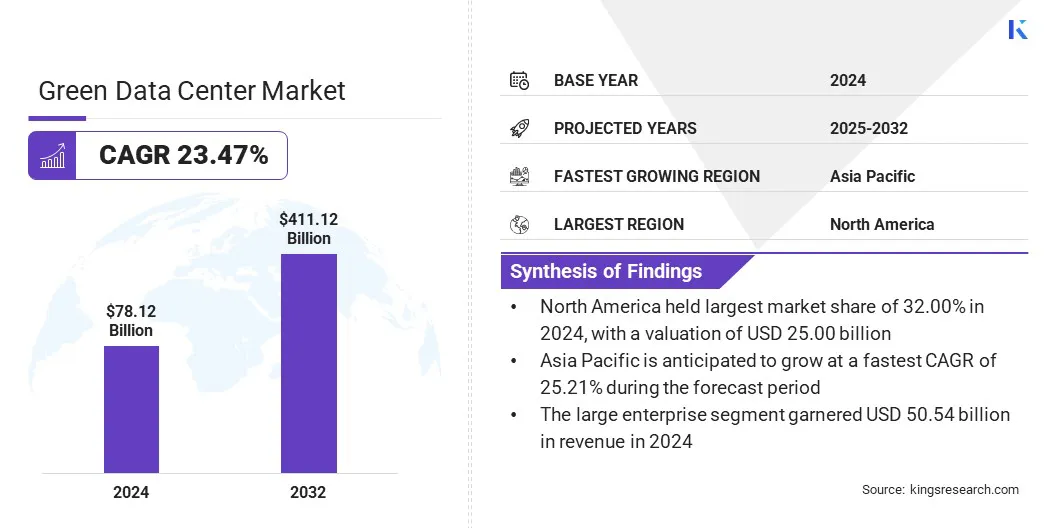
The green data center market is expanding rapidly to support the massive power requirements of artificial intelligence and high-performance computing worldwide. This surge in AI adoption necessitates specialized infrastructure that can manage extreme heat and high energy density while reducing operational costs. Since generative AI workloads can consume significantly more energy than traditional data processing, energy efficiency has moved from a secondary goal to a core requirement for large-scale AI deployment.
In addition to fundamental power conservation, green data centers combine innovative liquid cooling and thermal control using AI in specific applications to optimize high-density server performance in machine learning. These technologies are critical for the sustainable training of AI models and the efficient processing of large volumes of data, supporting the global transition to a digital economy in an environmentally sustainable manner. Energy efficiency of AI infrastructure is becoming a major focus, driving a paradigm shift toward carbon-neutral data processing and high-performance green computing guidelines.
The green data center is characterized by high investments in special cooling systems, renewable energy infrastructure, and sustainable building materials, and it can cost much more than traditional data center builds. Such initial expenditures tend to discourage small operators and delay the process of moving to eco-friendlier facilities, even though long-term operational costs are lower.
To address this challenge, market players are adopting Data Center as a Service (DCaaS) and green financing (e.g., sustainability-linked loans). With these models, organizations can shift from intensive expenditure to manageable operational payments, enabling access to advanced efficiency technologies. Modular green designs are also being adopted by many companies, which allows them to begin with small, efficient units and expand their sustainable infrastructure over time as demand and ROI increase.
There is a major trend toward offshore floating data center development, which involves the use of natural seawater for cooling and the integration of renewable energy. These systems are designed to either be submerged or floating on the ocean, where the surrounding water is used to naturally cool down the high-density server racks without the energy consumption associated with conventional air conditioning.
The capability assists operators in significantly reducing energy consumption and land usage, while also enabling high-speed connectivity for the urban population in coastal locations. The trend towards offshore floating green data centers represents a response to the need for more scalable and environmentally responsive infrastructure that reduces the carbon footprint of global data processing activities.
|
Segmentation |
Details |
|
By Component |
Hardware, Software, Services |
|
By Data Center Type |
Hyperscale, Colocation, Enterprise, Edge, Others |
|
By Organization Size |
Large Enterprise, Small and Medium-sized Enterprise (SME) |
|
By End-User Vertical |
IT & Telecommunications, BFSI, Commercial, Healthcare, Others |
|
By Region |
North America: U.S., Canada, Mexico |
|
Europe: France, UK, Spain, Germany, Italy, Russia, Rest of Europe |
|
|
Asia-Pacific: China, Japan, India, Australia, ASEAN, South Korea, Rest of Asia-Pacific |
|
|
Middle East & Africa: Turkey, U.A.E., Saudi Arabia, South Africa, Rest of Middle East & Africa |
|
|
South America: Brazil, Argentina, Rest of South America |
Based on region, the green data center market has been classified into North America, Europe, Asia Pacific, Middle East & Africa, and South America.
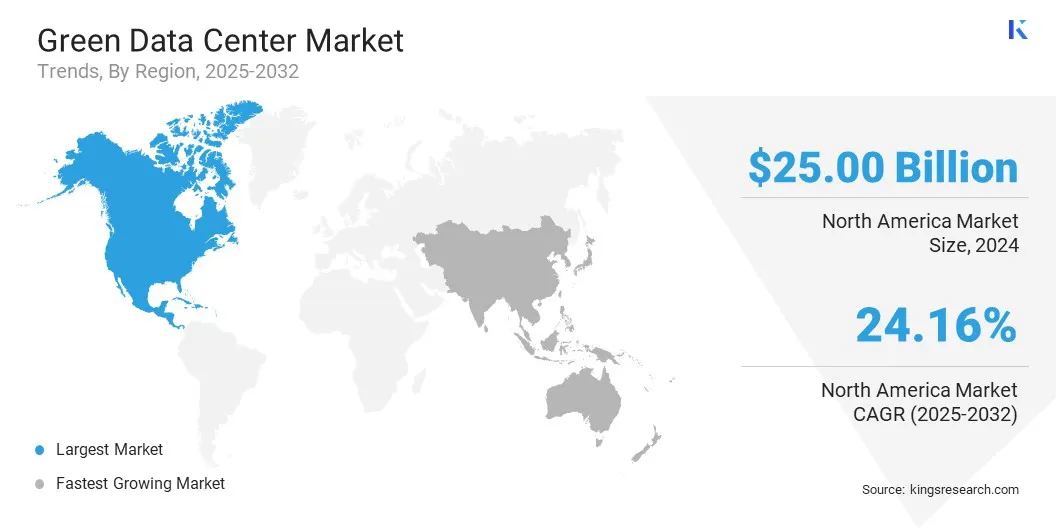
The North America green data center industry accounted for a substantial share of 32.00% in 2024, valued at USD 25.00 billion. This regional dominance is attributable to the early adoption of sustainable IT standards and the fact that there are large hyperscale cloud providers that have been first movers in procuring 100 percent renewable energy to run their global operations. Also, the fully developed regulatory environment, as well as the accelerated implementation of the high-density liquid cooling of sophisticated AI workloads, have facilitated the widespread adoption of friendly infrastructure, therefore demonstrating regional market dominance.
The Asia-Pacific green data center market is expected to register the fastest CAGR of 25.21% over the forecast period. This growth is fueled by the intensive investment and development of digital infrastructure in the region, especially in the emerging hubs such as India, Indonesia, and Vietnam that demand scalable and energy-efficient solutions to cope with the rising internet penetration. Also, due to the existence of good government policies and large-scale investments in sustainable urban planning and connectivity through subsea cables, the modernization of the data storage environment has increased at a faster rate, thereby creating a strong demand for green data center technology.
Major participants in the green data center market are working in the field of high-performance computing (HPC) by establishing partnerships and enhancing next-generation cooling solutions to handle heavy AI workloads. Significant infrastructure vendors are working together with liquid cooling vendors to incorporate direct-to-chip and immersion methods to achieve high heat dissipation and dynamic power optimization of high-density server racks.
Moreover, AI-based resource orchestration and efficient power distribution are being commercialized by hardware developers, particularly in HPC settings, to speed up the shift to self-optimizing and carbon-neutral facilities. Such collaborations and technologies assist in making the high-density data processing more energy-efficient, enabling the transition to sustainable AI scaling, and accelerating the implementation of high-performance green infrastructure.
Frequently Asked Questions

Tejasv specializes in secondary research and data validation, transforming complex information into clear market insights. He supports multi-industry research initiatives by delivering reliable intelligence that informs planning and strategic direction. With a disciplined and detail-focused approach, he emphasizes analytical clarity and practical application. His interest in geopolitics and history informs his broader market perspective. This unique lens allows him to contextualize industry shifts within larger socio-political frameworks, adding depth to his analyses. He maintains rigorous documentation standards, making his findings auditable and easily reproducible. His ability to distill vast amounts of secondary data into concise, decision-ready summaries has earned him the trust of project leads across multiple verticals. Tejasv actively tracks regulatory changes and economic indicators, which he incorporates into his research to enhance its forward-looking relevance. His methodical work ethic, combined with a calm demeanor under tight deadlines, ensures that his contributions remain both timely and impactful.

Ganapathy Subramaniam Suresh
With over a decade of research leadership across global markets, Ganapathy brings sharp judgment, strategic clarity, and deep industry expertise. Known for precision and an unwavering commitment to quality, he guides teams and clients with insights that consistently drive impactful business outcomes.