
Inquire Now
Key Strategic Points
The refrigeration coolers market encompasses the design, manufacturing, and distribution of equipment used to preserve, chill, and freeze perishable goods in controlled-temperature environments. These systems span commercial and industrial refrigeration units, along with standalone coolers used across food service, retail, healthcare, hospitality, and residential applications. The market includes various product types such as reach-in coolers, display coolers, undercounter coolers, countertop coolers, chest coolers, and other related equipment. These systems form a critical part of cold chain infrastructure, ensuring product integrity from storage to the point of sale.
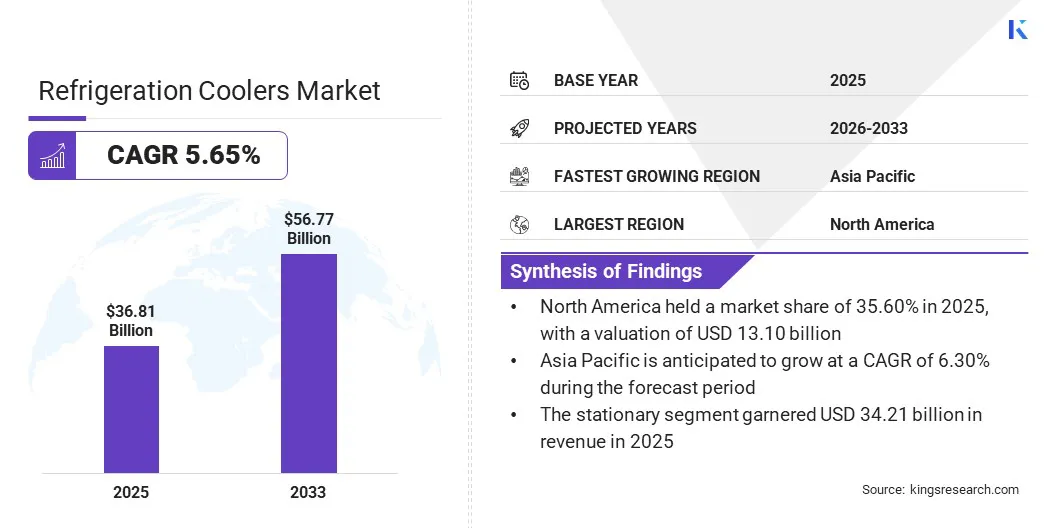
The refrigeration coolers industry size was valued at USD 36.81 billion in 2025 and is projected to reach USD 56.77 billion by 2033, exhibiting a CAGR of 5.65% during the forecast period. This robust growth is driven by the rising demand for packaged and perishable foods, advancements in cooling technologies, and stricter food safety regulations.
Major companies operating in the refrigeration coolers market include Carrier, SAMSUNG, LG Electronics, Haier Inc., Panasonic Holdings Corporation, Dover Corporation, Hussmann Corporation, HOSHIZAKI CORPORATION, True Manufacturing Co., Inc., LUVE, Guntner GmbH & Co. KG, EVAPCO, Inc., Modine Manufacturing Company, KeepRite Refrigeration, and Frigoglass.
Additionally, the integration of IoT-enabled monitoring and energy-efficient solutions continues to reshape industry practices. As retailers and logistics providers prioritize product quality and compliance, investment in advanced refrigeration coolers is expected to remain strong across global markets.
One of the most significant drivers of the refrigeration coolers market is the rising demand for packaged and perishable food products. As consumer preferences shift toward convenience, fresh produce, and ready-to-eat meals, grocery stores, supermarkets, and restaurants require advanced refrigeration solutions to maintain product quality and safety. Rapid urbanization, changing lifestyles, and the expansion of modern retail formats further supports this growth.
To meet these needs, food producers, distributors, and retailers are investing in energy-efficient, reliable, and technologically advanced refrigeration coolers. These systems ensure proper temperature control, extend shelf life, and help businesses comply with stringent food safety regulations, making them critical components of the modern food supply chain.
Compliance with evolving environmental regulations governing high-global-warming-potential refrigerants poses a significant challenge for manufacturers and end users. Regulatory bodies are progressively restricting the production, import, and use of synthetic HFC refrigerants in favor of lower-impact alternatives, requiring system redesigns and planned equipment upgrades or retrofits. Under the EPA's AIM Act, HFC production and consumption allowance will decline to 15% of historic baseline levels by 2036, with the Technology Transitions Rule on high-GWP refrigerants effective from January 1, 2025.
This transition demands substantial investment in research, re-engineering, and technician retraining, while compressed compliance timelines increase pressure on smaller operators with limited capital. In response, manufacturers are expanding natural refrigerant-based product lines, and component suppliers are introducing purpose-built low-GWP solutions to reduce conversion costs and enable phased, less-disruptive retrofits across the industry.
The rising integration of IoT-enabled smart monitoring systems is significantly transforming cold chain infrastructure in the market. By equipping coolers with connected sensors and real-time data analytics, companies can continuously track temperature, humidity, and equipment status across storage and transportation. This shift from manual checks to automated, sensor-based solutions ensures immediate detection of temperature excursions, minimizes spoilage risk, and enhances regulatory compliance.
As food safety and traceability standards continue to tighten, IoT-enabled monitoring is increasingly becoming essential for retailers, distributors, and logistics providers. The ability to access remote diagnostics, predictive maintenance, and centralized control further drives adoption, making smart monitoring a key trend influencing future investments in refrigeration equipment.
|
Segmentation |
Details |
|
By Product |
Display Coolers, Reach-in Coolers, Undercounter Coolers, Countertop Coolers, Chest Coolers, and Others |
|
By Mobility |
Stationary and Portable |
|
By Capacity |
Less than 150 Liters, 150–250 Liters, 250–350 Liters, 350–500 Liters, and More than 500 Liters |
|
By End User |
Residential, Hospitality, Food Service, Retail, Healthcare, and Others (Distribution centers, Governments, etc.) |
|
By Distribution Channel |
Online and Offline (Brand Stores, Hypermarket, Supermarket etc.) |
|
By Region |
North America: U.S., Canada, Mexico |
|
Europe: France, UK, Spain, Germany, Italy, Russia, Rest of Europe |
|
|
Asia-Pacific: China, Japan, India, Australia, ASEAN, South Korea, Rest of Asia-Pacific |
|
|
Middle East & Africa: Turkey, U.A.E., Saudi Arabia, South Africa, Rest of Middle East & Africa |
|
|
South America: Brazil, Argentina, Rest of South America |
Based on region, the global refrigeration coolers market has been classified into North America, Europe, Asia Pacific, Middle East & Africa, and South America.
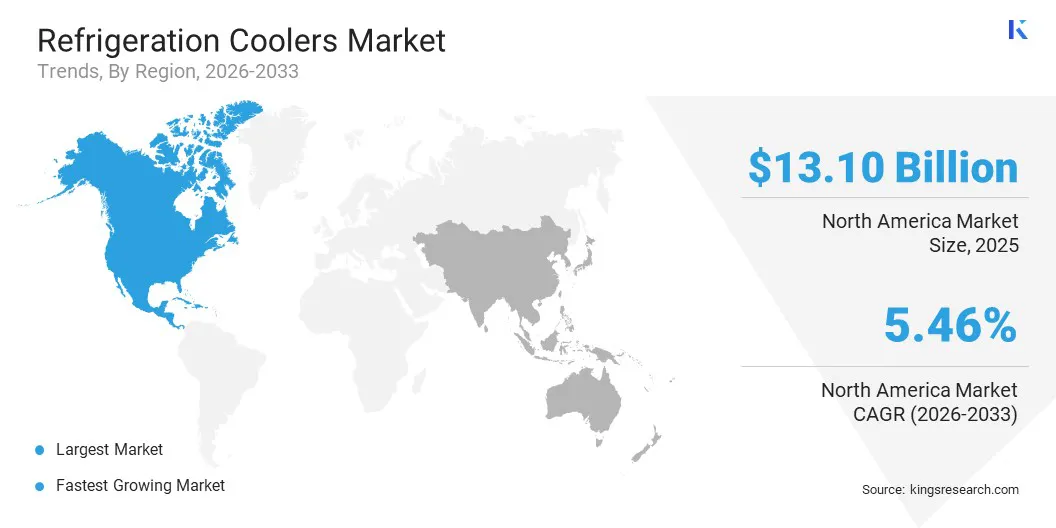
The North America refrigeration coolers market share stood at 35.60% in 2025, valued at USD 13.10 billion. This strong regional presence is supported by well-established food retail, hospitality, and healthcare sectors that require advanced refrigeration solutions to ensure product safety and quality. Growing investments in supermarket expansions, quick-service restaurants, and cold chain logistics continue to fuel regional market growth.
Additionally, increasing focus on energy efficiency, sustainability, and regulatory compliance is encouraging end users to adopt technologically advanced, eco-friendly refrigeration coolers. The region’s robust after-sales support and widespread adoption of connected, smart monitoring systems further aid regional market expansion.
The Asia-Pacific refrigeration coolers market is set to grow at a CAGR of 6.30% over the forecast period, driven by rapid urbanization, rising disposable incomes, and a growing food and beverage industry. The region is witnessing strong demand for modern retail formats such as supermarkets, hypermarkets, and convenience stores, which require efficient cold storage solutions.
Growth in e-commerce grocery delivery and expansion of food service chains are further highlighting the need for reliable refrigeration infrastructure. Additionally, supportive government initiatives for cold chain development and the adoption of advanced technologies like IoT-enabled monitoring are accelerating regional market expansion. Manufacturers are also focusing on energy-efficient and compact models to address space constraints in urban areas.
The refrigeration coolers market is moderately consolidated, with established manufacturers competing alongside regional players across commercial, industrial, and household segments. Competition is primarily driven by advancements in energy-efficient compressors, adoption of natural refrigerants, and integration of smart monitoring capabilities, as manufacturers align with tightening environmental regulations while controlling production costs. Companies are increasingly investing in modular and low-charge system designs to differentiate their offerings and address diverse end-use requirements across food service, retail, and pharmaceutical applications.
Strategic partnerships with component suppliers, technology providers, and distribution networks are common approaches to strengthen market presence and accelerate product development. Additionally, mergers, acquisitions, and capacity expansions remain key strategies among leading players seeking to broaden geographic reach and enhance their technological capabilities in response to evolving customer and regulatory demands.
Frequently Asked Questions

Aswathi holds cross-domain expertise, translating market trends and competitive intelligence into decision-ready insights. Her work helps clients interpret evolving market conditions and identify growth opportunities. She brings a focused, insight-led approach to research execution. She translates these findings into clear, prioritized action plans that align with client capabilities. Her research often includes scenario modeling to test growth strategies under varying economic conditions. She maintains a rigorous validation process, cross-checking primary and secondary sources to ensure reliability. Clients value her ability to synthesize noisy data into concise executive summaries that drive board-level discussions. Her sector-specific lens, combined with a pragmatic focus on execution, consistently delivers high-impact, commercially sound recommendations. Her structured yet flexible research frameworks adapt to client timelines without compromising depth. She is known for distilling complex trade-offs into straightforward, defensible positions that facilitate confident decision-making.
Habi is a seasoned research and consulting leader with renowned experience in guiding clients on strategic growth and transformation initiatives across global markets. He has led high-performing research teams that deliver actionable insights on market expansion, M&A strategies, opportunity assessment, new business development, and product launches. His project portfolio spans large petrochemical producers, electronic device manufacturers, lubricants companies, and other leading enterprises across diverse industrial and consumer sectors. He currently heads the research department at Kings Research, where he is responsible for setting the research agenda, mentoring analysts, and ensuring client-ready deliverables that support executive decision-making. With extensive experience in market intelligence, strategic research, and consulting, Habi brings a strong understanding of evolving industry dynamics, competitive landscapes, emerging opportunities, and business growth challenges. His expertise includes developing research frameworks, translating complex market data into actionable strategic recommendations, and working closely with senior stakeholders to address critical business questions. He has also contributed to building research capabilities, strengthening analytical methodologies, and driving a culture of quality and insight-led decision-making within research teams. His cross-industry exposure enables him to connect market trends with broader business implications and provide perspectives that help organizations identify opportunities, mitigate risks, and make informed strategic decisions.