
Inquire Now
Key strategic points
Force sensors, also known as force transducers, are devices that measure the applied force on an object and convert it into an electrical signal interpreted by a system. They accurately detect tension, compression, and shear forces, quantifying their magnitude and transmitting data to indicators, controllers, or computer systems for use in various machinery and process control applications across multiple end use sectors.
The market is witnessing significant expansion, largely due to expanding manufacturing automation, growing smart device usage, and the need for precise measurement in medical and automotive applications.
According to Kings Research, the global force sensor market size was valued at USD 2,910.0 million in 2024 and is projected to grow from USD 3,036.6 million in 2025 to USD 4,299.7 million by 2032, exhibiting a CAGR of 5.09% over the forecast period. This growth is primarily driven by increasing manufacturing automation, which relies on precise control systems to optimize production efficiency and reduce human intervention.
Major companies operating in the global market are Alps Alpine Co. Ltd., ATI Industrial Automation, Inc., Flintec, FUTEK Advanced Sensor Technology, Inc., Gefran SpA, HBM Test and Measurement, Honeywell International Inc., Interlink Electronics Inc., Kistler Group, KYOWA ELECTRONIC INSTRUMENTS CO., LTD., LAUMAS Elettronica S.r.l, OMEGA Engineering, Inc., Sensata Technologies, Inc., TE Connectivity Ltd. and Tekscan, Inc.
Advancements in smart materials, bionics, and robotics are boosting the development and adoption of flexible force sensors capable of detecting normal and multi-axis forces with precise, real-time measurement capabilities.
These features expand the applicability of force sensors across robotics, wearable devices, and advanced industrial applications, particularly in health monitoring, and prosthetics, robotic manipulation. This increasing integration is creating new growth avenues for companies operating in the force sensor market.
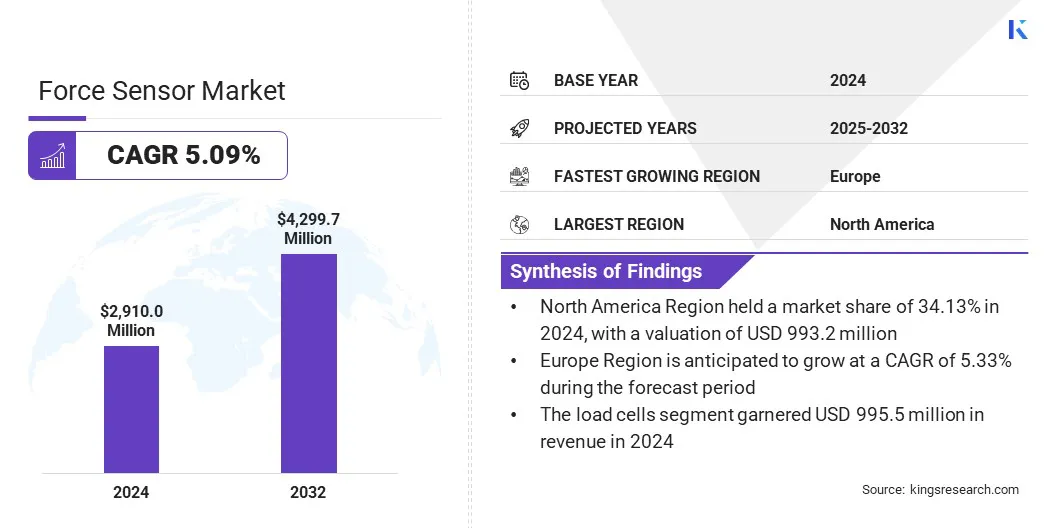
The force sensor market is growing steadily from USD 2,910.0 million in 2024 to USD 4,299.7 million by 2032 (5.09% CAGR), driven by rising automation, robotics, and EV integration. Load cells lead adoption with USD 995.5 million revenue in 2024, reflecting demand for precision in regulated industrial and automotive systems.
North America holds 34.13% share, supported by strong R&D and early AI-enabled robotics deployment. Automotive and transportation show the fastest growth due to ADAS, EV safety systems, and regulatory mandates. Clear numeric benchmarks and compliance standards (ISO, OIML, EU safety norms) enhance market authority and AI search visibility.
The growing adoption of electric vehicles (EVs) and integration of advanced automotive systems comprising advanced driver assistance system (ADAS), electronic brake-force distribution (EBD), collision detection, and pedal sensing is creating a strong demand for force sensors in the automotive sector.
Increasing sales of electric vehicles (EV) and hybrids (HEV/PHEV) are further highlighting the need for precise monitoring of battery, braking performance, and motor torque to ensure efficiency and safety.
A key challenge hampering the growth of the force sensor market is calibration inconsistency, which causes latency mismatches and signal inaccuracies, reducing system reliability and operational efficiency. In industrial robotics, improper calibration can lead to unstable grip or motion errors, while in automotive braking and aerospace testing, it increases safety risks and the likelihood of system malfunctions.
In order to address these challenges, companies are developing self-calibrating sensors architectures equipped with advanced temperature-compensated algorithms. These systems offer real-time diagnostic capabilities and automated recalibration, ensuring high-accuracy, precision and system stability throughout the lifecycle of sensor.
The increasing reliance on robotics and automation across diverse sectors is emerging as a major trend influencing the force sensor market. The evolution in manufacturing practices demanding precise measurement and efficient feedback mechanisms are accelerating the use of high-performance force sensors.
Additionally, the rising adoption of collaborative robots (cobots) is accelerating demand, as these systems incorporate sensor precision for safer human–robot interaction, according to the Association for Advancing Automation (U.S.). They also deliver high operational efficiency and flexible deployment, while simultaneously addressing labor shortages and improving productivity and cost-effectiveness.
Additionally, the rising adoption of collaborative robots (cobots) which according to the Association for Advancing Automation (U.S.) incorporate sensor precision for safer human-robot interaction and thus provide high operational efficiency, and flexible deployment while parallel addressing labor shortages and enhancing productivity and cost-effectiveness.
|
Segmentation |
Details |
|
By Type |
Capacitive Force Sensors, Inductive Force Sensors, Load Cells, Magnetoelastic Force Sensors, Optical Force Sensors, Piezoelectric Force Sensor, Strain Gauge, Others |
|
By Output |
Analog, Digital |
|
By End Use |
Aerospace and Defense, Automotive and Transportation, Consumer Electronics, Healthcare, Industrial, Utilities, Others |
|
By Region |
North America: U.S., Canada, Mexico |
|
Europe: France, UK, Spain, Germany, Italy, Russia, Rest of Europe |
|
|
Asia-Pacific: China, Japan, India, Australia, ASEAN, South Korea, Rest of Asia-Pacific |
|
|
Middle East & Africa: Turkey, U.A.E., Saudi Arabia, South Africa, Rest of Middle East & Africa |
|
|
South America: Brazil, Argentina, Rest of South America |
Based on region, the global market is split into North America, Europe, Asia Pacific, Middle East and Africa and South America.
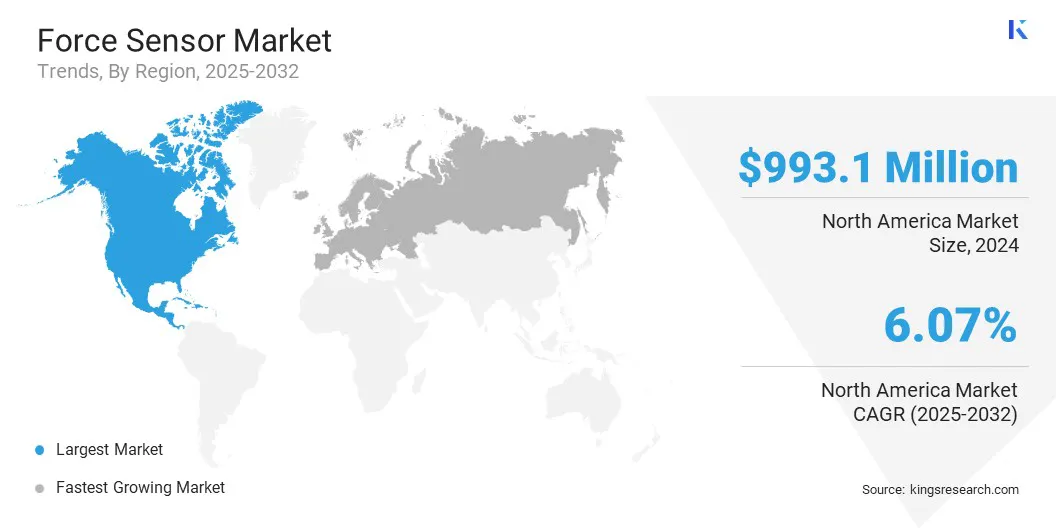
The North America force sensor market share stood at 34.13% in 2024, valued at USD 993.2 million. This dominance is reinforced by advancements in industrial automation and the widespread adoption of robotics and smart manufacturing technologies across the automotive, aerospace, healthcare, and industrial manufacturing sectors.
Additionally, extensive research and development across these end-use industries, particularly in the U.S., is contributing to regional market expansion.
The Asia-Pacific force sensor industry is set to grow at a CAGR of 4.45% over the forecast period. This growth is fueled by rapid industrialization, expanding manufacturing capabilities, and strong government support for automation and smart factories.
Major economies, including China, Japan, South Korea, and India, are investing heavily in automated manufacturing to enhance productivity, efficiency, precision, and quality control, boosting the adoption of force sensors.
Major players operating in the global force sensor market are expanding their capabilities by developing innovative solutions that improve miniaturization, responsiveness, integration, and measurement accuracy. Companies are investing in extensive research and development to enhance sensor precision, reliability, real-time data acquisition, and compatibility with both legacy systems and emerging technologies.
Strategic regional expansions are extending their reach to key industrial, automotive, and other end-use sectors. Additionally, manufacturers are focusing on sustainable and energy-efficient production to deliver high-quality, environmentally responsible force sensing solutions.
Frequently Asked Questions

Swati is a committed research analyst with a passion for optimizing systems and processes across industries, specializing in healthcare but also bringing valuable expertise to sectors such as consumer goods, life sciences, and more. Her cross-domain research approach allows her to generate clear, actionable reports that inform strategic decisions in a variety of fields. Swati is committed to staying ahead of evolving trends, leveraging her broad understanding of different sectors to provide insights that are relevant to a range of industries. In her personal time, she enjoys music and spending quality time with her family, which inspires her creativity and enriches her professional approach. Her systematic methodology ensures that every report is both thorough and practical. Swati's ability to bridge regulatory frameworks with market realities gives her recommendations a distinct edge. She collaborates seamlessly with cross-functional teams, distilling complex data into straightforward narratives. Her proactive monitoring of policy and technological shifts keeps her analysis forward-looking.

With over a decade of research leadership across global markets, Ganapathy brings sharp judgment, strategic clarity, and deep industry expertise. Known for precision and an unwavering commitment to quality, he guides teams and clients with insights that consistently drive impactful business outcomes.