
Inquire Now
Key Strategic Points
The femtech (female technology) market is the sector of technology and innovation dedicated to developing products, services, and digital solutions that address women's health and wellness needs. This market includes applications, medical devices, wearables, and digital platforms designed to support areas such as reproductive health, menstrual health, maternal care, fertility, contraception, menopause, and broader women’s health needs. The market aims to close gaps in traditional healthcare by providing accessible, inclusive, and tailored solutions for women’s health across different settings, including underserved and humanitarian contexts.
Market Overview
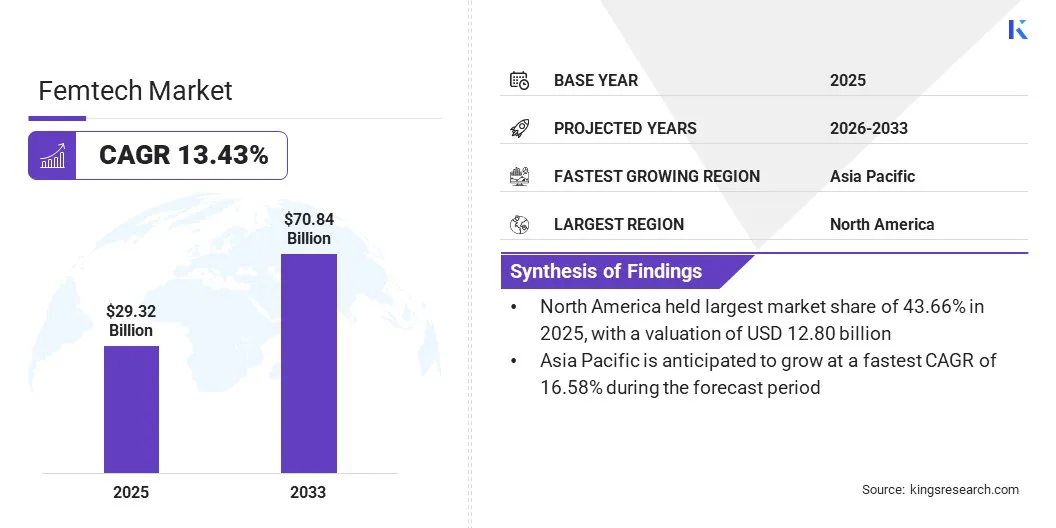
The global market size was valued at USD 29.32 billion in 2025 and is projected to grow to USD 70.84 billion by 2033, exhibiting a CAGR of 13.43% during the forecast period. The market is experiencing strong growth as healthcare systems, investors, and consumers place greater emphasis on addressing the unique health needs of women. The increasing adoption of digital health technologies further supports this growth.
Mobile applications, telehealth platforms, wearable devices, and connected health solutions are enabling women to access personalized healthcare information, monitor health conditions, and engage with healthcare providers more conveniently and efficiently.
Major companies operating in the global femtech industry are Flo Health Inc., Clue, Natural Cycles, Kindbody, Midi, Inc., Pomelo Care, Inc., Elvie (Willow Innovations, Inc), Ava, Maven Clinic Co., Glow Inc., Inito Inc., Organon group of companies, HeraMED, Carrot, and Hologic, Inc.
Investment activity in the sector has accelerated, supporting the development of new technologies and services tailored to women's healthcare needs. In addition, advances in data analytics, artificial intelligence, and remote monitoring technologies are enhancing the effectiveness of femtech solutions. As healthcare becomes more patient-centric and preventive, femtech is expected to play an increasingly important role in improving health outcomes and expanding access to specialized care for women worldwide.
Growing demand and awareness of women's health solutions are contributing significantly to market development. As women become more informed about their unique health needs, there is increased interest in solutions tailored to issues like menstrual health, fertility, pregnancy, menopause, and reproductive wellness. Public health campaigns, social media advocacy, and the destigmatization of women’s health topics have empowered more women to seek specialized products and services.
This heightened awareness is also prompting healthcare providers and innovators to develop accessible, user-friendly technologies that address gaps in traditional care. As a result, the market is seeing rapid adoption of Femtech solutions, with consumers seeking proactive, personalized, and data-driven tools to manage their health and well-being.
Historically, women have been underrepresented in clinical trials and health research, resulting in significant gaps in medical knowledge and product development. This data deficit makes it difficult to design solutions that accurately address the diverse needs of women across different age groups, geographies, and health conditions. It also hinders the ability to validate the effectiveness and safety of femtech products.
To address this challenge, many companies are investing in large-scale, women-centric research initiatives and promoting user participation in data collection through apps and wearables. By prioritizing robust data collection and collaboration with healthcare professionals, these companies aim to deliver evidence-based solutions.
The integration of AI and data analytics is emerging as a notable trend in the femtech market by enabling more personalized and effective women’s health solutions. Artificial intelligence algorithms can analyze vast amounts of health data from wearable devices, apps, and medical records to identify patterns and provide tailored recommendations for users. This capability allows femtech products to offer predictive insights, including ovulation windows, risk factors for certain conditions, and personalized wellness plans.
Data analytics also supports ongoing product improvement and clinical validation, ensuring that solutions meet user needs. By leveraging AI and data-driven insights, femtech companies are enhancing user engagement and trust while empowering women to make more informed decisions about their health and well-being.
|
Segmentation |
Details |
|
By Product Type |
Digital Health & Software (Consumer Mobile Apps, Telehealth & Virtual Care Platforms, Enterprise Benefits Software, Others), Connected Hardware & Consumer Tech (Smart Wearables, Consumer Diagnostics, Others), Clinical Screening & Medical Devices (Imaging & Diagnostics, Biotech & Lab Equipment, Others), Tech-Enabled Clinical Services (Hybrid/Physical Care Networks, Specialty Fertility & IVF Clinics, Others) |
|
By Application |
General Healthcare, Longevity, Menopause Care, Menstrual Health, Mental Health, Pelvic and Uterine Healthcare, Pregnancy and Nursing, Reproductive Health and Contraception, Sexual Health, Women’s Wellness |
|
By Sales Channel |
Direct-to-Consumer (B2C), Enterprise & Corporate Payers (B2B), Healthcare Providers (B2B2C), Diagnostic & Research Labs |
|
By Region |
North America: U.S., Canada, Mexico |
|
Europe: France, UK, Spain, Germany, Italy, Russia, Rest of Europe |
|
|
Asia-Pacific: China, Japan, India, Australia, ASEAN, South Korea, Rest of Asia-Pacific |
|
|
Middle East & Africa: Turkey, U.A.E., Saudi Arabia, South Africa, Rest of Middle East & Africa |
|
|
South America: Brazil, Argentina, Rest of South America |
Based on region, the global femtech market has been classified into North America, Europe, Asia Pacific, Middle East & Africa, and South America.
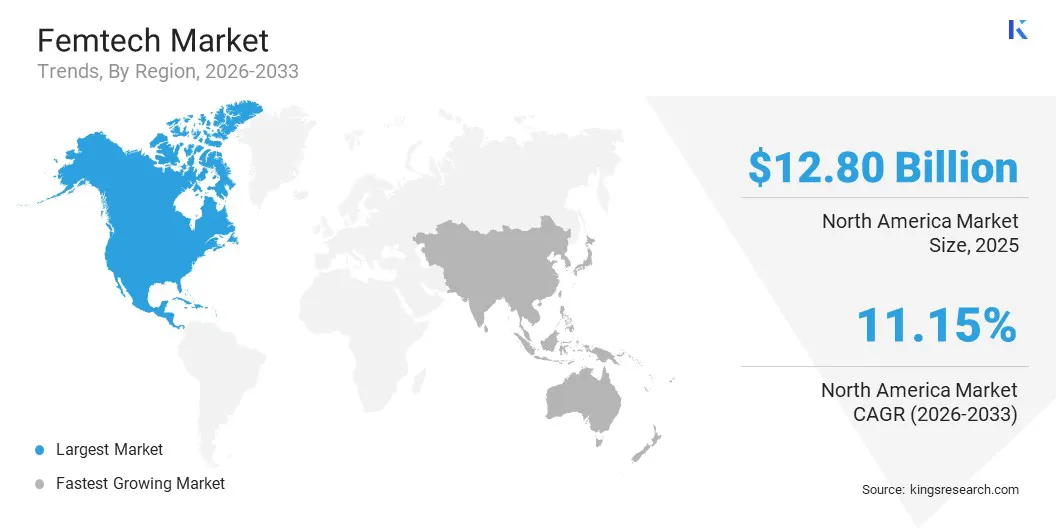
North America femtech market accounted for a share of 43.66% in 2025, with a market value of USD 12.8 billion. The region continues to lead the market due to its advanced healthcare infrastructure, high adoption of digital health solutions, and strong consumer awareness of women’s health issues. The presence of a large number of femtech startups, established healthcare technology companies, and supportive investors has created a favorable environment for innovation.
Demand is particularly strong in areas such as fertility care, pregnancy monitoring, menstrual health, and menopause management. Employers and health insurers are also increasingly incorporating women’s health benefits into their offerings, further supporting regional market expansion. In addition, widespread smartphone usage and growing acceptance of telehealth services have made digital women’s health solutions more accessible.
The Asia-Pacific femtech market is expected to grow at a CAGR of 16.76% over the forecast period, making it one of the fastest-growing regional markets globally. Growth is being supported by a large female population, rising healthcare spending, increasing internet penetration, and greater awareness of women’s health and wellness. Countries such as China, India, Japan, and Australia are witnessing growing demand for digital health platforms, fertility services, pregnancy care solutions, and menopause support products.
The rapid adoption of smartphones and mobile health applications has enabled women to access healthcare information and services more conveniently. Governments across the region are also investing in healthcare modernization and digital health initiatives, creating opportunities for femtech companies.
The femtech market is marked by growing competition, with both emerging startups and established healthcare and technology companies vying for major market share. Startups often lead in developing niche solutions targeting specific aspects of women’s health, including period tracking, fertility, menopause, or sexual wellness. Meanwhile, larger healthcare and technology companies are increasingly focusing on acquisitions, partnerships, or the launch of innovative femtech products.
This growing competition is driving rapid innovation, improved product offerings, and expanded access to women’s health solutions globally. Collaboration among femtech firms, research institutions, and healthcare providers is further accelerating advancements and addressing unmet market needs.
Frequently Asked Questions

Aswathi holds cross-domain expertise, translating market trends and competitive intelligence into decision-ready insights. Her work helps clients interpret evolving market conditions and identify growth opportunities. She brings a focused, insight-led approach to research execution. She translates these findings into clear, prioritized action plans that align with client capabilities. Her research often includes scenario modeling to test growth strategies under varying economic conditions. She maintains a rigorous validation process, cross-checking primary and secondary sources to ensure reliability. Clients value her ability to synthesize noisy data into concise executive summaries that drive board-level discussions. Her sector-specific lens, combined with a pragmatic focus on execution, consistently delivers high-impact, commercially sound recommendations. Her structured yet flexible research frameworks adapt to client timelines without compromising depth. She is known for distilling complex trade-offs into straightforward, defensible positions that facilitate confident decision-making.
With many years of consulting experience across global pharma, biotech, and MedTech markets, Minaz brings deep domain expertise, strategic clarity, and analytical rigor to every engagement. She has led 130+ consulting assignments spanning market entry, competitive landscaping, and portfolio prioritization, helping clients navigate complex, high-stakes decisions with confidence. Known for her ability to synthesize primary and secondary research into executive-ready recommendations, Minaz has built forecasting models and market sizing frameworks that have informed multi-million dollar investment decisions in oncology, diagnostics, and peptide therapeutics. Beyond her analytical strength, Minaz is a trusted client partner, translating complex datasets into clear, actionable insights for senior stakeholders. She currently leads a team of research analysts, driving business expansion, and shaping client engagement strategy.