
Inquire Now
Key Strategic Points
The fatty amines are nitrogen derivatives of fatty acids, olefins, or alcohols prepared from natural sources such as fats and oils, or from petrochemical raw materials. They are produced by hydrogenation of fatty nitriles, which are generated by the reaction between triglycerides, fatty acids, or fatty esters and ammonia, with the elimination of two molecules of water at high temperature in the presence of dehydrating catalyst.
Fatty amines are widely used in diverse end use industries owing to their applicability as adjuvants in agriculture, surfactants and corrosion inhibitors in manufacturing industries, and as fabric softeners due to their low toxicity and excellent surface activity.
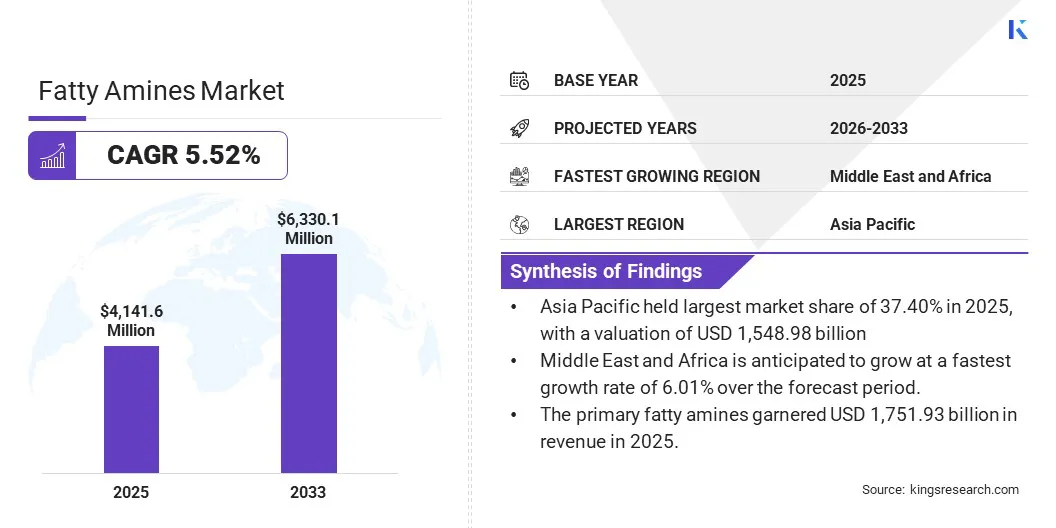
The fatty amines market size was valued at USD 4,141.67 million in 2025 and is projected to grow from USD 4,345.37 million in 2026 to USD 6,330.14 million by 2033, exhibiting a CAGR of 5.52 % over the forecast period. The market is experiencing rapid growth due to diverse applicability of fatty amines across key industries comprising agrochemicals, water treatment, personal care, and oilfields. Their application as potential corrosion inhibition, surfactants, and formulation enhancers to improve industrial performance fuels their adoption.
Major companies operating in the global market are Arkema, Akzo Nobel N.V., Albemarle Corporation, CLARIANT, Eastman Chemical Company, Evonik Industries AG, Global Amines Company Pte. Ltd., Huntsman, and Indo Amines Limited, Ascend Performance Materials, PT. Ecogreen Oleochemicals, Formosa Plastics Corporation, U.S.A., India Glycols Ltd., Kao Corporation, and KLK OLEO.
The applicability of fatty amines as biodegradable, low-toxic, and bio-based surfactants drives market growth. This enables market players to increase production and facility expansion.
The application of fatty amines in the production of diverse agrochemical solutions acts as a major driver towards their growth. The potential of fatty amines in enhancing the effectiveness of herbicides, fungicides, and insecticides by enabling targeted delivery and improving plant absorption acts as a major catalyzing factor driving their growth.
Additionally, the cationic properties of fatty amines that enhance adhesion to plant surfaces in addition with improving efficiency and reducing environmental impact, further act as a major driving factor for market growth.
Rising concerns over toxicity, biodegradability, and potential bioaccumulation of fatty amines in soil layers and water bodies restrict their usage to specific applications. The imposition of stringent regulations results in increased compliance costs for fatty amine producers, which results in restricted potential and growth avenues for the market.
To address this challenge, market players are aligning strategies with evolving regulatory frameworks such as the REACH or RoHS directive. This drives the shift toward greener chemistry technologies and biodegradable amine-based production.
Major players operating in the fatty amines industry are adopting innovative strategies involving the use of biodegradable materials to improve the productivity and efficacy of fatty amines while simultaneously promoting sustainability. The rising shift toward sustainability is compelling manufacturers to incorporate biodegradable raw materials and environmentally friendly manufacturing practices to pose less strain on the environment.
The development of cobalt-based catalytic technologies is enabling the hydrogenative depolymerization of polyesters and biogenic waste to produce high-value amine compounds. The process is utilized for the one-pot production of primary fatty amines from used cooking oil which offers an efficient and sustainable alternative to conventional multi-step industrial synthesis processes.
|
Segmentation |
Details |
|
By Type |
Primary, Secondary, Tertiary |
|
By Application |
Agrochemicals, Oilfield Chemicals, Personal Care, Chemical Synthesis, Water Treatment, Others |
|
By Region |
North America: U.S., Canada, Mexico |
|
Europe: France, UK, Spain, Germany, Italy, Russia, Rest of Europe |
|
|
Asia-Pacific: China, Japan, India, Australia, ASEAN, South Korea, Rest of Asia-Pacific |
|
|
Middle East & Africa: Turkey, U.A.E., Saudi Arabia, South Africa, Rest of Middle East & Africa |
|
|
South America: Brazil, Argentina, Rest of South America |
Based on region, the global fatty amines market has been classified into North America, Europe, Asia Pacific, Middle East & Africa, and South America.
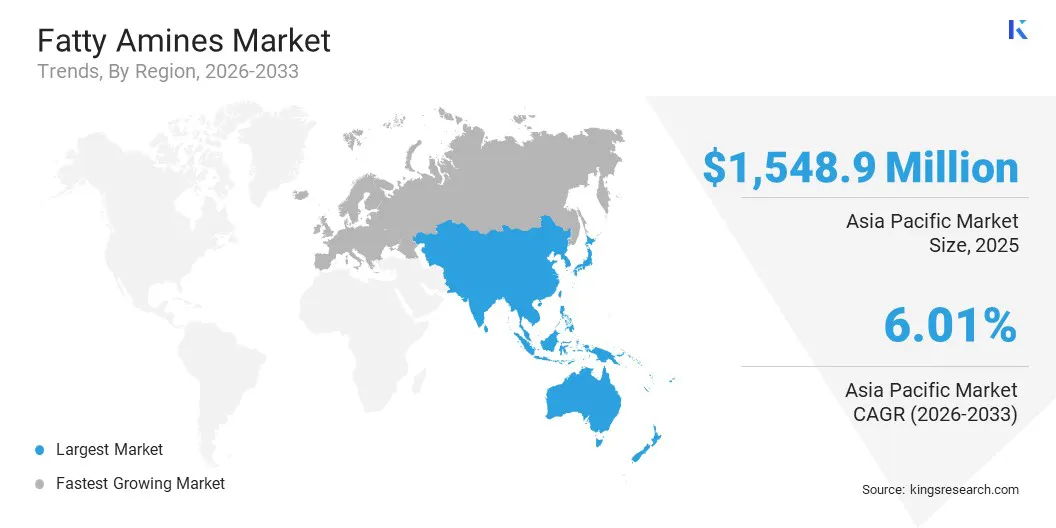
Asia Pacific accounts for the dominant market share, approximating 37.40% in 2025. The high share is attributable to the presence of a relatively larger industrial sector, rapid urbanization, and the surge in demand for agrochemicals, personal care, and water treatment facilities. The strong growth in agricultural activity across prominent Asian economies, including China, India, and Southeast Asia, further drives the demand for fatty amines, owing to their widespread consumption as emulsifiers and wetting agents in agrochemical formulations.
Additionally, increasing disposable income, leading to transforming lifestyles, fuels the demand for personal care and cosmetic products across Asian economies. This promotes the demand for fatty amines due to their applicability in personal care and cosmetic products such as conditioners, creams, and lotions for product formulation.
North America held nearly 26.80% share in the global market. The growth in the region is due to established industrial manufacturing infrastructure, which necessitates chemical formulations including corrosion inhibitors, demulsifiers, friction modifiers, and anti-wear additives in order to safeguard aging assets and optimize high-tech machinery.
Additionally, the strong demand for water treatment solutions across the U.S. and Canada due to stringent environmental regulations regarding the use of specific chemicals in water treatment methodologies further drives their demand.
Competitive Landscape
Key players in fatty amines market are undertaking sustainable and renewable feedstock integration to cater to evolving environmental regulations and consumer demands. Companies are investing significantly in R&D to develop biomass-balanced amine chemistries, thereby reducing dependence on fossil-based raw materials and introducing bio-attributed intermediates and amine derivatives through certified supply chains and mass balance approaches.
This enables downstream industries such as personal care, surfactants, and paper chemicals to transition to lower-carbon raw materials without major process modifications, thus supporting broader decarbonization goals across the chemical industry.
Frequently Asked Questions

Faizy brings over four years of experience in market research and consulting, with a proven ability to support strategic engagements across diverse industries and business environments. His work focuses on understanding complex market structures, identifying emerging opportunities, and translating research findings into clear, commercially relevant insights. With strong analytical capabilities and a structured approach to problem-solving, he evaluates industry trends, competitive landscapes, customer dynamics, and evolving business models. His expertise encompasses market research, competitive intelligence, market sizing and forecasting, industry assessment, company benchmarking, and strategic analysis. Faizy combines technical proficiency with a strong research orientation, enabling him to interpret both qualitative and quantitative information effectively. He has contributed to projects that help organizations assess growth potential, strengthen market positioning, and evaluate strategic priorities. His adaptable approach allows him to work across sectors while maintaining a consistent focus on accuracy, relevance, and delivering insights that support informed decision-making for clients and stakeholders.

Ganapathy Subramaniam Suresh
With over a decade of research leadership across global markets, Ganapathy brings sharp judgment, strategic clarity, and deep industry expertise. Known for precision and an unwavering commitment to quality, he guides teams and clients with insights that consistently drive impactful business outcomes.