
Inquire Now
Key Strategic Points
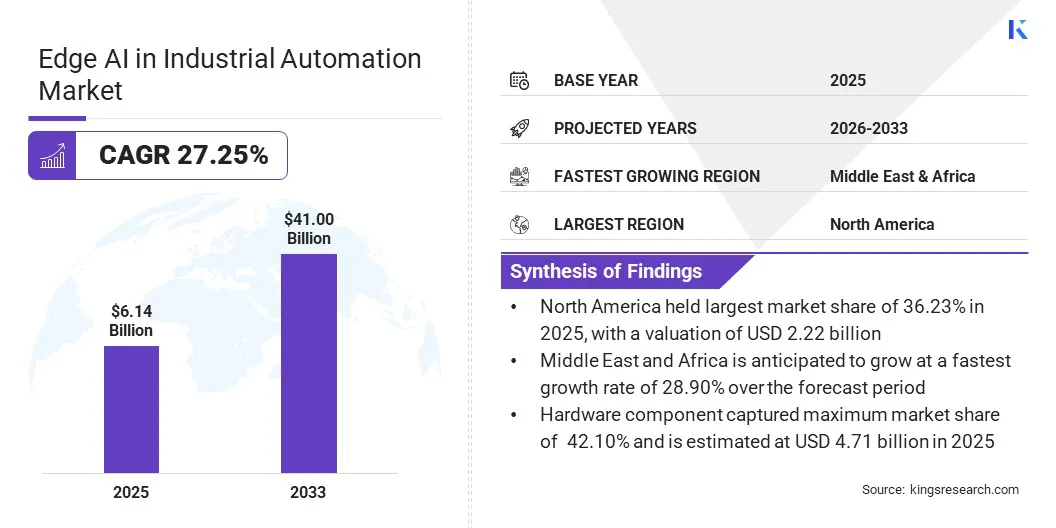
According to Kings Research, the global edge AI in industrial automation market size was recorded at USD 6.14 billion in 2025 and is projected to reach USD 41 billion by 2033, growing at a CAGR of 27.25% from 2026 to 2033. The increasing adoption of artificial intelligence at the industrial edge is a significant factor driving market growth, as edge AI enables real-time data processing, faster decision-making, reduced latency, improved data privacy, and lower bandwidth requirements.
The edge AI in the industrial automation market involves deploying artificial intelligence algorithms on edge devices such as sensors, cameras, industrial controllers, industrial PCs, and edge gateways. By processing data closer to the point of generation, edge AI enables industrial systems to analyze operational information in real time without relying entirely on centralized cloud infrastructure.
The technology is increasingly being used for equipment monitoring, predictive maintenance, automated quality inspection, anomaly detection, process optimization, and intelligent production control. Edge AI can also filter data at the source, reducing the volume of information transmitted to centralized systems and lowering network and computing requirements.
The growing adoption of Industry 4.0, industrial IoT, robotics, smart factories, and AI-enabled automation is further expanding the addressable market. The transition from centralized AI toward distributed intelligence is particularly important for high-mix production environments that require flexibility, scalability, and rapid responses.
In this study, the report covers companies such as ABB, ARM Limited, CEVA Inc., Honeywell International Inc., Infineon Technologies AG, Mitsubishi Electric Corporation, Nutanix, NVIDIA Corporation, Rockwell Automation, Siemens, SINTRONES Technology Corp., STMicroelectronics, Synaptics Incorporated, Tata Elxsi, and Yokogawa Electric Corporation.
The shift of artificial intelligence (AI) from centralized cloud infrastructure toward the industrial edge is accelerating the adoption of edge AI in industrial automation. Manufacturers increasingly require AI systems capable of processing operational data locally to support real-time decision-making, particularly in high-mix production environments where rapid responses and flexible automation are essential.
Edge AI-integrated automation solutions provide low-latency processing, improved performance per watt, scalability across industrial devices, and greater control over operational data. These capabilities support applications such as predictive maintenance, automated inspection, anomaly detection, process monitoring, and intelligent robotics.
The increasing deployment of connected industrial equipment is further strengthening demand. Sensors, cameras, controllers, robotics, and industrial machines continuously generate large volumes of operational data. Processing this information closer to the production line allows manufacturers to identify abnormalities and respond to changing conditions without transferring every data point to centralized cloud infrastructure.
Security, data privacy, legacy-system integration, and data silos remain significant challenges to the adoption of edge AI in industrial automation. Unlike centralized cloud environments, industrial edge architectures can involve large numbers of distributed devices deployed throughout production facilities, increasing the potential cybersecurity attack surface.
Manufacturers must therefore implement device authentication, encryption, secure boot mechanisms, network segmentation, firmware management, and continuous monitoring. These requirements can increase deployment complexity and operational costs.
Integration with legacy operational technology infrastructure represents another challenge. Existing industrial controllers, SCADA systems, machinery, and production software may not have been designed to communicate with modern AI platforms. Connecting these systems can require additional gateways, software, hardware upgrades, and integration expertise.
Industrial AI agents are emerging as a key trend as manufacturers move toward more autonomous production environments. These systems can analyze operational information, coordinate machines, adjust production parameters, identify quality issues, and optimize workflows with limited human intervention.
The integration of AI agents with edge computing enables time-sensitive decisions to be performed closer to industrial equipment. This can improve production responsiveness and reduce dependence on centralized systems.
AI-powered computer vision is also becoming increasingly important in manufacturing. Edge-based vision systems can process images locally to identify product defects, monitor production lines, conduct automated inspections, and initiate corrective actions.
|
Segmentation |
Details |
|
By Component |
Hardware, Software, Services |
|
By Organization Size |
Large Enterprises, Small and Medium Enterprises (SMEs) |
|
By Deployment Mode |
Cloud-based, On-Premise |
|
By End-User Industry |
Automotive, Aerospace & Defense, Manufacturing, Food & Beverage, Pharmaceuticals, Chemicals, Others |
|
By Region |
North America: U.S., Canada, Mexico |
|
Europe: France, UK, Spain, Germany, Italy, Russia, Rest of Europe |
|
|
Asia-Pacific: China, Japan, India, Australia, ASEAN, South Korea, Rest of Asia-Pacific |
|
|
Middle East & Africa: Turkey, U.A.E., Saudi Arabia, South Africa, Rest of Middle East & Africa |
|
|
South & Central America: Brazil, Argentina, Rest of South & Central America |
Based on the component, the market is categorized into hardware, software, and services. According to Kings Research, the hardware segment captured the largest market share in 2025 and is estimated to register a CAGR of 26.11% over the forecast period.
Industrial edge AI applications require processing devices such as industrial PCs, sensors, GPUs, processors, AI accelerators, controllers, and edge gateways to execute AI workloads locally.
The increasing adoption of computer vision, predictive maintenance, robotics, and intelligent industrial control is creating demand for rugged, energy-efficient, and high-performance hardware capable of operating within demanding industrial environments.
Based on organization size, the market is categorized into large enterprises and small and medium enterprises (SMEs).
Large enterprises remain important adopters because they operate multiple manufacturing facilities and possess the financial and technical resources required to implement AI-enabled automation across production networks.
At the same time, SMEs represent an increasingly important growth opportunity as edge AI solutions become more scalable and accessible. Local processing can enable smaller manufacturers to implement targeted automation applications without making extensive investments in centralized cloud infrastructure.
The SME segment is projected to reach USD 18.82 billion by 2033, supported by increasing adoption of scalable edge devices and automation solutions.
Based on deployment mode, the market is categorized into cloud-based and on-premises models.
The cloud-based segment held a 52.07% share in 2025. Cloud-connected edge AI environments provide manufacturers with scalability, remote access, centralized management, data integration, and cross-site analytics.
The combination of edge and cloud infrastructure allows latency-sensitive AI inference to occur locally while selected data can be transferred to centralized platforms for model training, long-term analytics, enterprise reporting, and fleet management.
On-premises deployment remains relevant for manufacturers that prioritize local data control, security, low latency, offline functionality, and strict operational requirements.
Based on end-user industry, the market is categorized into Automotive, Aerospace & Defense, Manufacturing, Food & Beverage, Pharmaceutical, Chemicals, and Others.
The automotive segment accounted for a 35.20% share in 2025 and is projected to reach USD 19.19 billion by 2033.
Automotive manufacturing relies extensively on robotics, automated inspection, industrial controllers, machine vision, and connected production systems. Edge AI enables sensor and production data to be analyzed directly on the production line, supporting predictive maintenance, quality inspection, and process optimization.
The chemicals segment is anticipated to register a CAGR of 27.37% and reach USD 4.20 billion by 2033. Edge AI can support continuous process monitoring, equipment health monitoring, anomaly detection, safety applications, and process optimization.
Aerospace & defense manufacturers can use edge AI for automated inspection, predictive maintenance, and intelligent production. Food & beverage manufacturers can deploy the technology for quality inspection, equipment monitoring, and production optimization, while pharmaceutical companies can use AI-enabled automation to improve process monitoring and manufacturing consistency.
Based on region, the market has been classified into North America, Europe, Asia Pacific, Middle East & Africa, and South and Central America.
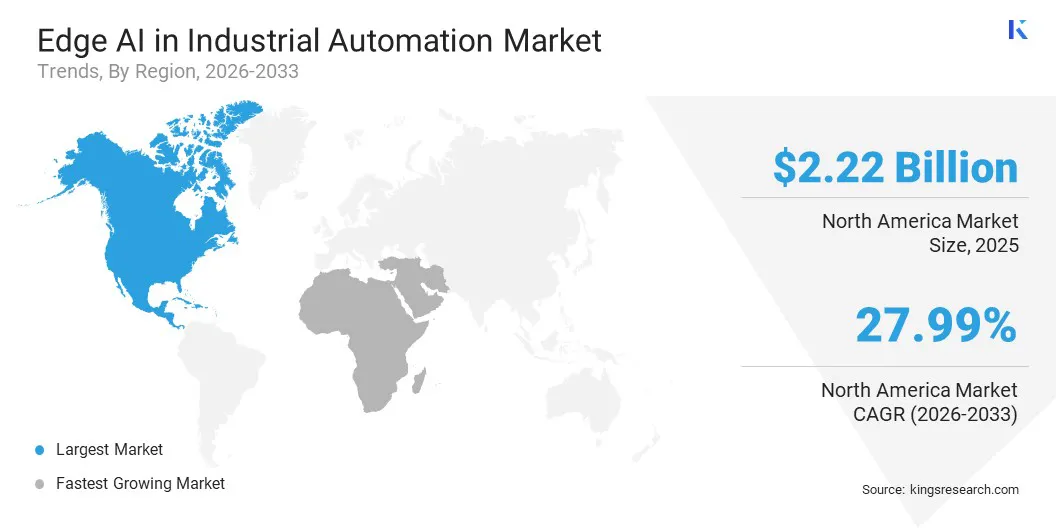
According to Kings Research, North America dominates the market with a share of 36.23% in 2025 due to its advanced digital infrastructure, strong presence of AI and semiconductor manufacturing facilities, and an extensive industrial landscape, which facilitates the adoption of Industry 4.0 technologies. This growth is further supported by rising investments in real-time analytics, IoT, and 5G-enabled smart factories.
Additionally, U.S. manufacturers are deploying edge AI for predictive maintenance and autonomous production lines. Its applicability as on-device processing for faster decisions and improved security acts as a significant propeller towards boosting regional market growth and parallelly supporting edge AI deployments in North American industrial sectors.
The market in the Middle East and Africa is anticipated to register the fastest growth, with a projected CAGR of 28.90% over the forecast period. Rapid industrial digitalization, smart city initiatives, investments in oil & gas automation, and government efforts to modernize infrastructure with AI are leading to the widespread adoption of edge AI in industrial automation. Additionally, the rising demand for real-time monitoring in remote, infrastructure-intensive environments like oil and gas for autonomous inspections and safety monitoring is fostering domestic market expansion.
Europe benefits from its strong manufacturing base, Industry 4.0 adoption, and increasing investments in smart factories and industrial AI. Asia-Pacific is driven by rapid industrialization and the growing deployment of robotics, industrial IoT, semiconductors, and AI-enabled manufacturing across major economies. The Middle East & Africa is witnessing increasing adoption through industrial digitalization, oil & gas automation, smart infrastructure, and AI investments. South & Central America is experiencing growing demand from the automotive, mining, energy, food & beverage, and manufacturing industries, particularly in Brazil. Overall, expanding industrial automation, smart manufacturing, and the growing need for real-time data processing are supporting the adoption of edge AI across these regions.
The edge AI in industrial automation market is growing significantly due to the rise in investments by industrial enterprises in technologies that enable real-time data processing, predictive maintenance, efficient production methodologies, and autonomous decision-making at the edge. Market players are integrating sensor data, edge computing, and AI to optimize operations, improve system efficiency, and reduce latency across industrial environments.
Market players are introducing technologies that involve the fusion of computer vision, AI, machine learning, and edge analytics to enhance process automation, quality inspection, and equipment monitoring. The solutions enable on-site intelligence, which facilitates faster response to anomalies, leading to enhanced asset performance and more efficient industrial workflows.
How We Gather This Information
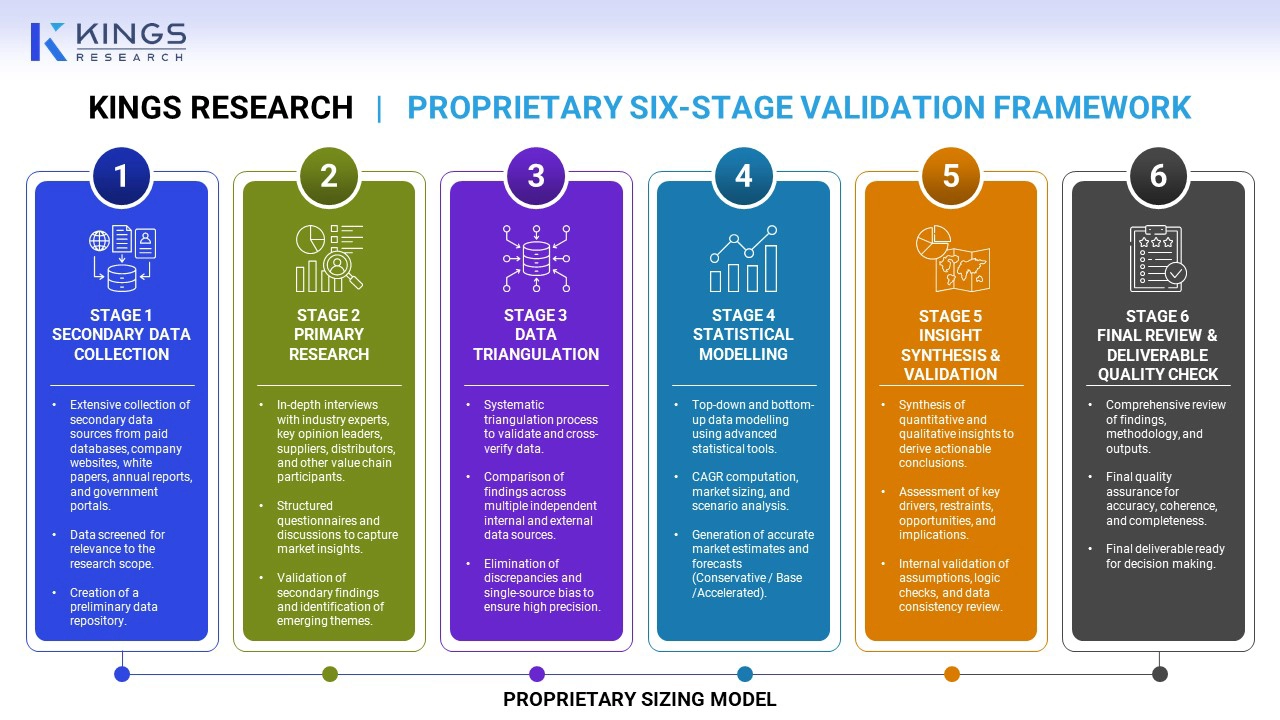
Our methodology triangulates insights from multiple independent and publicly available research databases and is further validated against regulatory filings and public company disclosures. All estimates are cross-verified; no single-source data is presented without validation.
Our custom offerings deliver tailored, data-driven intelligence and strategic guidance to help organizations identify, evaluate, and capitalize on key market opportunities.
Frequently Asked Questions

Faizy brings over four years of experience in market research and consulting, with a proven ability to support strategic engagements across diverse industries and business environments. His work focuses on understanding complex market structures, identifying emerging opportunities, and translating research findings into clear, commercially relevant insights. With strong analytical capabilities and a structured approach to problem-solving, he evaluates industry trends, competitive landscapes, customer dynamics, and evolving business models. His expertise encompasses market research, competitive intelligence, market sizing and forecasting, industry assessment, company benchmarking, and strategic analysis. Faizy combines technical proficiency with a strong research orientation, enabling him to interpret both qualitative and quantitative information effectively. He has contributed to projects that help organizations assess growth potential, strengthen market positioning, and evaluate strategic priorities. His adaptable approach allows him to work across sectors while maintaining a consistent focus on accuracy, relevance, and delivering insights that support informed decision-making for clients and stakeholders.
Habi is a seasoned research and consulting leader with renowned experience in guiding clients on strategic growth and transformation initiatives across global markets. He has led high-performing research teams that deliver actionable insights on market expansion, M&A strategies, opportunity assessment, new business development, and product launches. His project portfolio spans large petrochemical producers, electronic device manufacturers, lubricants companies, and other leading enterprises across diverse industrial and consumer sectors. He currently heads the research department at Kings Research, where he is responsible for setting the research agenda, mentoring analysts, and ensuring client-ready deliverables that support executive decision-making. With extensive experience in market intelligence, strategic research, and consulting, Habi brings a strong understanding of evolving industry dynamics, competitive landscapes, emerging opportunities, and business growth challenges. His expertise includes developing research frameworks, translating complex market data into actionable strategic recommendations, and working closely with senior stakeholders to address critical business questions. He has also contributed to building research capabilities, strengthening analytical methodologies, and driving a culture of quality and insight-led decision-making within research teams. His cross-industry exposure enables him to connect market trends with broader business implications and provide perspectives that help organizations identify opportunities, mitigate risks, and make informed strategic decisions.