
Inquire Now
Key strategic points
According to Kings Research, the global desktop virtualization market size was valued at USD 15.22 billion in 2025 and is projected to grow from USD 16.45 billion in 2026 to USD 30.50 billion by 2033, registering a CAGR of 9.22% from 2026 to 2033. The market encompasses technologies and services that separate desktop environments and associated software from the physical devices used to access them, including hosted virtual desktops, hosted shared desktops, and Desktop-as-a-Service (DaaS).
The market is primarily supported by the growing demand for secure and flexible digital workspaces, as organizations seek to protect data while providing distributed workforces with consistent access to corporate applications across devices. The strategic shift toward hybrid environments, which combine on-premises infrastructure with cloud-native solutions like DaaS, is also driving market growth by improving scalability, performance, and cost efficiency.
Major companies operating in the global desktop virtualization market include Microsoft, Cloud Software Group, Inc., Omnissa, LLC, Amazon Web Services, Inc., Nutanix, Google, Parallels International GmbH, Workspot, Nerdio, V2Cloud Solutions, Inc., Oracle, IBM, Hewlett Packard Enterprise Development LP, Cisco Systems, Inc., and Dizzion.
Organizations are increasingly deploying desktop virtualization to deliver resource-intensive applications to remote users while maintaining data integrity. By centralizing application processing and enforcing uniform security policies, these solutions reduce the risk of sensitive intellectual property being exposed on endpoints, while also improving productivity and providing a user experience similar to local hardware.
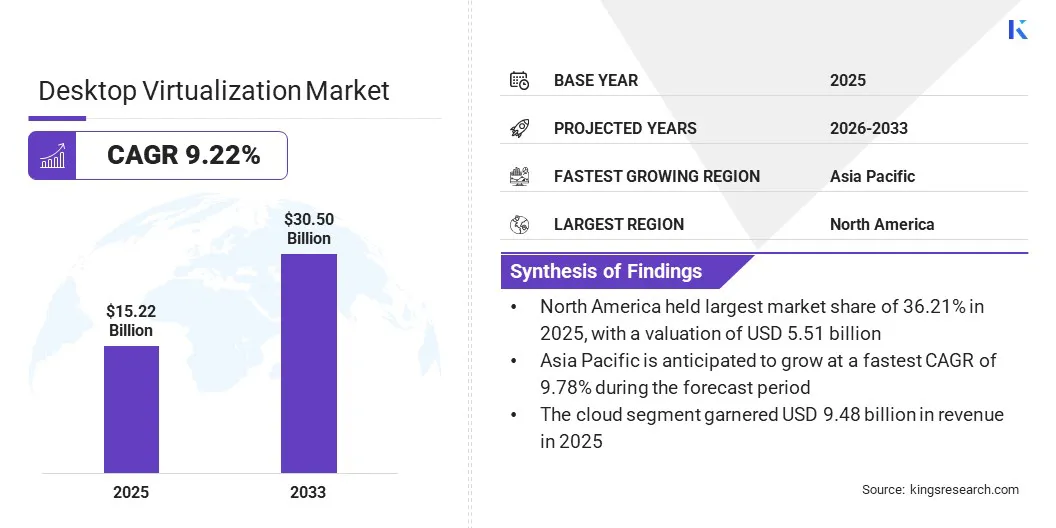
The growing need for secure and versatile digital workspaces is accelerating the adoption of desktop virtualization worldwide. Organizations use virtual desktops to provide remote employees with consistent access to corporate applications and data from different devices, while reducing hardware requirements and improving operational flexibility.
Desktop virtualization also supports centralized data management and endpoint protection. Technologies such as Virtual Desktop Infrastructure (VDI) and Desktop-as-a-Service (DaaS) centralize IT administration, allowing organizations to scale computing resources rapidly and maintain business continuity during disruptions.
In December 2025, Sopra Steria and Nerdio established a strategic partnership to enhance the delivery of desktop virtualization solutions on Microsoft Azure. The collaboration combines Sopra Steria's managed services with Nerdio's automation technology to simplify the implementation and management of Azure Virtual Desktop and Windows 365, including automated scaling and standardized configurations.
High initial infrastructure costs and strong dependence on reliable network connectivity remain major challenges for the desktop virtualization market. Traditional virtual desktop infrastructure requires powerful centralized servers and high-speed storage, creating significant capital requirements, particularly for small and medium-sized enterprises.
The need to process and manage large volumes of information online also makes virtual desktop performance vulnerable to latency, connectivity issues, and network disruptions, which can negatively affect user experience and productivity. Providers are addressing these challenges through cloud-based delivery models, improved compression technologies, local caching, edge computing, and hybrid-cloud protocols designed to reduce hardware requirements and bandwidth dependence.
The growing adoption of hybrid desktop virtualization environments is emerging as a key trend in the market. Hybrid models integrate existing on-premises infrastructure with public cloud capabilities, enabling organizations to retain control over sensitive data while using cloud resources for scalability, flexibility, and disaster recovery.
In November 2025, Microsoft introduced a preview of Azure Virtual Desktop for hybrid environments, enabling Arc-enabled on-premises servers to function as session hosts. The development extends cloud-native desktop virtualization to infrastructures such as VMware vSphere, Nutanix AHV, and physical servers, supporting unified management and compliance requirements.
|
Segmentation |
Details |
|
By Desktop Delivery Platform |
Hosted Virtual Desktop (HVD), Hosted Shared Desktop (HSD), Desktop-as-a-Service (DaaS)/Other Forms |
|
By Deployment |
Cloud, On-Premises |
|
By Organization Size |
Large Organizations, SMEs |
|
By End User |
IT & Telecom, Financial Services, Government & Public Sector, Healthcare, Retail & E-Commerce, Manufacturing, Education, Others |
|
By Region |
North America: U.S., Canada, Mexico |
|
Europe: France, UK, Spain, Germany, Italy, Russia, Rest of Europe |
|
|
Asia-Pacific: China, Japan, India, Australia, ASEAN, South Korea, Rest of Asia-Pacific |
|
|
Middle East & Africa: Turkey, U.A.E., Saudi Arabia, South Africa, Rest of Middle East & Africa |
|
|
South & Central America: Brazil, Argentina, Rest of South & Central America |
Based on desktop delivery platform, the market is categorized into Hosted Virtual Desktop (HVD), Hosted Shared Desktop (HSD), and Desktop-as-a-Service (DaaS)/Other Forms. According to Kings Research, the Hosted Virtual Desktop (HVD) segment earned USD 7.02 billion in 2025, primarily due to its ability to provide users with dedicated, high-performance computing environments that replicate traditional physical PCs.
HVD solutions are particularly attractive to organizations requiring high levels of data isolation and customization for specialized workloads. The growing demand for consistent desktop experiences, where user settings and data remain available across sessions, is further supporting adoption in security-conscious industries.
Based on deployment, the market is categorized into cloud and on-premises. According to Kings Research, the cloud segment held a share of 62.31% in 2025, supported by its scalability, lower upfront capital requirements, and ability to support distributed workforces without extensive infrastructure management. Cloud-based desktop virtualization enables IT teams to provision resources rapidly in response to changing demand while leveraging the security infrastructure of major cloud providers. In addition, subscription-based models allow organizations to align IT expenditure with actual usage, improving financial flexibility during digital transformation initiatives.
Based on organization size, the market is categorized into large organizations and SMEs. According to Kings Research, the large organization segment is projected to reach USD 16.34 billion by 2033, driven by the need to manage large numbers of distributed endpoints while maintaining corporate governance and compliance.
Large enterprises generally have complex IT environments and the financial capacity to deploy sophisticated virtualization platforms integrated with identity management and security systems. Their focus on centralized administration and reducing the total cost of ownership across multiple workstations further supports adoption.
Based on end users, the market is segmented into IT & telecom, financial services, government & public sector, healthcare, retail & e-commerce, manufacturing, education, and others. According to Kings Research, the IT & telecom segment is projected to reach USD 7.77 billion by 2033, supported by the sector's continued focus on software development, remote technical support, and secure sandbox environments.
IT and telecom companies use virtual desktops to provide developers and technical teams with secure access to proprietary code and sensitive systems while reducing the risk of data leakage on local hardware. The expansion of 5G networks and increasingly complex network-management requirements are further creating demand for flexible virtualized workspaces accessible from different locations.
Based on region, the desktop virtualization market is classified into North America, Europe, Asia-Pacific, Middle East & Africa, and South & Central America.
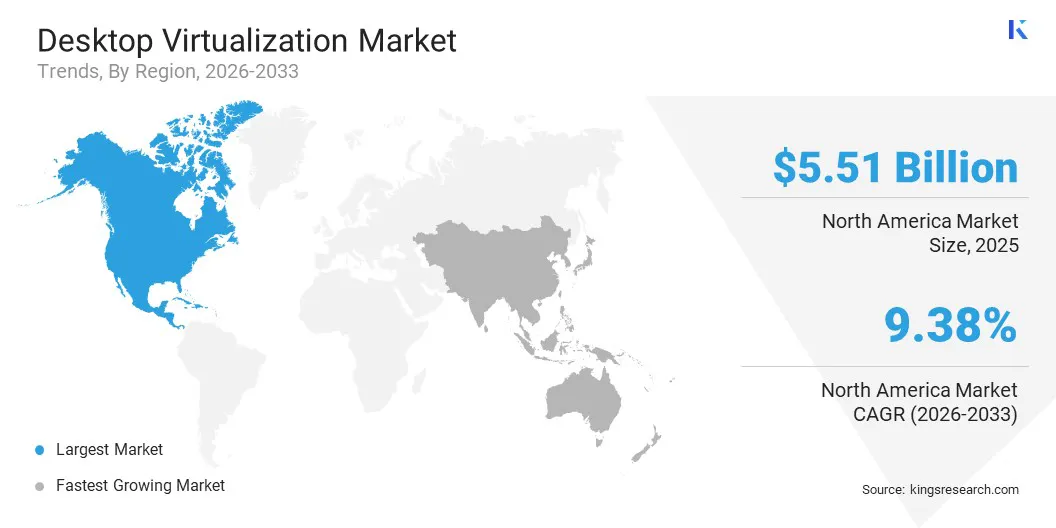
North America accounted for a substantial share of 36.21% in 2025, valued at USD 5.51 billion, supported by the strong presence of major IT and cloud service providers and early adoption of virtual workspace technologies. Growing use of AI-supported usage analytics and automated lifecycle management is enabling organizations to optimize resource consumption across virtual desktops.
Asia-Pacific is expected to register the fastest CAGR of 9.78% over the forecast period, driven by large-scale digital transformation initiatives in China and India. The expansion of mobile-first workforces, regional IT services, smart-city projects, and cloud infrastructure investments is increasing demand for scalable and cost-effective virtual desktop solutions.
Europe is seeing stronger desktop virtualization potential as cloud adoption expands, with 52.7% of EU enterprises using paid cloud services in 2025, which supports cloud-based virtual desktop deployment. Ongoing digital transformation, cloud migration, and the need for secure, centrally managed access to enterprise applications across distributed workforces are driving support for MEA. South and Central America are gradually adopting virtual desktop environments as organizations modernize IT infrastructure and seek flexible, cost-efficient remote access solutions.
The major players in the desktop virtualization market are forming alliances to offer customers greater choices. Key software vendors are working with cloud infrastructure pioneers to increase deployment options. These partnerships enable organizations to operate virtual applications on more than one private and public cloud. Meanwhile, platform developers are collaborating with hardware vendors to deliver compatibility with various devices. These alliances assist in easing the delivery of complicated workloads to distant users.
Such collaborations also incorporate advanced security features within the virtualization layer. These strategic associations make virtual desktops more flexible and manageable. They facilitate the transition to hybrid-work systems and adaptable online workplaces. This kind of cooperation across the industry speeds up the implementation of newer, software-defined infrastructure.
How We Gather This Information
Our methodology triangulates insights from multiple independent and publicly available research databases and is further validated against regulatory filings and public company disclosures. All estimates are cross-verified; no single-source data is presented without validation.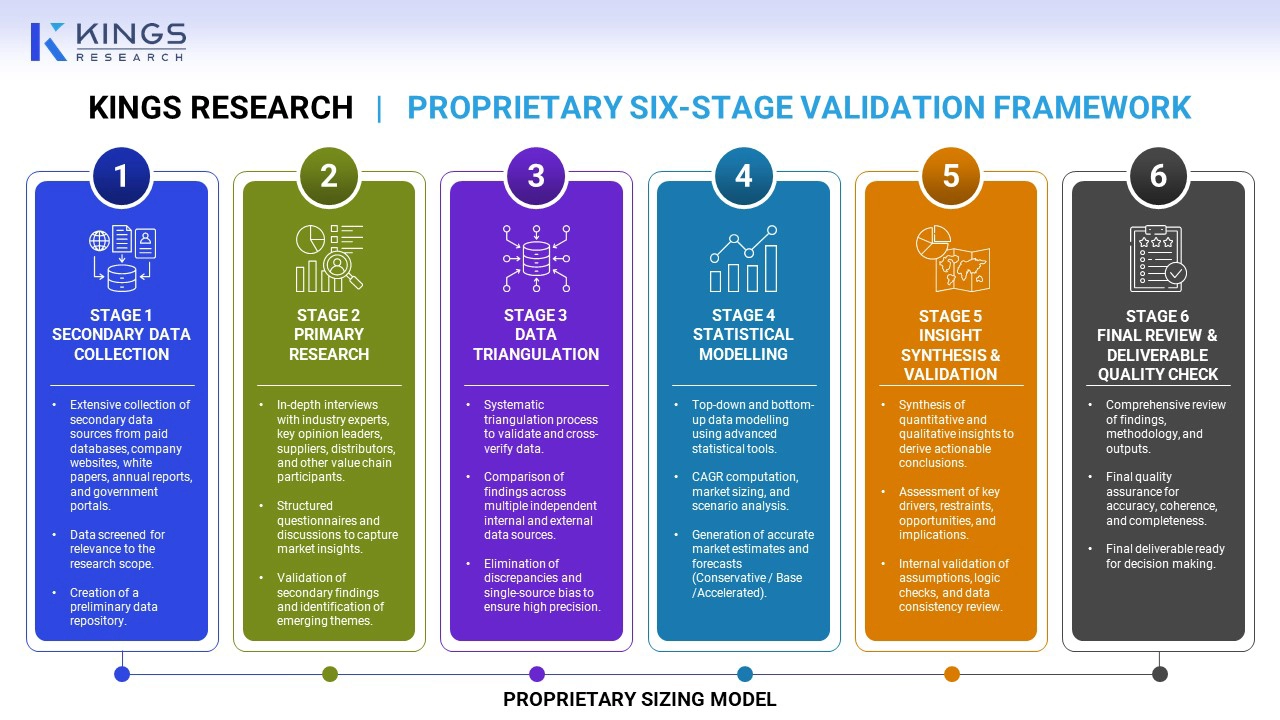
Our custom offerings deliver tailored, data-driven intelligence and strategic guidance to help organizations identify, evaluate, and capitalize on key market opportunities.
Frequently Asked Questions

Tejasv specializes in secondary research and data validation, transforming complex information into clear market insights. He supports multi-industry research initiatives by delivering reliable intelligence that informs planning and strategic direction. With a disciplined and detail-focused approach, he emphasizes analytical clarity and practical application. His interest in geopolitics and history informs his broader market perspective. This unique lens allows him to contextualize industry shifts within larger socio-political frameworks, adding depth to his analyses. He maintains rigorous documentation standards, making his findings auditable and easily reproducible. His ability to distill vast amounts of secondary data into concise, decision-ready summaries has earned him the trust of project leads across multiple verticals. Tejasv actively tracks regulatory changes and economic indicators, which he incorporates into his research to enhance its forward-looking relevance. His methodical work ethic, combined with a calm demeanor under tight deadlines, ensures that his contributions remain both timely and impactful.
Habi is a seasoned research and consulting leader with renowned experience in guiding clients on strategic growth and transformation initiatives across global markets. He has led high-performing research teams that deliver actionable insights on market expansion, M&A strategies, opportunity assessment, new business development, and product launches. His project portfolio spans large petrochemical producers, electronic device manufacturers, lubricants companies, and other leading enterprises across diverse industrial and consumer sectors. He currently heads the research department at Kings Research, where he is responsible for setting the research agenda, mentoring analysts, and ensuring client-ready deliverables that support executive decision-making. With extensive experience in market intelligence, strategic research, and consulting, Habi brings a strong understanding of evolving industry dynamics, competitive landscapes, emerging opportunities, and business growth challenges. His expertise includes developing research frameworks, translating complex market data into actionable strategic recommendations, and working closely with senior stakeholders to address critical business questions. He has also contributed to building research capabilities, strengthening analytical methodologies, and driving a culture of quality and insight-led decision-making within research teams. His cross-industry exposure enables him to connect market trends with broader business implications and provide perspectives that help organizations identify opportunities, mitigate risks, and make informed strategic decisions.