
Inquire Now
Key Strategic Points
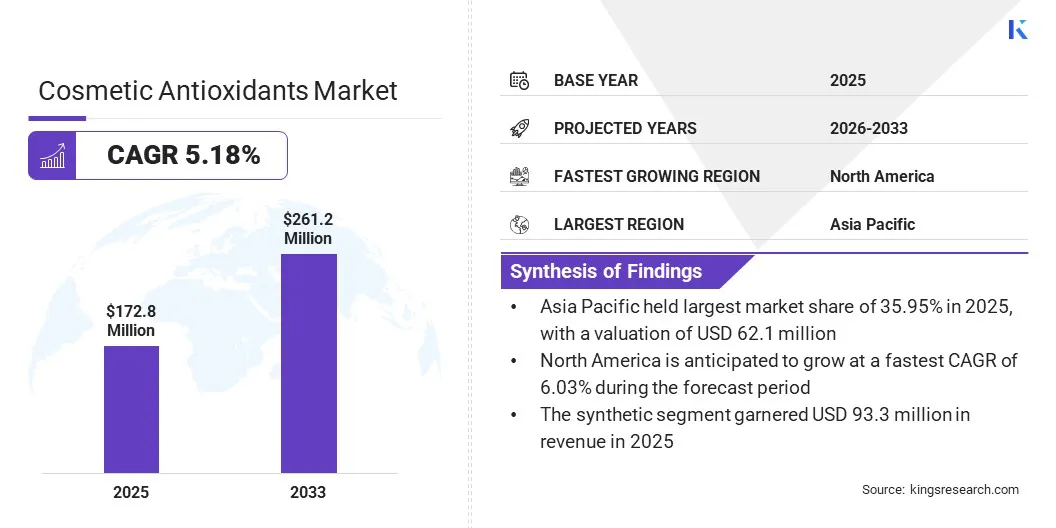
According to Kings Research, the global cosmetic antioxidants industry size was valued at USD 172.8 million in 2025 and is projected to reach USD 261.2 million by 2033, exhibiting a CAGR of 5.18% during the forecast period.
The growth is driven by the increasing adoption of encapsulation technologies that protect sensitive ingredients from degradation and facilitate controlled release in skincare applications.
Rising interest in products targeting wrinkles, fine lines, and other age-related skin concerns is primarily driving the traction of anti-aging solutions among consumers. Skin rejuvenation is catching on and consumers are on the lookout for formulations that restore elasticity, improve skin texture and support barrier repair.
Major companies operating in the cosmetic antioxidants market are BASF SE, Wacker Chemie AG, Evonik Industries AG, Jan Dekker, Nexira, Croda International Plc, Provital, Symrise AG, Corbion NV, Eastman Chemical Company, Ashland, BTSA, The Estee Lauder Companies, SEPPIC and Kemin Industries, Inc.
Antioxidants are being integrated into advanced skincare products to enhance renewal, firmness, and a youthful appearance, underscoring their importance in cosmetic innovation.
Increasing demand for premium skincare and personal care products is one of the major factors driving the growth of the cosmetic antioxidants market. Companies are constantly coming out with advanced antioxidant-based solutions to combat anti-aging concerns, environmental damage, and skin rejuvenation.
Premiumization is a trend across the global skincare and personal care industry, with consumers demanding safe, clinically validated, high-performance products, and antioxidants are now being adopted in serums, creams and specialized treatments.
One of the major challenges hampering the growth of the cosmetic antioxidants market is the presence of counterfeit cosmetic products. They often contain unsafe ingredients which lack efficacy, creating damage to consumer trust and brand credibility. For established companies, who are spending big on innovation, this is a headache, because the fakes eat into sales and reputation.
Therefore, regulators are stepping up their scrutiny and companies are putting in place authentication measures to protect the integrity of their products and the safety of their customers. To meet this challenge, companies are deploying track-and-trace technologies such as QR codes, barcodes and RFID to improve supply chain transparency, and are also increasing collaborations with regulators to reduce the spread of counterfeit and to maintain consumer trust in legitimate cosmetic products.
The increasing use of plant-based and natural antioxidants is one of the major trends that impact the cosmetic antioxidants market. This is due to the increasing consumer preference for clean-label and sustainable skincare. Manufacturers are focusing on botanical extracts such as polyphenols, carotenoids and flavonoids, to provide effective and natural solutions.
The trend is also driven by a growing awareness of ingredient sourcing, safety and regulatory compliance. Companies with standardized natural extracts further help market expansion by expanding their portfolios to maintain consistent efficacy and quality.
|
Segmentation |
Details |
|
By Source |
Synthetic, Natural |
|
By Type |
Vitamins, Carotenoids, Polyphenols, Enzymes, Others |
|
By Function |
Anti-aging, UV-Protection, Cleansing & Conditioning, Moisturizing, Others |
|
By Application |
Skin care, Hair care, Make-up, Others |
|
By Region |
North America: U.S., Canada, Mexico |
|
Europe: France, UK, Spain, Germany, Italy, Russia, Rest of Europe |
|
|
Asia-Pacific: China, Japan, India, Australia, ASEAN, South Korea, Rest of Asia-Pacific |
|
|
Middle East & Africa: Turkey, U.A.E., Saudi Arabia, South Africa, Rest of Middle East & Africa |
|
|
South America: Brazil, Argentina, Rest of South America |
Based on region, the market has been classified into North America, Europe, Asia Pacific, Middle East & Africa, and South America.
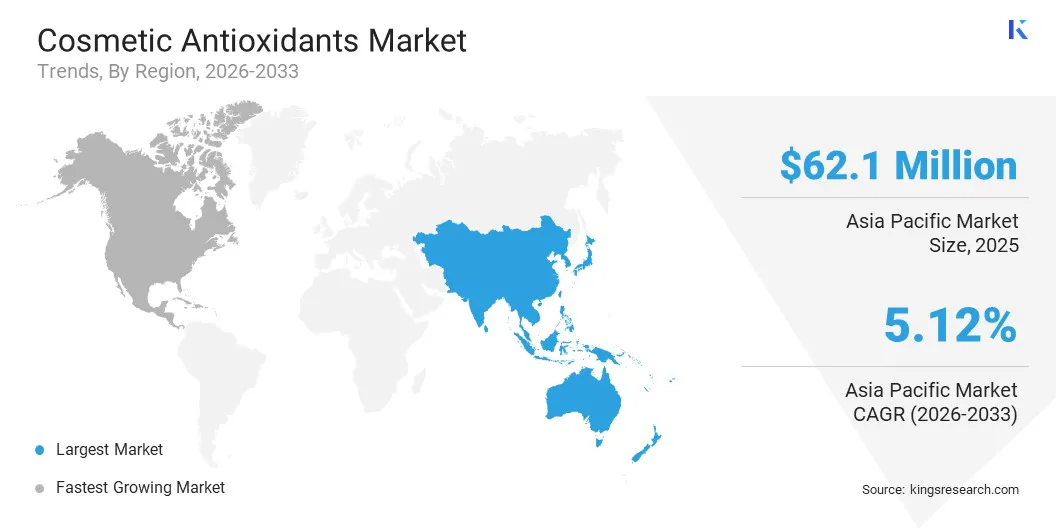
Asia Pacific cosmetic antioxidants market share stood at 35.95% in 2025, valued at USD 62.1 million. This dominance is reinforced by the rising consumer demand for premium skincare formulations that address anti-aging and pollution-related concerns.
Expanding urban populations are increasing awareness of skincare benefits, while regional manufacturers focus on incorporating plant-derived antioxidants into their product portfolios.
North America is estimated to grow at a robust CAGR of 6.03% over the forecast period. This expansion is attributed to the strong consumer preference for dermatologically tested and clinically validated skincare solutions.
The growing popularity of premium anti-aging formulations is particularly boosting the uptake of antioxidant-based creams, serums and specialized treatments. Moreover, the presence of established skincare brands that are committed to innovation in antioxidant formulations further supports product availability and consumer adoption.
Major players in the cosmetic antioxidants market are focusing on expanding their product portfolios by developing stabilized and plant-based antioxidant formulations. To support this, companies are promoting research initiatives to improve ingredient efficacy and product shelf life.
Moreover, strategic alliances are being formed with biotech companies and suppliers of raw materials to guarantee a constant supply of high-quality extracts. In addition to these efforts, market participants are also expanding their regional footprint by strengthening distribution networks.
How We Gather This Information
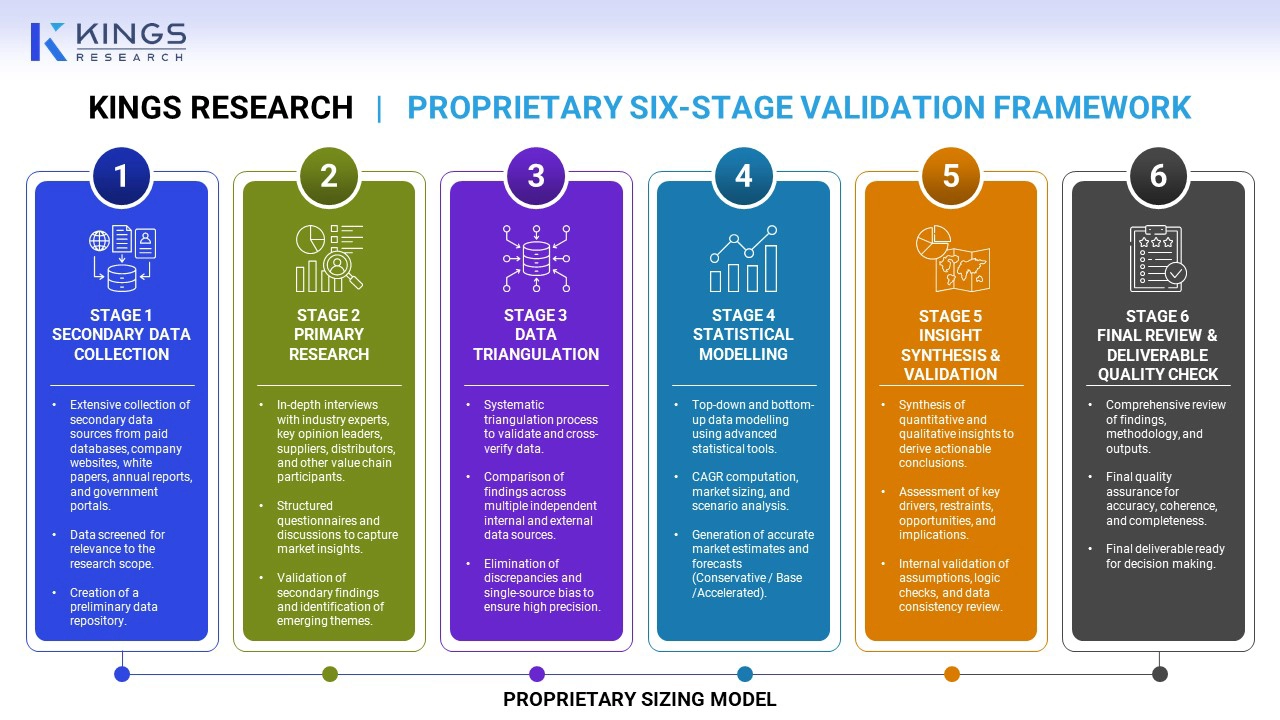
Our methodology triangulates insights from multiple independent and publicly available research databases and is further validated against regulatory filings and public company disclosures. All estimates are cross-verified; no single-source data is presented without validation.
Frequently Asked Questions

Antriksh is an experienced analyst specializing in cross-domain research across diverse industries. With a strong foundation in data analysis and statistical interpretation, he delivers insightful market reports that guide strategic decision-making. Antriksh excels in conducting primary research, with a focus on identifying trends and understanding consumer behavior. Thriving in dynamic and high-pressure environments, he combines analytical expertise with a commitment to delivering impactful outcomes. Beyond his professional pursuits, Antriksh's passion for travel fuels his curiosity and broadens his perspectives, enriching his ability to uncover unique insights that enhance his research capabilities. He is equally adept at synthesizing quantitative findings with qualitative context, which allows him to present holistic viewpoints to clients. His disciplined work ethic and intellectual agility make him a trusted partner in navigating market uncertainties. He consistently seeks out new methodologies to refine his analytical toolkit, and his ability to communicate complex insights clearly ensures stakeholders act confidently on his recommendations.
Smriti Vinodia is a market research and consumer insights professional with expertise in qualitative research, consumer behavior, and strategic market intelligence across the FMCG and FMCD industries. She has experience supporting leading brands by transforming complex consumer and market insights into actionable strategies that inform product development, innovation, positioning, and business growth. Her expertise spans qualitative consumer research, market and competitive intelligence, consumer trend analysis, and AI-enabled insight generation. She has worked across diverse research engagements, helping organizations understand evolving consumer needs, identify emerging market opportunities, and strengthen customer-centric decision-making. Combining analytical rigor with a strong understanding of consumer psychology and market dynamics, Smriti brings a strategic perspective to research and insights. She focuses on connecting consumer behavior with commercial priorities, enabling organizations to make informed decisions, develop relevant products and experiences, and build sustainable growth strategies in rapidly evolving and competitive markets.



.webp&w=128&q=75&dpl=dpl_CJzjB6WVUAT19Reax6v8xwinTPW6)
