
Inquire Now
Key Strategic Points
A coffee roaster is a machine used to heat and transform green coffee beans into roasted coffee through controlled thermal processes. The market encompasses a wide range of equipment, including small-scale artisan models and large industrial roasters, across electric, gas, and hybrid technologies.
Additionally, it includes roasting systems, automation controls, and related accessories used in commercial roasting facilities, cafés, and specialty coffee operations, with applications spanning retail, foodservice, and industrial production worldwide.
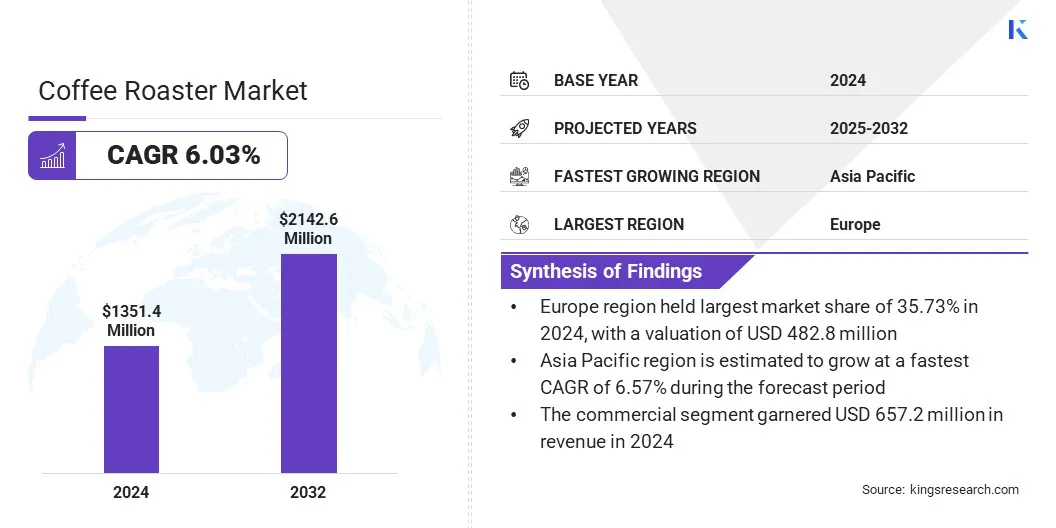
The global coffee roaster market size was valued at USD 1,351.4 million in 2024 and is projected to grow from USD 1,421.9 million in 2025 to USD 2,142.6 million by 2032, exhibiting a CAGR of 6.03% during the forecast period.
Market growth is driven by rising coffee consumption and the widespread adoption of electric roasters, as manufacturers shift toward cleaner energy sources and improved operational efficiency.
Major companies operating in the coffee roaster market are PROBAT SE, Bühler AG, Loring Smart Roast, Inc., Giesen, IMF s.r.l., NEUHAUS NEOTEC Maschinen- und Anlagenbau GmbH, BESCA ROASTERS, Joper Roasters, oper, Garanti Roasters, US Roaster Corp, Behmo, Inc., Hottop Americas LLC, Fuji Kouki Co., Ltd., Stronghold Robotics Inc., and others.
Expansion of coffee shop chains is fueling market growth by increasing demand for high-capacity, consistent roasting solutions across global retail networks. Major brands such as Starbucks and Costa Coffee are scaling rapidly, requiring roasting systems that ensure flavor consistency and operational efficiency.
Equipment providers are aligning technologies with chain-specific requirements and scalable automation. This sustained growth in branded outlets continues to boost demand for advanced roasting systems, supporting broader market expansion.
Rising Coffee Consumption
Rising global coffee consumption is propelling the expansion of the market by increasing demand for roasted coffee products, particularly in emerging economies with increasing per capita intake. This highlights the increased need for high-capacity, efficient roasting systems that deliver consistent quality.
The growing preference for fresh, locally roasted products, fueled by changing consumption habits, urbanization, and demand for premium varieties, is further boosting market expansion.
High Capital Requirements
The coffee roaster market faces significant barriers due to high initial investment and operational costs, particularly affecting small and mid-sized enterprises. Advanced roasting systems require significant capital for procurement, installation, and maintenance, which restricts market entry and slows adoption in cost-sensitive regions.
To mitigate this challenge, manufacturers are introducing modular systems, flexible financing options, and scalable solutions tailored to varying production capacities. These strategic measures are aimed at lowering entry barriers, improving accessibility, and supporting broader market participation.
Rising Adoption of Electric Roasters
A prominent trend influencing the market is the increasing adoption of electric-powered roasters, supported by rising environmental concerns and stringent emission regulations. This transition is prominent in urban areas and sustainability-focused segments, where reducing carbon emissions is a priority.
The shift toward electric models is enabling manufacturers to comply with regulatory standards while improving energy efficiency. This development is strengthening market competitiveness and supporting long-term sustainability goals.
|
Segmentation |
Details |
|
By Type |
Drum Roasters, Hot-Air / Fluid-Bed Roasters, Direct Fire Roasters |
|
By Batch Size |
Small (100 grams to 1 kg), Medium (1 kg to 15 kg), Large (above 15 kg), Industrial (More than 50 kg) |
|
By Application |
Industrial, Commercial, Residential |
|
By Region |
North America: U.S., Canada, Mexico |
|
Europe: France, UK, Spain, Germany, Italy, Russia, Rest of Europe |
|
|
Asia-Pacific: China, Japan, India, Australia, ASEAN, South Korea, Rest of Asia-Pacific |
|
|
Middle East & Africa: Turkey, U.A.E., Saudi Arabia, South Africa, Rest of Middle East & Africa |
|
|
South America: Brazil, Argentina, Rest of South America |
Based on region, the global market has been classified into North America, Europe, Asia Pacific, Middle East & Africa, and South America.
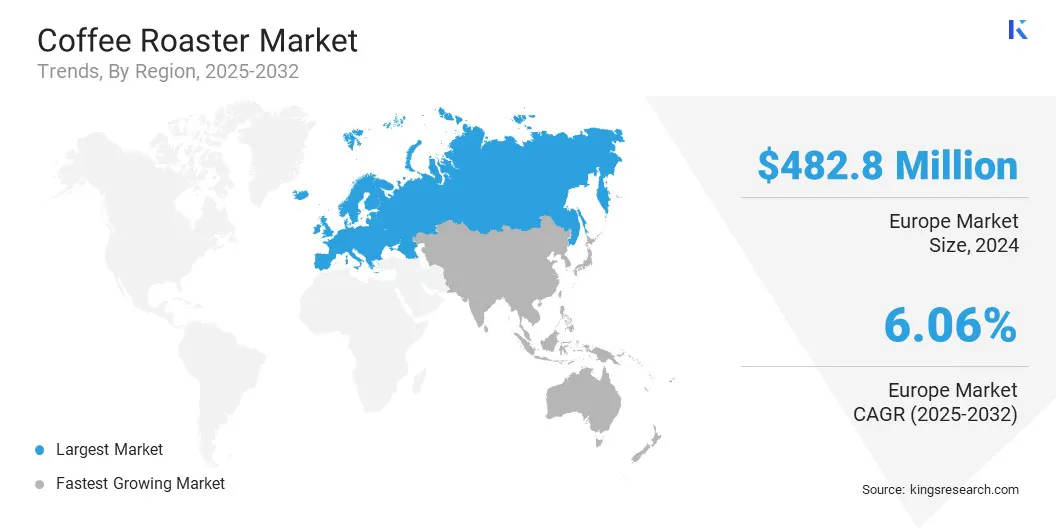
Europe coffee roaster market share stood at 35.73% in 2024, valued at USD 482.8 million. This dominance is attributed to the region's well-established coffee culture, particularly in countries such as Italy, France, and Germany, where consistent demand for high-quality roasted coffee persists.
Consumer preference for premium blends and fresh preparation promotes continuous investment in advanced technologies and artisanal methods by roasters, specialty brands, and equipment manufacturers. These factors contribute to stable market conditions and reinforce Europe’s leading market position.
The Asia-Pacific coffee roaster industry is estimated to grow at a CAGR of 6.57% over the forecast period. This growth is fostered by the rising coffee consumption among millennials in urban centers in China, India, and Vietnam, where changing lifestyles are boosting demand for fresh and specialty coffee.
This has led to increased preference for premium blends and in-store roasting experiences. Moreover, the growth of cafe culture is bolstering demand for commercial roasting equipment aligned with evolving consumer preferences.
These developments are positioning Asia Pacific as the fastest-growing market for coffee roasters, supported by rising disposable income and urban retail expansion.
Key players in the coffee roaster market are focusing on acquisitions and product innovation to enhance capabilities and meet evolving customer demands. Companies are integrating advanced technologies like precision control, automation, and data analytics to improve efficiency and roast quality.
Sustainability is also a key focus, with energy-efficient systems and eco-friendly designs gaining traction. These strategies are helping firms strengthen their market position, support artisanal and commercial roasting needs, and drive innovation across the global coffee industry.
Frequently Asked Questions

Over the years, Versha brings over 15 years of experience managing consulting assignments across industries, including Food and Beverage, Consumer Goods, ICT, Aerospace, and more. Her work has spanned diverse sectors. Her cross-domain expertise and adaptability make her a versatile and dependable professional. She is known for her keen business insight and foresight. With sharp analytical skills and a curious mindset, Versha excels at transforming complex data into actionable insights. She has a proven track record of unraveling market dynamics, identifying trends, and delivering tailored solutions to meet client needs. As a skilled leader, Versha has successfully mentored research teams and directed projects with precision, ensuring high-quality outcomes. Her collaborative approach and strategic vision enable her to turn challenges into opportunities and consistently deliver impactful results. Whether analyzing markets, engaging stakeholders, or crafting strategies, Versha draws on her deep expertise and industry knowledge to drive innovation and deliver measurable value.

Ganapathy Subramaniam Suresh
With over a decade of research leadership across global markets, Ganapathy brings sharp judgment, strategic clarity, and deep industry expertise. Known for precision and an unwavering commitment to quality, he guides teams and clients with insights that consistently drive impactful business outcomes.



.webp&w=128&q=75&dpl=dpl_DPva2LrvfsBdTJm1XZj67UTrvMHL)