
Inquire Now
Key Strategic Points
Cathodic protection is an electrochemical method used to prevent corrosion in metallic structures exposed to corrosive environments such as soil, seawater, or concrete. It functions by converting the protected surface into a cathode of an electrochemical cell through an external current or a sacrificial anode. This process minimizes oxidation reactions, extending asset lifespan and structural reliability.
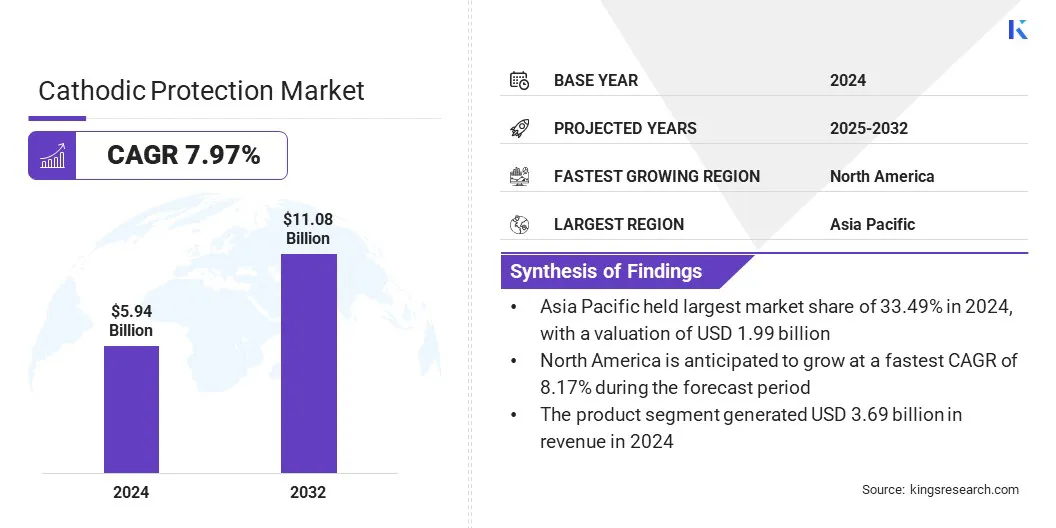
According to Kings Research, the global cathodic protection market size was valued at USD 5.94 billion in 2024 and is projected to grow from USD 6.38 billion in 2025 to USD 11.08 billion by 2032, exhibiting a CAGR of 7.97% during the forecast period.
This growth is driven by the increasing need to rehabilitate deteriorating oil, gas, and water pipelines. Aging infrastructure requires corrosion prevention solutions, accelerating the adoption of cathodic protection systems for long-term asset reliability.
Major companies operating in the global cathodic protection market are MME Group, Cathodic Protection Co. Ltd., Cor-Pro, TC Energy, Deepwater Corrosion Services Inc, Sika Limited, Industrie De Nora S.p.A., Corrtech International Pvt Ltd., MATCOR, Inc., Azuria, BAC Corrosion Control LTD, Mears, Wilson Walton International S.A., Omniflex, and Anotec Industries Ltd.
Market growth is supported by the increasing development of offshore wind farms, subsea pipelines, and marine platforms requiring corrosion protection. Growing investments in renewable and deep-water energy projects are accelerating the use of cathodic protection systems to ensure asset durability and reduce operational risks.
Additionally, the rising replacement of aging offshore assets is further supporting demand, emphasizing the need for technologically advanced systems capable of performing effectively in harsh marine environments.
Stringent regulatory frameworks mandating corrosion prevention across industrial sectors are propelling the growth of the cathodic protection market. International standards established by organizations such as NACE and ISO require the adoption of cathodic protection in pipelines, marine, and infrastructure applications.
Additionally, governments are promoting corrosion management programs to reduce safety risks and environmental damage. These regulations have intensified demand for certified systems, enhancing accountability and system quality. The compliance landscape continues to influence procurement decisions and promotes investment in advanced monitoring and design solutions.
The growth of the market is hindered by a shortage of qualified professionals for system design, installation, and monitoring. Inadequate technical expertise affects performance accuracy and leads to inefficiencies in corrosion management, particularly in emerging economies.
This shortage also increases project delays and dependency on specialized consultants, constraining large-scale deployments. The lack of structured training programs and standardization further restricts workforce development, making it difficult for companies to maintain consistent quality and operational reliability across diverse infrastructure projects.
To address this challenge, companies are investing in workforce development through structured training programs, certification initiatives, and partnerships with technical institutions. Automation, remote monitoring, and AI-assisted diagnostics are streamlining system management, reducing dependency on specialized personnel and improving overall operational consistency.
The market is witnessing a rapid shift toward intelligent monitoring solutions that improve operational control and data transparency. Integration of IoT sensors and cloud-based analytics enables real-time tracking of corrosion activity, enhancing maintenance efficiency and predictive performance.
Asset operators increasingly prefer automated systems that reduce manual inspection costs and ensure continuous compliance with safety standards. This trend supports digital transformation within the industry, aligning cathodic protection with broader asset integrity management frameworks and long-term operational reliability goals.
|
Segmentation |
Details |
|
By Component |
Product, Services |
|
By Type |
Galvanic Anode, Impressed Current, Hybrid |
|
By Application |
Pipeline, Storage facilities, Processing plants, Water & Wastewater, Transportation, Buildings, Others |
|
By Region |
North America: U.S., Canada, Mexico |
|
Europe: France, UK, Spain, Germany, Italy, Russia, Rest of Europe |
|
|
Asia-Pacific: China, Japan, India, Australia, ASEAN, South Korea, Rest of Asia-Pacific |
|
|
Middle East & Africa: Turkey, U.A.E., Saudi Arabia, South Africa, Rest of Middle East & Africa |
|
|
South America: Brazil, Argentina, Rest of South America |
Based on region, the global market has been classified into North America, Europe, Asia Pacific, Middle East & Africa, and South America.
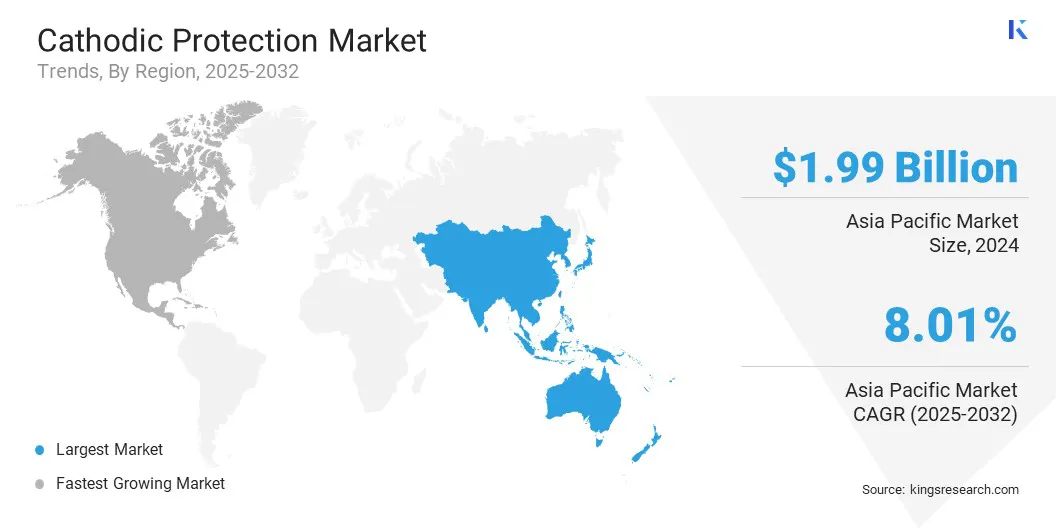
The Asia Pacific cathodic protection market accounted for a share of 33.49% in 2024, valued at USD 1.99 billion. This dominance is supported by extensive investments in oil and gas pipeline networks, marine infrastructure, and industrial facilities requiring corrosion control systems.
Rising construction activity and expanding utility infrastructure are creating a strong demand for both sacrificial anode and impressed current systems. Increasing focus on infrastructure longevity and asset integrity management is driving adoption among industrial operators.
Local manufacturers are enhancing product capabilities through partnerships and technology integration, which is strengthening regional competitiveness and operational efficiency. There is a sustained demand across diverse applications such as pipelines, storage tanks, marine structures, water treatment facilities, and reinforced concrete infrastructure, which is supporting regional market expansion.
The North America cathodic protection industry is projected to grow at a CAGR of 8.17% over the forecast period. This expansion is fostered by increased investments in oil and gas transportation infrastructure and strict regulatory enforcement for corrosion prevention standards.
Rising emphasis on maintenance of existing assets and adoption of advanced monitoring technologies is influencing product development and system upgrades. Industrial operators are shifting toward digital corrosion management platforms that enhance monitoring accuracy and operational efficiency.
Market participants are focusing on expanding service portfolios, integrating automation, and strengthening long-term maintenance contracts to address the region’s evolving asset protection requirements.
Key players operating in the cathodic protection market are expanding manufacturing capabilities to meet the rising demand for anode systems and power control units. Investments in digital monitoring solutions and remote corrosion assessment tools are increasing, aligning operations with data-driven maintenance strategies.
Many participants are forming alliances with engineering and procurement firms to secure large-scale infrastructure projects. Product development efforts are focused on durable materials and modular system designs to enhance installation efficiency.
Mergers, acquisitions, and regional expansions remain key imperatives, allowing companies to optimize distribution networks and increase participation in long-term service contracts.
Frequently Asked Questions

Antriksh is an experienced analyst specializing in cross-domain research across diverse industries. With a strong foundation in data analysis and statistical interpretation, he delivers insightful market reports that guide strategic decision-making. Antriksh excels in conducting primary research, with a focus on identifying trends and understanding consumer behavior. Thriving in dynamic and high-pressure environments, he combines analytical expertise with a commitment to delivering impactful outcomes. Beyond his professional pursuits, Antriksh's passion for travel fuels his curiosity and broadens his perspectives, enriching his ability to uncover unique insights that enhance his research capabilities. He is equally adept at synthesizing quantitative findings with qualitative context, which allows him to present holistic viewpoints to clients. His disciplined work ethic and intellectual agility make him a trusted partner in navigating market uncertainties. He consistently seeks out new methodologies to refine his analytical toolkit, and his ability to communicate complex insights clearly ensures stakeholders act confidently on his recommendations.

With over a decade of research leadership across global markets, Ganapathy brings sharp judgment, strategic clarity, and deep industry expertise. Known for precision and an unwavering commitment to quality, he guides teams and clients with insights that consistently drive impactful business outcomes.



.webp&w=128&q=75&dpl=dpl_DTCDzuzZgrG9H8b9yf8P7a1CSdCK)