
Inquire Now
Key Strategic Points
Biosimilar monoclonal antibodies are biologic medicines designed to replicate the structure, efficacy, and safety profile of an already approved reference monoclonal antibody. They exhibit high similarity to the original approved product and maintain consistent therapeutic performance in terms of quality, purity, and potency.
The market includes the research, production, and commercialization of biosimilar antibody therapies across oncology, autoimmune diseases, hematology, and ophthalmology, serving hospitals, specialty treatment centers, and infusion facilities.
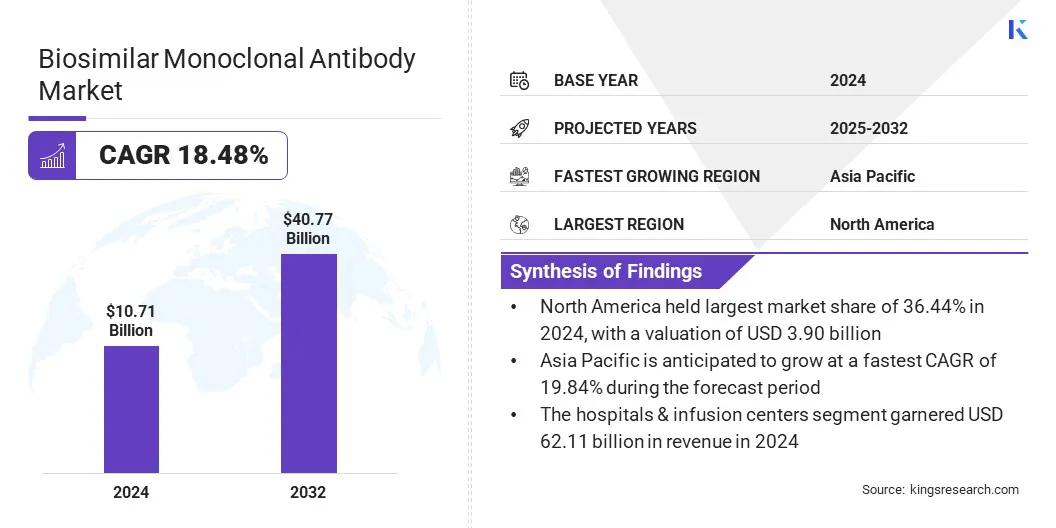
The global biosimilar monoclonal antibody market size was valued at USD 10.71 billion in 2024 and is projected to grow from USD 12.44 billion in 2025 to USD 40.77 billion by 2032, exhibiting a CAGR of 18.48% during the forecast period. The market is experiencing significant growth due to the rising prevalence of cancer and autoimmune diseases worldwide.
Increasing adoption of cost-effective biologic therapies is expanding patient access while stimulating market demand and encouraging investment in biopharmaceutical research and development. Biosimilars reduce treatment costs and enhance drug availability, and supportive healthcare infrastructure coupled with clear regulatory frameworks accelerates their production and commercial adoption across multiple therapeutic areas.
Major companies operating in the global biosimilar monoclonal antibody market are Biocon Limited, CELLTRION INC., Sandoz, SAMSUNG, Pfizer Inc., Amgen Inc., Viatris Inc., Dr. Reddy’s Laboratories Ltd., Coherus Oncology, Formycon AG, Alvotech, Teva Pharmaceutical Industries Ltd., Boehringer Ingelheim International GmbH, F. Hoffmann-La Roche Ltd, and Enzene Biosciences.
Companies are focusing on research and development to advance novel biosimilar monoclonal antibodies and explore expanded therapeutic applications. Companies are also pursuing strategic acquisitions to strengthen regional presence, enhance distribution capabilities, and accelerate commercialization, enabling broader patient access and strengthening their competitive position globally.
The biosimilar monoclonal antibody market is witnessing significant growth due to the rising prevalence of chronic and oncology-related diseases worldwide. According to the Centers for Disease Control and Prevention’s Preventing Chronic Disease report, in 2023, 76.4% of United States adults (194 million) had at least one chronic condition, and 51.4% (130 million) had multiple chronic conditions, highlighting the growing patient populations requiring effective therapies.
Increasing incidence of cancer, autoimmune disorders, and other long-term conditions drives demand for targeted biologic treatments. Healthcare systems are seeking cost-efficient alternatives to reference biologics, promoting broader adoption of biosimilars.
The growing disease burden and emphasis on sustainable healthcare spending accelerate research, development, and commercialization of biosimilar monoclonal antibodies, fostering innovation and expanding global treatment access.
A major challenge in the biosimilar monoclonal antibody market is regulatory complexity combined with high development costs. Developing biosimilars requires extensive clinical trials to prove similarity to the reference biologic, which consumes significant time and financial resources. Diverse regulatory frameworks across countries complicate market entry and increase the risk of delays.
To overcome these obstacles, manufacturers form strategic partnerships and collaborations to share costs and leverage specialized expertise. Companies invest in advanced manufacturing technologies and modular production platforms, enabling streamlined development, reduced expenses, and faster regulatory approvals, which supports efficient market entry while ensuring full compliance.
The biosimilar monoclonal antibody market is witnessing a growing trend toward developing interchangeable biosimilars, allowing direct substitution with reference biologics. Manufacturers increasingly focus on interchangeability to enhance adoption rates and strengthen market competitiveness. This trend supports improved patient access and more efficient treatment protocols while addressing healthcare system demands for cost-effective therapies.
Interchangeable biosimilars are reshaping prescribing practices, guiding portfolio strategies, and promoting wider acceptance across hospitals, specialty centers, and clinics globally, reflecting a shift in integrating biosimilar therapies into standard treatment pathways.
|
Segmentation |
Details |
|
By Therapeutic Area |
Oncology, Autoimmune & Inflammatory Diseases, Hematology, Ophthalmology, Others |
|
By Route of Administration |
Intravenous, Subcutaneous, Intravitreal, Others |
|
By End-User |
Hospitals & Infusion Centers, Specialty Treatment Centers, Others |
|
By Region |
North America: U.S., Canada, Mexico |
|
Europe: France, UK, Spain, Germany, Italy, Russia, Rest of Europe |
|
|
Asia-Pacific: China, Japan, India, Australia, ASEAN, South Korea, Rest of Asia-Pacific |
|
|
Middle East & Africa: Turkey, U.A.E., Saudi Arabia, South Africa, Rest of Middle East & Africa |
|
|
South America: Brazil, Argentina, Rest of South America |
Based on region, the biosimilar monoclonal antibody market has been classified into North America, Europe, Asia Pacific, Middle East & Africa, and South America.
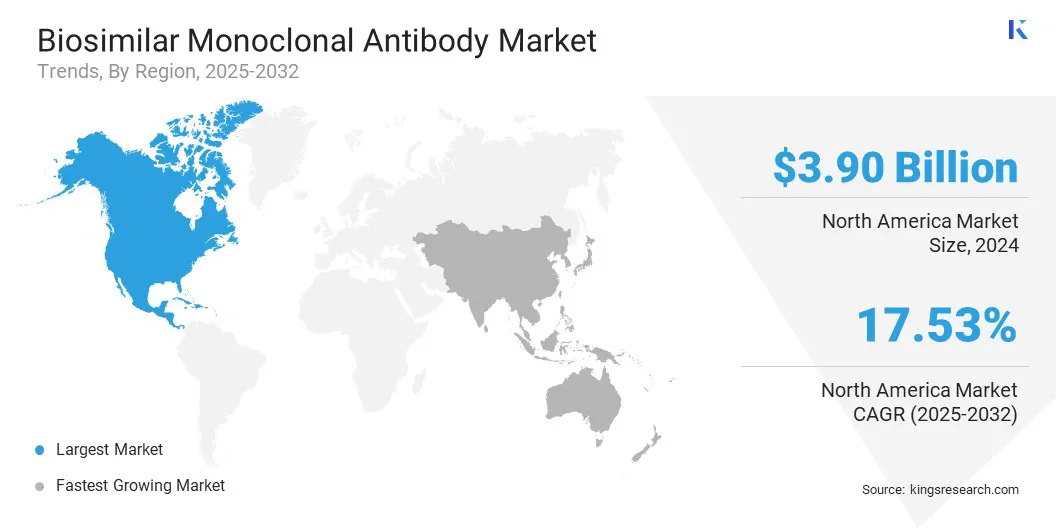
North America biosimilar monoclonal antibody market share stood at around 36.44% in 2024 in the global market, with a valuation of USD 3.90 billion. This dominance is due to advanced healthcare infrastructure that enables hospitals and specialty centers to distribute and administer biologic therapies efficiently. Strong regulatory support from the U.S. FDA provides clear guidance on approval, interchangeability, and post-market monitoring, encouraging investment and increasing biosimilar adoption.
Robust research and development initiatives focus on novel monoclonal antibodies and expanded therapeutic applications. These efforts leverage the region’s advantages and drive innovation, reinforcing North America’s market position and sustaining its leadership in the market.
The biosimilar monoclonal antibody industry in Asia Pacific is expected to register fastest growth in the market, with a projected CAGR of 19.84% over the forecast period. This growth is fueled by the rising prevalence of cancer in China, India, and Japan, which increases the demand for effective biologic therapies.
Expanding healthcare infrastructure, growing awareness of biosimilar treatments, and supportive government initiatives enhance accessibility and adoption, enabling hospitals and specialty centers to deliver therapies efficiently.
Pharmaceutical companies are actively expanding their biosimilar portfolios through strategic commercialization and licensing initiatives, leveraging regional expertise in regulatory approvals, distribution, and market penetration, while collaborations with local partners support broader adoption in high-demand regions.
Key players in the biosimilar monoclonal antibody industry are strengthening their competitive positions through strategic partnerships and investments. Companies are forming collaborations with regional distributors and healthcare providers to enhance market access, streamline regulatory approvals, and expand the commercial reach of biosimilar portfolios across high-growth regions.
Key players are also increasing investments in advanced manufacturing infrastructure and clinical research capabilities to accelerate product development and ensure consistent supply quality. These strategies enable firms to improve operational efficiency, establish strong regional footprints, and sustain long-term competitiveness in the evolving biosimilar landscape.
Frequently Asked Questions

Swati is a committed research analyst with a passion for optimizing systems and processes across industries, specializing in healthcare but also bringing valuable expertise to sectors such as consumer goods, life sciences, and more. Her cross-domain research approach allows her to generate clear, actionable reports that inform strategic decisions in a variety of fields. Swati is committed to staying ahead of evolving trends, leveraging her broad understanding of different sectors to provide insights that are relevant to a range of industries. In her personal time, she enjoys music and spending quality time with her family, which inspires her creativity and enriches her professional approach. Her systematic methodology ensures that every report is both thorough and practical. Swati's ability to bridge regulatory frameworks with market realities gives her recommendations a distinct edge. She collaborates seamlessly with cross-functional teams, distilling complex data into straightforward narratives. Her proactive monitoring of policy and technological shifts keeps her analysis forward-looking.

With over a decade of research leadership across global markets, Ganapathy brings sharp judgment, strategic clarity, and deep industry expertise. Known for precision and an unwavering commitment to quality, he guides teams and clients with insights that consistently drive impactful business outcomes.