
Inquire Now
Key Strategic Points
The big data market refers to the industry that provides tools and services for collecting, storing, and analyzing large and complex structured and unstructured data sets that cannot be efficiently processed by conventional data-processing systems. The market involves adopting machine learning, predictive modeling, and other advanced analytics to transform data into meaningful insights.
The rapid increase in the volume of data generated by social media, IoT devices, and digital transactions is driving demand for scalable, efficient data management solutions that enable real-time decision-making, faster customer service, risk management, data protection, and revenue growth.
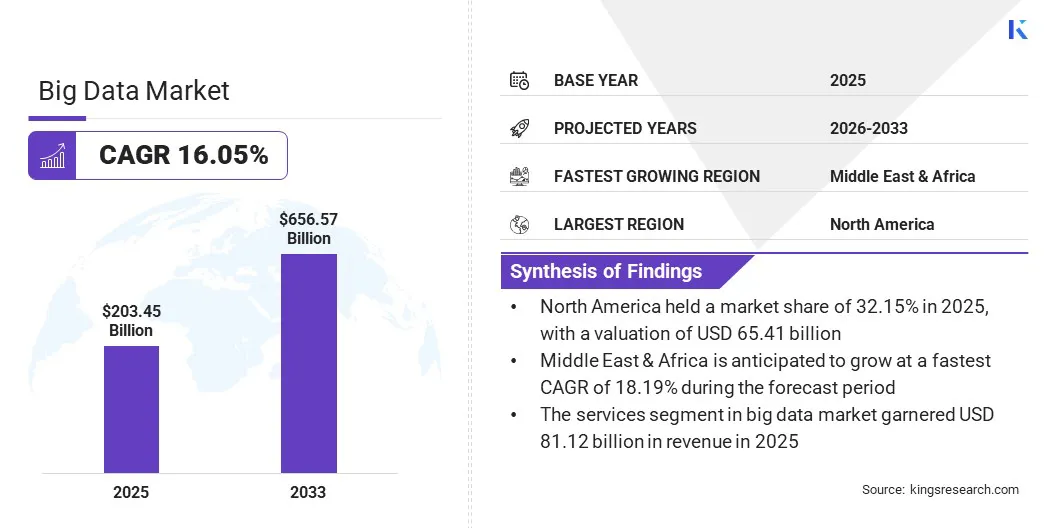
The global big data market was valued at USD 203.45 billion in 2025 and is projected to reach around USD 656.57 billion by 2033, representing a CAGR of 16.05% over the forecast period. The rise of internet adoption and connected technologies is leading to the generation of massive volumes of data across transactions, operations, and social media, which conventional data processing systems cannot handle efficiently.
This, in turn, drives market growth and enhances efficiency and performance across industries like retail, healthcare, finance, manufacturing, and other end-use sectors.
Major companies operating in the global big data industry are Amazon Web Services, Inc., Cisco Systems, Inc., Cloudera, Inc., Databricks, Dell Inc., Google, Hewlett Packard Enterprise Development LP, IBM Corporation, Microsoft Corporation, Oracle, Palantir Technologies Inc., Salesforce, Inc., SAP SE, Splunk LLC, and Teradata.
Businesses and diverse end-user domains utilize big data mining to analyze, assess, and transform big data collected from mobile applications, social networks, website surfing, and product purchases into actionable insights. This, in turn, is used by various departments within a company, generally including marketing, sales, and human resources, to ensure business growth and customer satisfaction.
The global surge in digitalization, leading to massive user data generation, acts as a major driving factor. The United Nations reported that total user-generated data volumes reached 175 zettabytes in 2025. The growth is largely attributable to increasing investments in advanced data storage, cloud computing, and analytics capabilities.
Additionally, advancements in artificial intelligence and machine learning are enabling real-time data processing, predictive big data analytics, and deeper insights into consumer behavior and societal trends amid increasing digitization. These advancements enable businesses and governments to effectively utilize large datasets to understand consumer behavior, enhance decision-making, optimize operations, and deliver personalized services, thereby creating significant growth avenues for the big data market.
The surge in data breach incidents, due to the increasing adoption of connected devices, cloud based services, real-time analytics, and distributed frameworks, acts as a major restraining factor. The utilization of massive consumer data by organizations to enhance efficiency, customer satisfaction, and revenue makes them vulnerable to malware attacks, data breaches, and fake data injection, thereby impeding market growth.
To address this challenge, market players are improving cybersecurity frameworks to improve the protection of big data handling systems. Companies are innovating security solutions that protect user identities, isolate different data silos in case of a breach, secure network communication, and enable continuous monitoring for suspicious activity.
The rapid surge in data generation, combined with advancements in cloud computing and demand for remote data storage and processing requirements is leading to the surge in demand for multi/hybrid cloud deployments in the big data market. Enterprises are transitioning from conventional on premise systems to multi-cloud and hybrid cloud infrastructures supported by major providers like AWS, Microsoft Azure, and Google Cloud. The shift is driven by the demand for better connectivity, scalability, security, and agility owing to the evolving data landscape from a static resource to a continuous flow of business-critical information.
|
Segmentation |
Details |
|
By Component |
Hardware, Software, Services |
|
By Deployment |
On-Premise, Cloud-Based, Hybrid |
|
By Organization Size |
Large Enterprise, Small & Medium Enterprise (SME) |
|
By End Use Industry |
Banking, Financial Services & Insurance (BFSI), Healthcare, Retail & E-commerce, IT & Telecommunications, Transportation & Logistics, Travel & Hospitality, Media & Entertainment, Others |
|
By Region |
North America: U.S., Canada, Mexico |
|
Europe: France, UK, Spain, Germany, Italy, Russia, Rest of Europe |
|
|
Asia-Pacific: China, Japan, India, Australia, ASEAN, South Korea, Rest of Asia-Pacific |
|
|
Middle East & Africa: Turkey, U.A.E., Saudi Arabia, South Africa, Rest of Middle East & Africa |
|
|
South America: Brazil, Argentina, Rest of South America |
Based on region, the global big data market is split into North America, Europe, Asia Pacific, Middle East and Africa and South America.
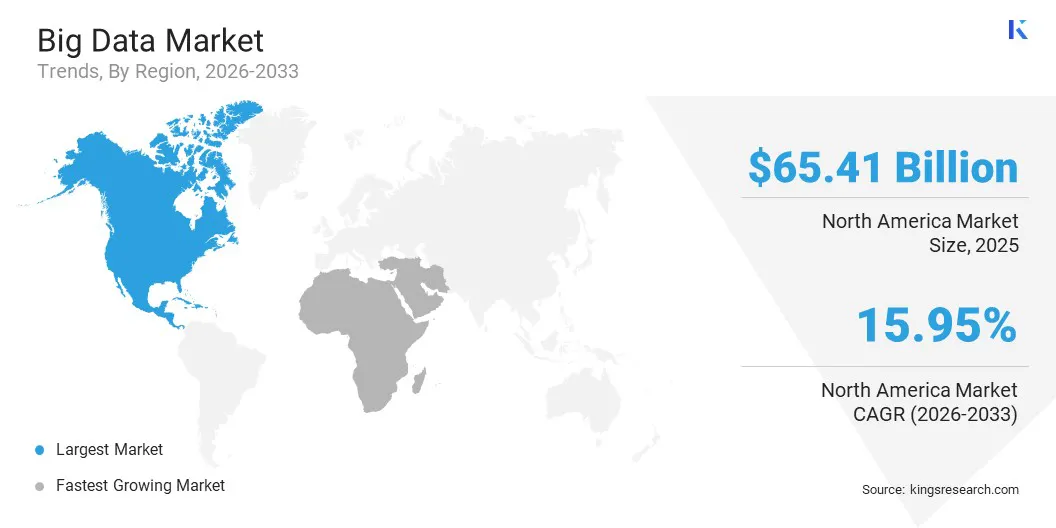
The North America big data market share stood at 32.15% in 2025, valued at USD 65.41 billion. The high share is attributable to the presence of major tech companies, robust IT infrastructure, and investments in AI, cloud computing, and digitization applications. The U.S. emerges as the dominant market in North America due to surging data volumes from connected devices, data streaming platforms, and a strong concentration of data centers, which enable the storage and processing of massive volumes of big data, aiding regional market expansion.
The Middle East and Africa big data market is set to grow at a CAGR of 18.19% over the forecast period. Rising digital transformation initiatives across the region, particularly the 5G penetration, rapid adoption of cloud services are accelerating the demand for big data solutions. Key government strategies like Saudi Arabia Vision 2030, UAE Smart Government Initiative, and Kenya Digital Economy Blueprint are acting as significant propeller towards fueling substantial public and private investment into cloud infrastructure, smart cities, and digital services. This in turn is leading to the generation of massive consumer data which drives the demand for advanced analytics and big data solutions.
Key players operating in the big data market are focusing on the integration of artificial intelligence (AI), machine learning (ML), cloud computing, and real-time analytics to address the rising demand for data-driven decision-making. Companies are investing in data platforms, data lakes, and scalable cloud infrastructure to process massive volumes of structured and unstructured data.
Advancements across end use sectors such as BFSI, healthcare, retail, manufacturing, and telecommunications are enhancing operational efficiency, strengthening real-time decision-making capabilities, and enabling the delivery of personalized, data-driven services. Additionally, the adoption of predictive analytics, automation, and AI-powered data solutions is prompting organizations to enhance forecasting, optimize operations, and support digital transformation.
Frequently Asked Questions

Faizy brings over four years of experience in market research and consulting, with a proven ability to support strategic engagements across diverse industries and business environments. His work focuses on understanding complex market structures, identifying emerging opportunities, and translating research findings into clear, commercially relevant insights. With strong analytical capabilities and a structured approach to problem-solving, he evaluates industry trends, competitive landscapes, customer dynamics, and evolving business models. His expertise encompasses market research, competitive intelligence, market sizing and forecasting, industry assessment, company benchmarking, and strategic analysis. Faizy combines technical proficiency with a strong research orientation, enabling him to interpret both qualitative and quantitative information effectively. He has contributed to projects that help organizations assess growth potential, strengthen market positioning, and evaluate strategic priorities. His adaptable approach allows him to work across sectors while maintaining a consistent focus on accuracy, relevance, and delivering insights that support informed decision-making for clients and stakeholders.
Habi is a seasoned research and consulting leader with renowned experience in guiding clients on strategic growth and transformation initiatives across global markets. He has led high-performing research teams that deliver actionable insights on market expansion, M&A strategies, opportunity assessment, new business development, and product launches. His project portfolio spans large petrochemical producers, electronic device manufacturers, lubricants companies, and other leading enterprises across diverse industrial and consumer sectors. He currently heads the research department at Kings Research, where he is responsible for setting the research agenda, mentoring analysts, and ensuring client-ready deliverables that support executive decision-making. With extensive experience in market intelligence, strategic research, and consulting, Habi brings a strong understanding of evolving industry dynamics, competitive landscapes, emerging opportunities, and business growth challenges. His expertise includes developing research frameworks, translating complex market data into actionable strategic recommendations, and working closely with senior stakeholders to address critical business questions. He has also contributed to building research capabilities, strengthening analytical methodologies, and driving a culture of quality and insight-led decision-making within research teams. His cross-industry exposure enables him to connect market trends with broader business implications and provide perspectives that help organizations identify opportunities, mitigate risks, and make informed strategic decisions.