
Inquire Now
Key Strategic Points
The automotive remanufacturing market refers to the industrial ecosystem dedicated to the systematic restoration, quality validation, and lifecycle management of vehicle components to their original performance criteria. This market covers the circular processing of critical systems for 2, 3, and 4-wheelers across ICE, BEV, and hybrid propulsion technologies, combining complex supply chains that serve both original equipment manufacturers and the aftermarket.
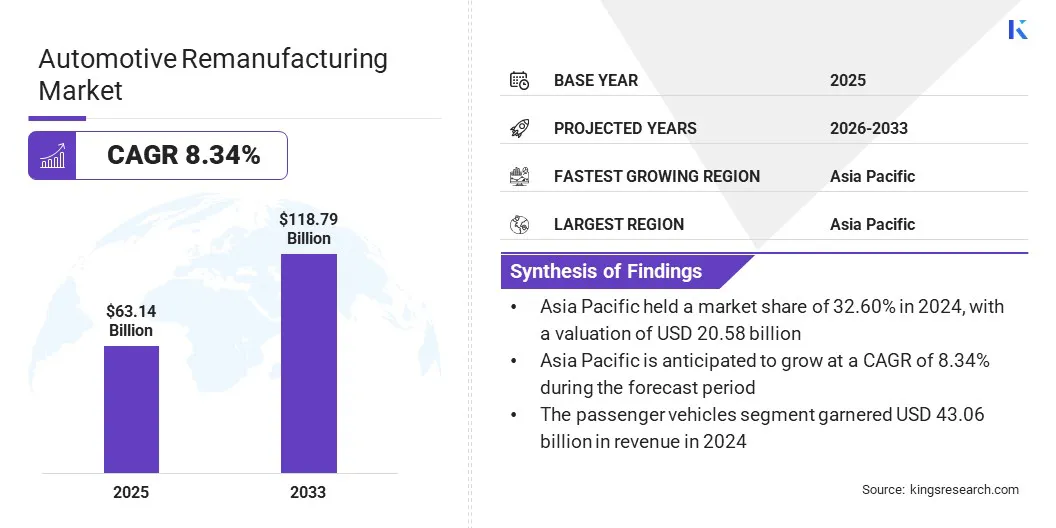
The global automotive remanufacturing market size was valued at USD 63.14 billion in 2024 and is projected to grow from USD 67.81 billion in 2025 to USD 118.79 billion by 2032, exhibiting a CAGR of 8.34% during the forecast period. This expansion is primarily driven by the industry-wide shift toward a circular economy model that promotes a reduction in resource depletion and environmental waste.
Major companies operating in the global automotive remanufacturing industry are LKQ Corporation, Robert Bosch GmbH, VALEO, Caterpillar, ZF Friedrichshafen AG, BorgWarner Inc., DENSO, CARDONE Industries, Cummins Inc, Eaton, Schaeffler Technologies AG & Co. KG, Standard Motor Products, Inc., MPA, JASPER Engines & Transmissions, and ATCDT Corp.
Companies are also proactively increasing their engineering expertise to recreate sophisticated power electronics like inverters to their original performance standards. These companies are investing in specialized testing environments and high-end diagnostic software to handle high-end semiconductor recalibration and module restoration.
In contrast to traditional mechanical component restorers, automotive remanufacturing companies are placing a significant emphasis on clean-room production and automated testing to ensure the reliability of electrified powertrains. This interest is expanding as the global fleet is becoming increasingly hybrid and electrically propelled, and remanufactured inverters have become a very common form of sustainable vehicle maintenance.
The market is growing rapidly due to the rising adoption of circular economy models to minimize resource depletion and waste. This solution involves shifting away from conventional linear forms of production in favor of closed systems that emphasize the recovery, restoration, and reuse of valuable vehicle components. The lifecycle of components such as engines and transmissions should be extended as much as possible to minimize energy usage and carbon emissions in comparison to new units.
Such green practices assist manufacturers in addressing stringent environmental policies while also stabilizing the supply chain of essential raw materials. This model is a critical component of resource optimization that allows a more sustainable and low-cost method of maintaining a vehicle and fleet management.
The biggest challenge in the market is the increasing complexity of modern vehicle electronics and software integration. Because the majority of modern components are equipped with proprietary sensors and control units, accessing encrypted diagnostic data and specialist firmware needed in the restoration process is difficult.
Such integrated systems need highly technical expertise as well as costly machines to re-calibrate and that can act as a hindrance to the traditional remanufacturing plants. This lack of homogeneous access to internal electronic structure makes it complicated to test the levels of performance and safety.
To address these hurdles, manufacturers are investing in advanced diagnostic software and automated testing benches that have the capability to operate with modern vehicle architecture. They are also forging stronger relationships with original equipment manufacturers so that they can access valuable technical specifications and proprietary recovery software.
Standardized certification programs and specialized training for technicians can be used to ensure that such complex electronic assemblies are restored to their original performance levels without causing data loss.
One of the key market trends is the growing popularity of artificial intelligence (AI), digital technologies, and automation used to restore processes. These advanced tools are designed to streamline tasks such as core identification, precision disassembly, and high-fidelity quality inspection. They differ from traditional manual methods, which do not enable rapid, data-driven diagnostic accuracy at a large industrial scale.
Automation and digital twin technology are being increasingly used as components become more complex and electronically integrated, making them widely implemented solutions for modern vehicle systems.
|
Segmentation |
Details |
|
By Component |
Engine, Transmission, Brake System, Electrical & Electronic Components, Chassis & Suspension, Others |
|
By Vehicle Configuration |
4-Wheelers, 2-Wheelers, 3-Wheelers |
|
By Propulsion |
Internal Combustion Engine (ICE), Battery Electric Vehicles (BEVs), Hybrid Vehicles |
|
By Vehicle Type |
Passenger Vehicles, Commercial Vehicles |
|
By End User |
Original Equipment Manufacturer (OEM), Aftermarket |
|
By Region |
North America: U.S., Canada, Mexico |
|
Europe: France, UK, Spain, Germany, Italy, Russia, Rest of Europe |
|
|
Asia-Pacific: China, Japan, India, Australia, ASEAN, South Korea, Rest of Asia-Pacific |
|
|
Middle East & Africa: Turkey, U.A.E., Saudi Arabia, South Africa, Rest of Middle East & Africa |
|
|
South America: Brazil, Argentina, Rest of South America |
Based on region, the market has been classified into North America, Europe, Asia Pacific, Middle East & Africa, and South America.
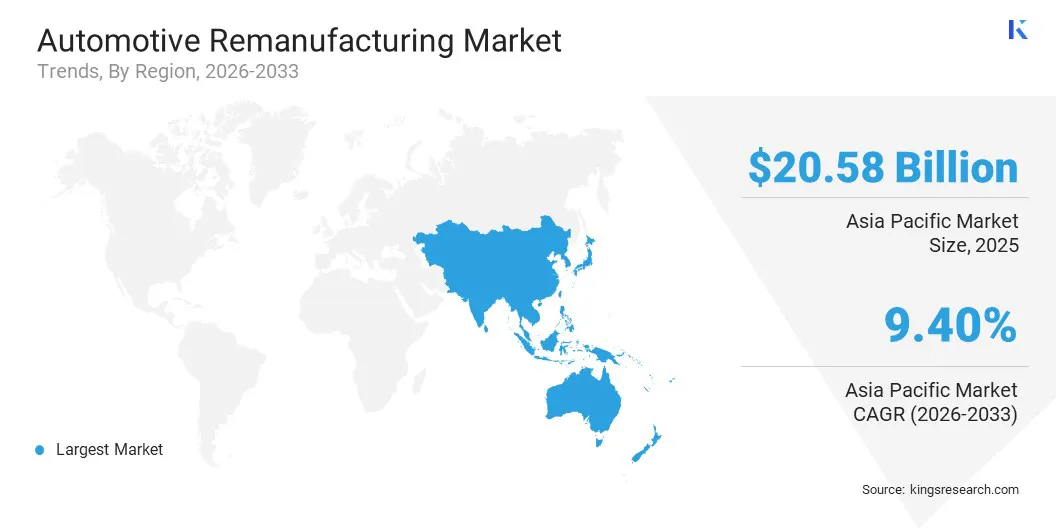
The Asia-Pacific automotive remanufacturing market accounted for a substantial share of 32.60% in 2024, valued at USD 20.58 billion. This dominance is due to the region's strong manufacturing base for the automotive industry, which provides a consistent supply of vehicle components for remanufacturing.
Countries such as China, India, and Japan have a massive active vehicle fleet that creates high demand for cost-effective replacement parts. Furthermore, the region benefits from expanding industrial infrastructure and rising consumer interest in affordable vehicle maintenance, which supports the large-scale expansion of the remanufacturing sector.
The market in Europe is expected to register the fastest CAGR of 8.60% over the forecast period. The reason behind this growth is the high level of government concern regarding sustainability and strict adherence to circular economy policies. Major stakeholders in the region are now paying more attention to reworking automotive parts to comply with the environmental requirements and minimize waste generation during the industrial process.
Major players operating in the automotive remanufacturing industry are forming strategic partnerships and implementing business models based on the circular economy to gain a competitive edge. Large manufacturers are also collaborating with technology experts to incorporate sophisticated diagnostics and automated recovery systems, ensuring that restored parts meet original performance levels.
Moreover, the commercialization of closed-loop supply chains and cross-sector partnerships is being undertaken by industry players to stabilize core material sourcing and mitigate environmental impact. These collaborations and the transition to circularity help stabilize the availability of key components for ICE, BEV, and hybrid propulsion systems and accelerate the shift toward a more sustainable and resource-efficient global automotive aftermarket.
Frequently Asked Questions

Tejasv specializes in secondary research and data validation, transforming complex information into clear market insights. He supports multi-industry research initiatives by delivering reliable intelligence that informs planning and strategic direction. With a disciplined and detail-focused approach, he emphasizes analytical clarity and practical application. His interest in geopolitics and history informs his broader market perspective. This unique lens allows him to contextualize industry shifts within larger socio-political frameworks, adding depth to his analyses. He maintains rigorous documentation standards, making his findings auditable and easily reproducible. His ability to distill vast amounts of secondary data into concise, decision-ready summaries has earned him the trust of project leads across multiple verticals. Tejasv actively tracks regulatory changes and economic indicators, which he incorporates into his research to enhance its forward-looking relevance. His methodical work ethic, combined with a calm demeanor under tight deadlines, ensures that his contributions remain both timely and impactful.
Habi is a seasoned research and consulting leader with renowned experience in guiding clients on strategic growth and transformation initiatives across global markets. He has led high-performing research teams that deliver actionable insights on market expansion, M&A strategies, opportunity assessment, new business development, and product launches. His project portfolio spans large petrochemical producers, electronic device manufacturers, lubricants companies, and other leading enterprises across diverse industrial and consumer sectors. He currently heads the research department at Kings Research, where he is responsible for setting the research agenda, mentoring analysts, and ensuring client-ready deliverables that support executive decision-making. With extensive experience in market intelligence, strategic research, and consulting, Habi brings a strong understanding of evolving industry dynamics, competitive landscapes, emerging opportunities, and business growth challenges. His expertise includes developing research frameworks, translating complex market data into actionable strategic recommendations, and working closely with senior stakeholders to address critical business questions. He has also contributed to building research capabilities, strengthening analytical methodologies, and driving a culture of quality and insight-led decision-making within research teams. His cross-industry exposure enables him to connect market trends with broader business implications and provide perspectives that help organizations identify opportunities, mitigate risks, and make informed strategic decisions.