
Inquire Now
Key Strategic Points
Automotive cybersecurity protects vehicles, their electronic systems, communication networks, software, and data from unauthorized access, cyberattacks, or malicious manipulation. It focuses on securing connected and automated vehicles against threats that compromise safety, privacy, or operational integrity.
It includes safeguarding in-vehicle control units, over-the-air updates, telematics, infotainment systems, and vehicle-to-everything (V2X) communication from vulnerabilities that attackers exploit. The market encompasses security solutions, services, and technologies that protect passenger cars, commercial vehicles, and autonomous vehicles.
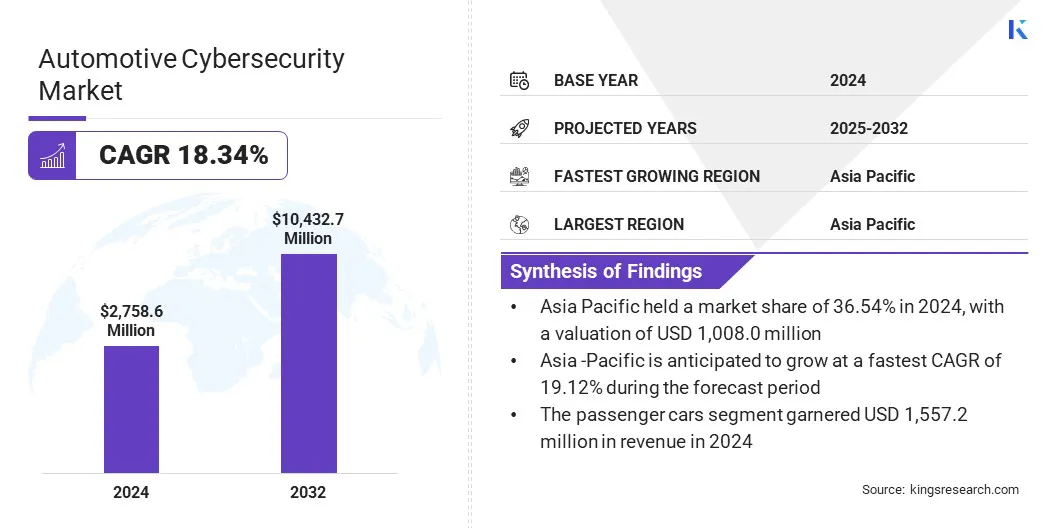
The global automotive cybersecurity market size was valued at USD 2,758.6 million in 2024 and is projected to grow from USD 3,210.3 million in 2025 to USD 10,432.7 million by 2032, exhibiting a CAGR of 18.34% over the forecast period.
Market growth is driven by the rising adoption of connected cars to enable secure communication, data exchange, and vehicle network integration. The growing use of advanced driver-assistance systems (ADAS) and autonomous driving technologies is further driving demand for stronger cybersecurity measures across vehicles and automotive networks.
Major companies operating in the automotive cybersecurity market are PlaxidityX Ltd, Karamba Security, Upstream Security Ltd, Harman International Industries, Inc., GuardKnox Cyber Technologies Ltd., ETAS GmbH, Elektrobit Automotive GmbH, NXP Semiconductors N.V., Infineon Technologies AG, Thales S.A., BlackBerry Limited, Vector Informatik GmbH, Tata Elxsi Ltd, Trustonic, Cybellum Ltd.
The increasing emphasis on workforce training and skill development in the automotive sector is driving the adoption of advanced cybersecurity solutions. Market players are conducting specialized training programs to enhance skills, improve threat preparedness, and accelerate the deployment of cybersecurity measures across software-defined vehicles.
Growth in Electric Vehicle (EV) Adoption
A key factor propelling the growth of the automotive cybersecurity market is the rapid adoption of electric vehicles (EVs). EVs increasingly rely on connected systems, software-defined architectures, and telematics, which expose vehicles to potential cyber threats.
Manufacturers and suppliers are implementing advanced cybersecurity measures to secure battery management systems, over-the-air (OTA) updates, and vehicle-to-everything (V2X) communication. These factors are driving the demand for advanced cybersecurity solutions to protect against unauthorized access and secure critical data.
High Cost of Advanced Cybersecurity Solutions
A key challenge impeding the growth of the automotive cybersecurity market is the high cost of advanced cybersecurity solutions. Implementing comprehensive security measures, including intrusion detection systems and encryption technologies, requires substantial investment in hardware, software, and skilled personnel.
Ongoing maintenance, updates, and compliance with evolving standards further increase the costs and slow the adoption of these solutions across the automotive sector.
To address this challenge, market players are developing scalable and modular security platforms that allow OEMs and suppliers to purchase only the features they need, reducing upfront expenses. Additionally, market players are focusing on cloud-based security services and automated testing tools to lower maintenance costs and make advanced cybersecurity cost-effective.
Increasing Integration of Artificial Intelligence
A key trend influencing the automotive cybersecurity market is the increasing integration of artificial intelligence (AI) into vehicle security solutions. Market players are incorporating AI-driven capabilities such as real-time anomaly detection, predictive threat modeling, and automated response across electronic control units (ECUs).
These advancements help identify and mitigate cyber threats proactively and enhance the resilience of connected and software-defined vehicles. This shift is driving the adoption of intelligent, AI-enabled cybersecurity platforms across the automotive sector.
|
Segmentation |
Details |
|
By Security Type |
Network Security, Application Security, Endpoint Security, Cloud Security, Others |
|
By Solution |
Intrusion Detection and Prevention Systems, Encryption and Cryptography, Identity and Access Management, Risk and Vulnerability Management, Others |
|
By Vehicle Type |
Passenger Cars, Light Commercial Vehicles, Heavy Commercial Vehicles, Electric Vehicles |
|
By Application |
Telematics, Infotainment Systems, Powertrain Systems, ADAS & Safety Systems, Others |
|
By Region |
North America: U.S., Canada, Mexico |
|
Europe: France, UK, Spain, Germany, Italy, Russia, Rest of Europe |
|
|
Asia-Pacific: China, Japan, India, Australia, ASEAN, South Korea, Rest of Asia-Pacific |
|
|
Middle East & Africa: Turkey, U.A.E., Saudi Arabia, South Africa, Rest of Middle East & Africa |
|
|
South America: Brazil, Argentina, Rest of South America |
Based on region, the market has been classified into North America, Europe, Asia Pacific, Middle East & Africa, and South America.
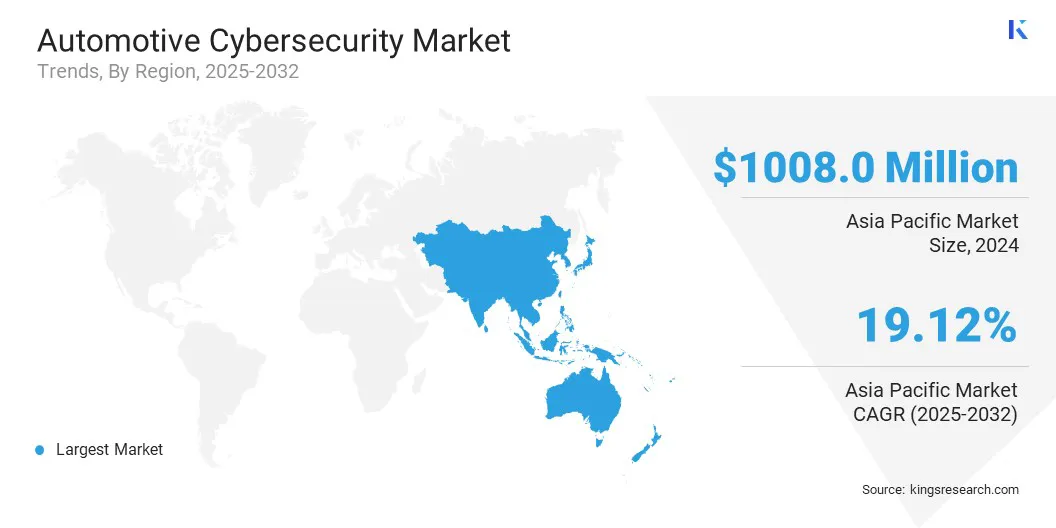
Asia Pacific automotive cybersecurity market share stood at 36.54% in 2024 in the global market, with a valuation of USD 1,008.0 million. This dominance is due to the rapid expansion of the automotive industry across this region. Increasing adoption of electric vehicles (EVs) and advanced driver-assistance systems (ADAS) in the region is driving demand for cybersecurity solutions to protect vehicle electronics, infotainment, and telematics systems.
Government initiatives and regulations, including local compliance requirements and ISO 21434 adoption, are compelling OEMs and suppliers to implement standardized security measures.
The rise of over-the-air (OTA) software updates in Asia Pacific further increases the need for continuous monitoring and secure deployment of vehicle systems and software. Additionally, regional players are focusing on partnerships with cybersecurity technology providers to integrate advanced threat detection and further support market expansion.
North America is set to grow at a CAGR of 18.65% over the forecast period. This growth is attributed to the rising adoption of software-defined vehicles, driving demand for cybersecurity solutions to protect vehicles from cyberattacks. Rising government regulations, such as the UN R155/156, are compelling OEMs to implement advanced security measures to ensure compliance and safety of vehicles.
The growing use of over-the-air (OTA) software updates is increasing the need for continuous monitoring and secure deployment to prevent remote cyber threats to vehicle systems. Additionally, regional players are focusing on collaboration to strengthen proactive security measures and implement robust cybersecurity solutions for the automotive sectors across the region.
Companies operating in the automotive cybersecurity industry are actively developing advanced security solutions to protect connected vehicles from cyber threats. They are collaborating with specialized technology partners to integrate expertise and deliver end-to-end protection across vehicle networks and over-the-air software updates.
Additionally, market players are investing in proactive threat detection, intrusion prevention, and continuous monitoring initiatives to enhance vehicle safety and cybersecurity resilience.
Frequently Asked Questions

Swati is a committed research analyst with a passion for optimizing systems and processes across industries, specializing in healthcare but also bringing valuable expertise to sectors such as consumer goods, life sciences, and more. Her cross-domain research approach allows her to generate clear, actionable reports that inform strategic decisions in a variety of fields. Swati is committed to staying ahead of evolving trends, leveraging her broad understanding of different sectors to provide insights that are relevant to a range of industries. In her personal time, she enjoys music and spending quality time with her family, which inspires her creativity and enriches her professional approach. Her systematic methodology ensures that every report is both thorough and practical. Swati's ability to bridge regulatory frameworks with market realities gives her recommendations a distinct edge. She collaborates seamlessly with cross-functional teams, distilling complex data into straightforward narratives. Her proactive monitoring of policy and technological shifts keeps her analysis forward-looking.

Ganapathy Subramaniam Suresh
With over a decade of research leadership across global markets, Ganapathy brings sharp judgment, strategic clarity, and deep industry expertise. Known for precision and an unwavering commitment to quality, he guides teams and clients with insights that consistently drive impactful business outcomes.