
Inquire Now
Key Strategic Points
Augmented reality in retail involves integrating interactive digital elements such as images, 3D models, or product information into physical shopping environment through smartphones, tablets, or AR devices. It enhances the consumer experience through virtual try-ons, real-time product visualization, and immersive engagement. Retailers leverage AR to bridge online and offline channels, boost purchase confidence, and improve customer engagement.
The global augmented reality in retail market size was valued at USD 6.87 billion in 2024 and is projected to grow from USD 9.11 billion in 2025 to USD 67.73 billion by 2032, exhibiting a CAGR of 33.19% during the forecast period.
This growth is attributed to increasing consumer demand for precise product evaluation and informed purchasing across online and physical retail channels. Augmented reality solutions offer immersive product visualization, minimizing purchase uncertainty and improving decision-making.
Major companies operating in the augmented reality in retail market are Zebra Technologies Corp., Google LLC, Snap Inc., PTC, Inter IKEA Systems B.V., Engine Creative Agency Ltd (Reydar), Blippar Group Limited, Holition Limited, Zugara, Inc., Amazon.com Services LLC, Salsify, Sony Semiconductor Solutions Corporation, Vuzix Corporation, Magic Leap, Inc., and SAMSUNG.
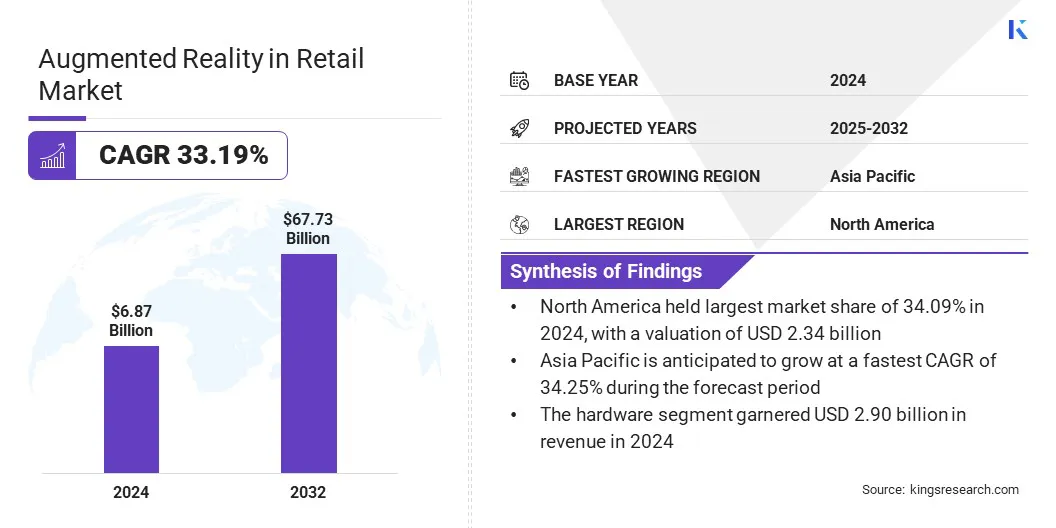
Market growth is driven by retailers’ growing adoption of omnichannel retail strategies that integrate digital and physical shopping experiences. The approach allows consumers to engage consistently across online platforms, mobile applications, and brick-and-mortar stores.
Augmented reality further enhances this integration through virtual product trials, in-store navigation, and immersive displays, improving consumer engagement and retention. Leveraging AR to connect online and offline touchpoints helps strengthen brand loyalty and boost conversion rates across channels.
Increasing device affordability, high-speed connectivity, and improved processing power enable large-scale deployment of AR-based retail applications. Consumers increasingly engage in immersive shopping experiences via mobile devices, influencing purchase behavior and driving higher engagement.
Retailers leverage mobile AR tools for product visualization and virtual trials, supporting the expanding adoption of augmented reality in the retail landscape. Expanding smartphone usage and advancements in mobile AR technology are propelling market growth.
AR applications collect sensitive consumer data, including facial scans, location details, and behavioral patterns, raising data privacy and security concerns. Unauthorized data access or misuse can compromise consumer trust and brand credibility.
Retailers face stringent data protection regulations that require secure handling of user information and transparent privacy policies, making cybersecurity investments essential to maintain consumer confidence and compliance in AR-driven retail operations.
To address this challenge, companies are adopting end-to-end encryption, multi-layer authentication, and anonymized data frameworks. Retailers are increasingly partnering with cybersecurity firms to strengthen AR infrastructure, ensuring user data integrity and regulatory compliance across all retail touchpoints.
The augmented reality in retail market is influenced by the growing adoption of AR-powered furniture and home décor visualization tools. These technologies allow customers to virtually preview products in real-world settings, improving purchase confidence and decision-making.
Brands such as IKEA use AR applications to demonstrate furniture placement, texture, and scale. These solutions enhance user experience, minimize product returns, and strengthen consumer trust, underscoring the importance of AR-powered furniture visualization.
|
Segmentation |
Details |
|
By Component |
Hardware, Software, Services |
|
By Display |
Head-mounted Display, Smart Glass, Head-up Display, Handheld Devices |
|
By Application |
Digital Product Information, AR Campaigns, Virtual Try-On, AR Layout Planning, Others |
|
By Region |
North America: U.S., Canada, Mexico |
|
Europe: France, UK, Spain, Germany, Italy, Russia, Rest of Europe |
|
|
Asia-Pacific: China, Japan, India, Australia, ASEAN, South Korea, Rest of Asia-Pacific |
|
|
Middle East & Africa: Turkey, U.A.E., Saudi Arabia, South Africa, Rest of Middle East & Africa |
|
|
South America: Brazil, Argentina, Rest of South America |
Based on region, the global augmented reality in retail market has been classified into North America, Europe, Asia Pacific, Middle East & Africa, and South America.
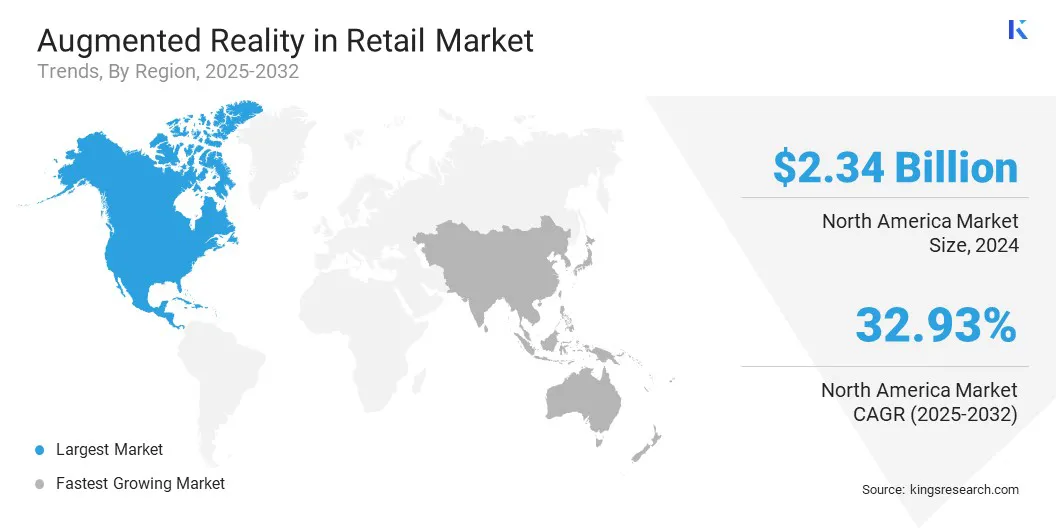
The North America augmented reality in retail market accounted for a share of 34.09% in 2024, valued at USD 2.34 billion. This dominance is attributed to robust technology infrastructure, widespread adoption of AR-enabled devices, and increasing use of virtual product visualization tools in fashion, beauty, and home décor.
Strategic collaborations between AR software developers and retail enterprises are further reinforcing regional market growth, as companies focus on advancing immersive retail technologies to enhance customer engagement across digital and physical channels.
The Asia-Pacific augmented reality in retail industry is set to grow at a CAGR of 34.25% over the forecast period. This notable growth is supported by rapid digital transformation, expanding e-commerce, and increasing investments in immersive retail technologies.
Additionally, emerging retail ecosystems and rising disposable incomes are fostering AR adoption. Retailers in the region are integrating AR features into mobile applications and online platforms to improve consumer engagement and brand differentiation, supporting regional market expansion.
Key players in the augmented reality in retail industry are focusing on continuous technological innovation, strategic collaborations, and product portfolio expansion to sustain competitiveness. Firms are investing in R&D to improve real-time rendering, 3D visualization, and cross-platform compatibility.
Strategic acquisitions support diversification and entry into niche retail applications. Investments in AR software, hardware upgrades, and advanced analytics strengthen integration within retail ecosystems, while partnerships with retailers, device manufacturers, and AR content developers expand deployment opportunities.
Frequently Asked Questions

Antriksh is an experienced analyst specializing in cross-domain research across diverse industries. With a strong foundation in data analysis and statistical interpretation, he delivers insightful market reports that guide strategic decision-making. Antriksh excels in conducting primary research, with a focus on identifying trends and understanding consumer behavior. Thriving in dynamic and high-pressure environments, he combines analytical expertise with a commitment to delivering impactful outcomes. Beyond his professional pursuits, Antriksh's passion for travel fuels his curiosity and broadens his perspectives, enriching his ability to uncover unique insights that enhance his research capabilities. He is equally adept at synthesizing quantitative findings with qualitative context, which allows him to present holistic viewpoints to clients. His disciplined work ethic and intellectual agility make him a trusted partner in navigating market uncertainties. He consistently seeks out new methodologies to refine his analytical toolkit, and his ability to communicate complex insights clearly ensures stakeholders act confidently on his recommendations.

Ganapathy Subramaniam Suresh
With over a decade of research leadership across global markets, Ganapathy brings sharp judgment, strategic clarity, and deep industry expertise. Known for precision and an unwavering commitment to quality, he guides teams and clients with insights that consistently drive impactful business outcomes.



.webp&w=128&q=75&dpl=dpl_DPva2LrvfsBdTJm1XZj67UTrvMHL)