
Inquire Now
Key Strategic Points
The market encompasses water-based and solvent-based formulations and a range of applications that include paints & coatings, adhesives & sealants, textile finishing, natural leather finishing, and synthetic leather finishing.
This market framework encompasses the entire supply chain, from the development of specialized formulations to their application across diverse industries, reflecting a balance between technological innovation and end-user performance requirements.
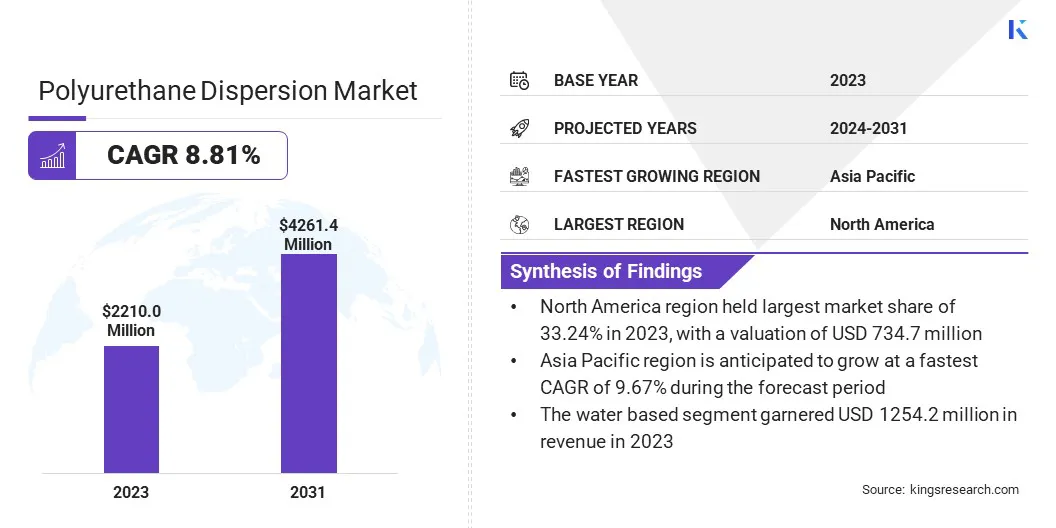
The global polyurethane dispersion market size was valued at USD 2210.0 million in 2023 and is projected to grow from USD 2360.4 million in 2024 to USD 4261.4 million by 2031, exhibiting a CAGR of 8.81% during the forecast period.
The market is driven by the increasing demand for eco-friendly and high-performance coating solutions across various industries. The shift toward water-based formulations, favored for their low VOC content and regulatory compliance, is a key factor supporting market expansion.
Major companies operating in the polyurethane dispersion industry are Asahi Kasei Corporation, LANXESS, Mitsui Chemicals, Inc., Stahl Holdings B.V., BASF, C. L. HAUTHAWAY & SONS CORP, Lamberti S.p.A., Perstorp, Cosmos Plastics & Chemicals, The Lubrizol Corporation, Huntsman International LLC, ALBERDINGK BOLEY GmbH, Dow, Wanhua, and Covestro AG.
The market is further supported by advancements in formulation technology, enhancing the durability, flexibility, and chemical resistance of Polyurethane Dispersion (PUD). Growing investments in the automotive, construction, furniture, and fashion industries are also contributing to the rising adoption of PUD globally.
Market Driver
Rising Demand for Eco-friendly Solutions and Sustainable Packaging
The market is registering significant growth, driven by the increasing demand for eco-friendly coatings and adhesives as well as the expanding use of PUDs in sustainable packaging solutions.
The shift toward low-VOC, water-based formulations is gaining momentum, particularly in industries such as automotive, construction, textiles, and leather finishing, where regulatory policies and environmental concerns are pushing manufacturers to adopt greener alternatives.
Additionally, the growing emphasis on sustainable packaging, particularly mono-material food packaging, has fueled the need for PUD-based adhesives and coatings that enhance recyclability while maintaining strong barrier properties and durability. Major manufacturers are expanding their production capacities, further strengthening the market’s growth trajectory.
Market Challenge
High Production Costs
A major challenge in the polyurethane dispersion market is the high production cost associated with raw materials and advanced formulation technologies. The reliance on specialty polyols, isocyanates, and additives increases manufacturing expenses, making PUD-based products less cost-competitive compared to conventional solvent-based alternatives.
Market Trend
Advancements in High-performance Technologies
The market is evolving with rapid advancements in high-performance technologies, enhancing the durability, flexibility, and chemical resistance of PUD-based coatings and adhesives.
Crosslinking technology aids in improving adhesion strength, water resistance, and mechanical properties, making PUDs more suitable for demanding applications in automotive, construction, and industrial coatings. Additionally, hybrid PUDs that combine multiple polymer technologies are gaining traction, offering superior performance in textile finishing, synthetic leather, and protective coatings.
|
Segmentation |
Details |
|
By Product |
Water based, Solvent based |
|
By Application |
Paints & Coatings, Adhesives & Sealants, Textile Finishing, Natural Leather Finishing, Synthetic Leather, Others |
|
By Region |
North America: U.S., Canada, Mexico |
|
Europe: France, UK, Spain, Germany, Italy, Russia, Rest of Europe |
|
|
Asia-Pacific: China, Japan, India, Australia, ASEAN, South Korea, Rest of Asia-Pacific |
|
|
Middle East & Africa: Turkey, UAE, Saudi Arabia, South Africa, Rest of Middle East & Africa |
|
|
South America: Brazil, Argentina, Rest of South America |
Market Segmentation:
Based on region, the global market has been classified into North America, Europe, Asia Pacific, Middle East & Africa, and Latin America.
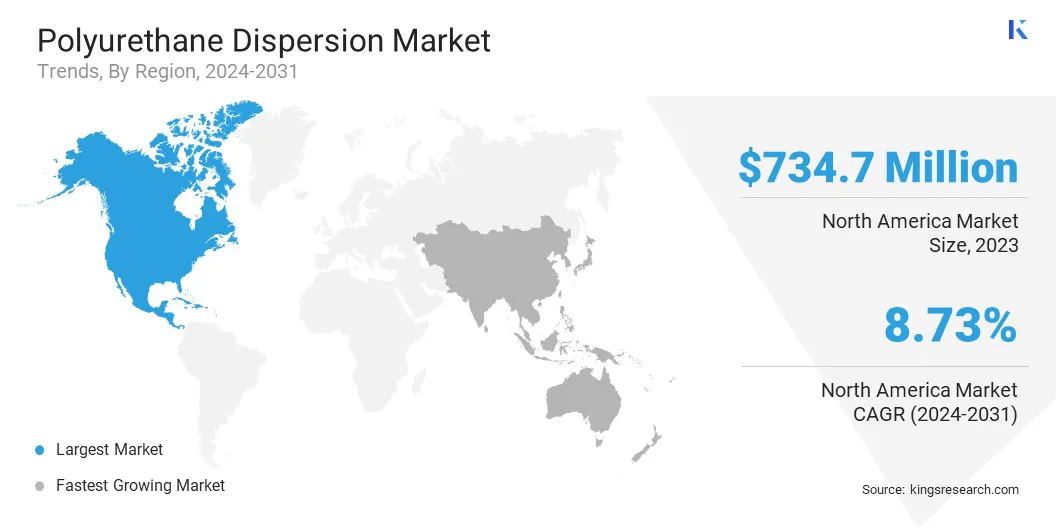
North America accounted for 33.24% share of the polyurethane dispersion market in 2023, with a valuation of USD 734.7 million. This is attributed to the strong demand for high-performance coatings, adhesives, and sealants in industries such as automotive, construction, and textiles.
Environmental regulations encouraging the adoption of low-VOC, water-based PUDs, along with technological advancements and the presence of key manufacturers, have contributed to the region's dominance. Additionally, the region benefits from a well-established industrial base and increasing investments in sustainable and advanced material solutions.
The market in Asia Pacific is poised to grow at a significant CAGR of 9.67% over the forecast period, driven by rapid industrialization, urbanization, and expanding manufacturing sectors in countries like China, India, and Japan.
The booming automotive, construction, and footwear industries, along with the rising demand for synthetic leather and textile finishing applications, are driving the consumption of PUDs. The presence of a large number of PUD manufacturers in the region, particularly in China and India, has strengthened supply chains and enhanced production capabilities.
Increasing environmental awareness and supportive government initiatives promoting eco-friendly coatings and adhesives further accelerate the market growth in this region.
The polyurethane dispersion industry is marked by strong competition, with leading companies emphasizing technological advancements, industry collaborations, production enhancements, and eco-friendly initiatives to expand their market footprint.
Companies are investing in research and development to enhance the performance of PUDs, offering improved durability, flexibility, and environmental compliance. Mergers, acquisitions, and collaborations with raw material suppliers and end-use industries are common strategies aimed at expanding market reach and optimizing supply chains.
Additionally, manufacturers are increasing their production capacities, particularly in high-growth regions such as Asia Pacific, to meet the rising demand for water-based PUDs. A growing emphasis on sustainable and bio-based formulations has led to the development of low-VOC and solvent-free alternatives, aligning with global environmental regulations.
Companies are also leveraging advanced manufacturing technologies to enhance efficiency and cost-effectiveness while maintaining high product quality.
Recent Developments (Product Launch)
Frequently Asked Questions

Over the years, Versha brings over 15 years of experience managing consulting assignments across industries, including Food and Beverage, Consumer Goods, ICT, Aerospace, and more. Her work has spanned diverse sectors. Her cross-domain expertise and adaptability make her a versatile and dependable professional. She is known for her keen business insight and foresight. With sharp analytical skills and a curious mindset, Versha excels at transforming complex data into actionable insights. She has a proven track record of unraveling market dynamics, identifying trends, and delivering tailored solutions to meet client needs. As a skilled leader, Versha has successfully mentored research teams and directed projects with precision, ensuring high-quality outcomes. Her collaborative approach and strategic vision enable her to turn challenges into opportunities and consistently deliver impactful results. Whether analyzing markets, engaging stakeholders, or crafting strategies, Versha draws on her deep expertise and industry knowledge to drive innovation and deliver measurable value.

Ganapathy Subramaniam Suresh
With over a decade of research leadership across global markets, Ganapathy brings sharp judgment, strategic clarity, and deep industry expertise. Known for precision and an unwavering commitment to quality, he guides teams and clients with insights that consistently drive impactful business outcomes.



.webp&w=128&q=75&dpl=dpl_DPva2LrvfsBdTJm1XZj67UTrvMHL)