
Inquire Now
Key Strategic Points
The global linear actuator market size was valued at USD 54.90 billion in 2024 and is projected to grow from USD 59.91 billion in 2025 to USD 115.93 billion by 2032, exhibiting a CAGR of 9.89% during the forecast period.
The market is driven by the increasing demand for automation and efficiency in manufacturing. Technological advances, including smart controls, advanced materials, and IoT integration are enhancing actuator performance, enabling reliable, compact, and energy-efficient solutions across diverse industrial applications.
Major companies operating in the linear actuator industry are Rockwell Automation Inc., Parker Hannifin Corp, Erhardt+Leimer., ABB, SMC Corporation, Actuonix Motion Devices, BISHOP-WISECARVER, ElectroCraft, Inc., Emerson Electric Co., Fabco-Air, IAI Industrieroboter GmbH, LINAK, Progressive Automations Inc, Rollon S.p.A, and Tecnotion.
The linear actuator market is driven by the growing adoption of electric vehicles requiring adjustable components for enhanced comfort, safety, and performance. Linear actuators enable precise control of features such as seat positioning, throttle control, and battery management systems. Advances in compact, energy-efficient actuator designs are supporting the stringent space and power constraints of electric vehicles.
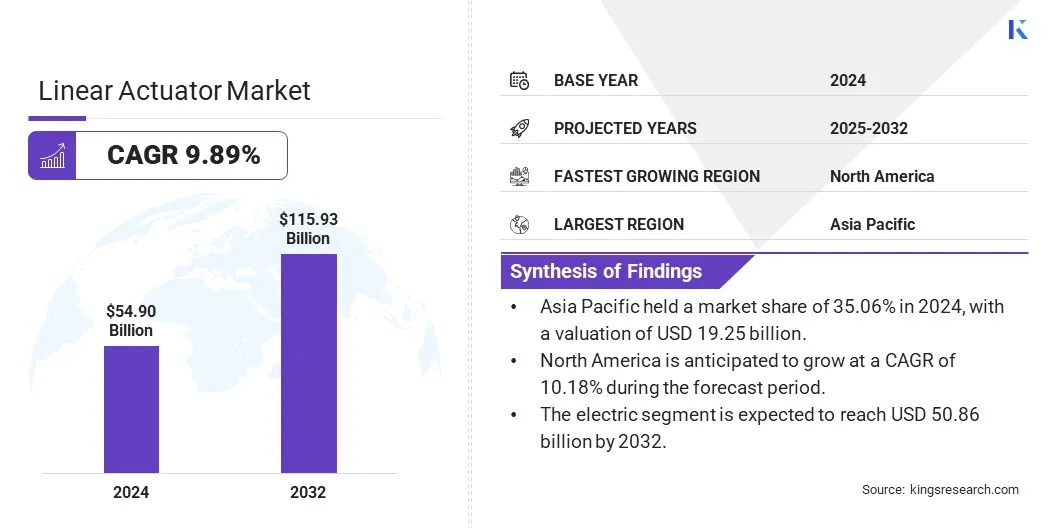
The market is experiencing strong growth due to increasing automation across manufacturing and industrial sectors. As companies seek to enhance productivity, reduce labor costs, and improve process accuracy, the demand for automated systems is rapidly increasing.
Linear actuators play a critical role in enabling precise, repeatable motion for applications such as material handling, assembly lines, and packaging. Their ability to integrate with control systems and support complex automated operations makes them essential components in modern industrial automation and smart factory environments.
A key challenge in the linear actuator market is limited load capacity in compact electric actuator designs. These smaller actuators are essential for space constrained applications with limitations in terms of strength to handle heavy-duty tasks, limiting their use in the industrial and automotive sectors.
To address this, companies are investing in advanced materials, enhanced gear mechanisms, and improved motor technologies. Manufacturers are also developing hybrid actuators that combine compact size with higher torque output, enabling broader application while maintaining the space-saving benefits.
The market is witnessing significant technological advancement focused on improving efficiency, precision, and durability. Innovations such as the integration of smart controls, use of advanced materials, and miniaturization is enabling the development of compact designs with higher load capacities.
Enhanced energy-efficient electric actuators and incorporation of IoT connectivity facilitate real-time monitoring and predictive maintenance. These improvements expand application potential across industries, enabling more reliable, customizable, and sustainable solutions that meet evolving automation and industrial requirements.
|
Segmentation |
Details |
|
By Operation Mechanism |
Mechanical, Hydraulic, Pneumatic, Electro-mechanical Actuators |
|
By Type |
Electric, Pneumatic, Hydraulic |
|
By Region |
North America: U.S., Canada, Mexico |
|
Europe: France, UK, Spain, Germany, Italy, Russia, Rest of Europe |
|
|
Asia-Pacific: China, Japan, India, Australia, ASEAN, South Korea, Rest of Asia-Pacific |
|
|
Middle East & Africa: Turkey, U.A.E., Saudi Arabia, South Africa, Rest of Middle East & Africa |
|
|
South America: Brazil, Argentina, Rest of South America |
Based on region, the global market has been classified into North America, Europe, Asia Pacific, Middle East & Africa, and South America.
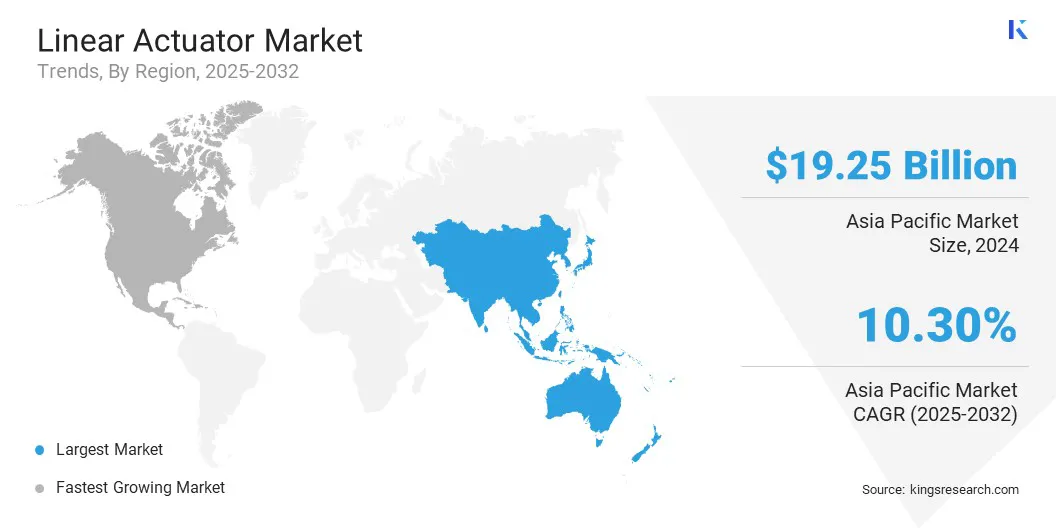
Asia Pacific linear actuator market share stood at 35.06% in 2024 in the global market, with a valuation of USD 19.25 billion. The Asia Pacific region leads the market driven by its advanced precision manufacturing capabilities that enable the production of high-quality, reliable components.
Innovation in compact and high-performance actuator technologies further strengthens the region’s position by meeting the growing demand for efficient, space-saving solutions across industries such as automotive, robotics, and electronics.
Strong investments in research and development, along with supportive government initiatives, foster continuous technological advancements, making Asia Pacific a key hub for cutting-edge linear actuator development and production.
North America is poised for significant growth at a robust CAGR of 10.18% over the forecast period. North America’s linear actuator industry growth is driven by increasing demand for high-capacity, high-performance electric actuators that replace traditional hydraulic systems. The region’s focus on cost-effective, durable, and energy-efficient motion control solutions supports adoption across material handling and factory automation industries.
Advancements enabling greater load capacity, enhanced speed, continuous duty cycles, and integrated features such as regenerative energy and brushless motors further stimulate market expansion by meeting the region’s industrial requirements for reliable, clean, and controllable actuator technologies.
Key players in the linear actuator industry are focusing on strategic mergers, acquisitions, and product launches to strengthen their competitive positions. These initiatives help companies expand their product portfolios, improve technological capabilities, and access new geographic markets.
By investing in innovation and integrating advanced features into their offerings, companies aim to meet the evolving demands of industrial applications. Consolidation efforts also support operational efficiency and global reach, highlighting the industry's emphasis on growth, differentiation, and sustained market leadership.
Frequently Asked Questions

Over the years, Versha brings over 15 years of experience managing consulting assignments across industries, including Food and Beverage, Consumer Goods, ICT, Aerospace, and more. Her work has spanned diverse sectors. Her cross-domain expertise and adaptability make her a versatile and dependable professional. She is known for her keen business insight and foresight. With sharp analytical skills and a curious mindset, Versha excels at transforming complex data into actionable insights. She has a proven track record of unraveling market dynamics, identifying trends, and delivering tailored solutions to meet client needs. As a skilled leader, Versha has successfully mentored research teams and directed projects with precision, ensuring high-quality outcomes. Her collaborative approach and strategic vision enable her to turn challenges into opportunities and consistently deliver impactful results. Whether analyzing markets, engaging stakeholders, or crafting strategies, Versha draws on her deep expertise and industry knowledge to drive innovation and deliver measurable value.

Ganapathy Subramaniam Suresh
With over a decade of research leadership across global markets, Ganapathy brings sharp judgment, strategic clarity, and deep industry expertise. Known for precision and an unwavering commitment to quality, he guides teams and clients with insights that consistently drive impactful business outcomes.



.webp&w=128&q=75&dpl=dpl_DPva2LrvfsBdTJm1XZj67UTrvMHL)