
Inquire Now
Key Strategic Points
The dermatology devices industry involves the development, manufacturing, and distribution of medical devices used for the diagnosis, treatment, and management of various skin conditions. This market includes devices employed in procedures such as skin resurfacing, hair removal, acne treatment, tattoo removal, and anti-aging therapies.
Technologies such as lasers, radiofrequency, and light therapy are commonly utilized for non-invasive or minimally invasive treatments, serving both cosmetic and therapeutic dermatology applications.
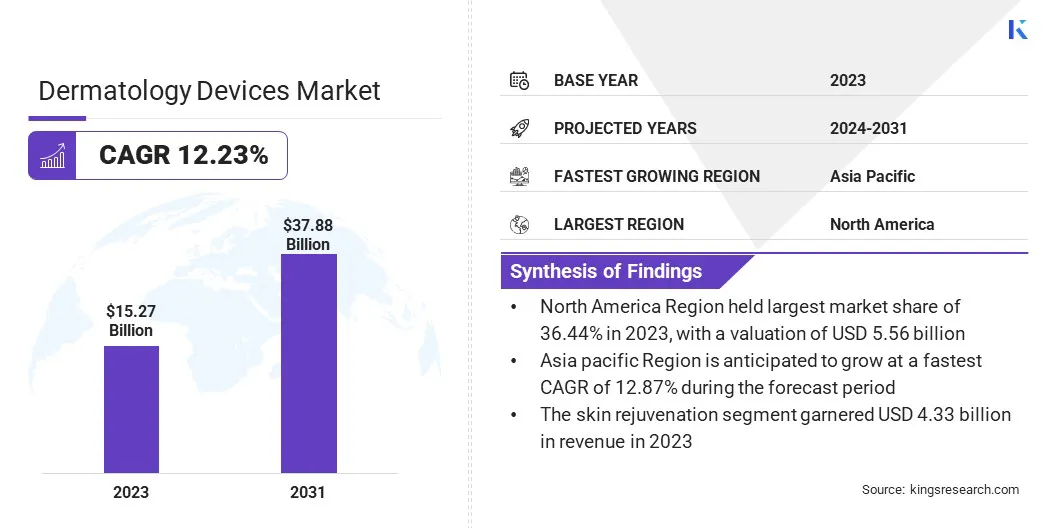
The global dermatology devices market size was valued at USD 15.27 billion in 2023 and is projected to grow from USD 16.89 billion in 2024 to USD 37.88 billion by 2031, exhibiting a CAGR of 12.23% during the forecast period.
The market is growing rapidly, due to the rising prevalence of skin disorders, increasing demand for minimally invasive cosmetic procedures, and technological advancements. Key drivers include AI integration, laser treatments, medical tourism, and improved diagnostic tools.
Government investments and tele-dermatology services further boost the market, though high costs and regulatory challenges may hinder expansion.
Major companies operating in the dermatology devices market are Alma Lasers, Bruker, ZEISS Group, Cutera, Inc, Galderma, Lumenis Be Ltd, AbbVie Inc, Candela Corporation, GSK plc, Hologic, Inc, photomedex.com, Johnson & Johnson Services, Inc, Cynosure, LLC, Solta Medical Inc, and Canfield Scientific, Inc.
The integration of artificial intelligence (AI) in dermatology devices, increasing adoption of laser treatments for esthetic and medical purposes, and the expanding medical tourism industry are contributing to the market growth. The availability of innovative diagnostic tools, such as AI-powered imaging systems for early skin cancer detection, is enhancing patient outcomes and fueling market demand.
Market Driver
"Growing Demand for Esthetic Procedures"
The growing demand for esthetic procedures is a major driver of the dermatology devices market, fueled by increasing beauty awareness, social media influence, and technological advancements. Consumers are increasingly opting for non-invasive and minimally invasive treatments such as laser hair removal, skin tightening, and anti-aging procedures, due to their effectiveness and shorter recovery times.
The rising popularity of energy-based devices, including lasers and radiofrequency treatments, has led to innovations by companies like Cutera, Cynosure, and Alma Lasers.
Social media and celebrity endorsements have significantly influenced consumer preferences, making esthetic dermatology treatments more mainstream. As disposable income rises and technology improves, the demand for these procedures is expected to grow further.
Market Challenge
"Strict Regulatory Requirements"
Stringent regulatory approvals is a key challenge in the dermatology devices market. Devices must undergo rigorous testing and meet strict safety and efficacy standards set by regulatory bodies like the FDA and EMA.
This process, involving clinical trials and extensive documentation, can delay product launches and increase costs. It creates barriers for smaller companies and slows the adoption of new technologies like lasers and AI-driven tools in the market.
Companies can take several steps to streamline the process. Early engagement with regulatory authorities helps clarify requirements and ensures compliance from the start. Investing in thorough research and well-designed clinical trials provides the necessary data to support safety and efficacy claims, potentially speeding up approvals.
Collaborating with regulatory consultants can also be beneficial, as their expertise helps companies navigate complex regulatory landscapes more efficiently.
Market Trend
"Growth in Non-Invasive Treatments"
Growth in non-invasive treatments is a major trend in the dermatology devices market, as patients increasingly seek effective procedures with minimal recovery time.
Treatments like laser hair removal, skin resurfacing, acne treatments, and wrinkle reduction through injectables such as botox and dermal fillers are becoming mainstream, due to their convenience and safety.
The growing focus on esthetics, along with consumers seeking affordable yet effective solutions, has led to significant advancements in radiofrequency (RF) and ultrasound technologies for skin tightening and collagen stimulation. The popularity of these treatments has been fueled by rising disposable income and an increase in wellness awareness, particularly in regions with high consumer spending power.
|
Segmentation |
Details |
|
By Application |
Skin Cancer, Hair Removal, Acne, Psoriasis, Wrinkle Removal, Skin Rejuvenation, Others |
|
By End-User |
Hospitals, Dermatology Clinics, Others |
|
By Product Type |
Diagnostic Devices, Treatment Devices |
|
By Region |
North America: U.S., Canada, Mexico |
|
Europe: France, UK, Spain, Germany, Italy, Russia, Rest of Europe |
|
|
Asia Pacific: China, Japan, India, Australia, ASEAN, South Korea, Rest of Asia Pacific |
|
|
Middle East & Africa: Turkey, UAE, Saudi Arabia, South Africa, Rest of Middle East & Africa |
|
|
South America: Brazil, Argentina, Rest of South America |
Market Segmentation
Based on region, the market has been classified into North America, Europe, Asia Pacific, Middle East & Africa, and Latin America.
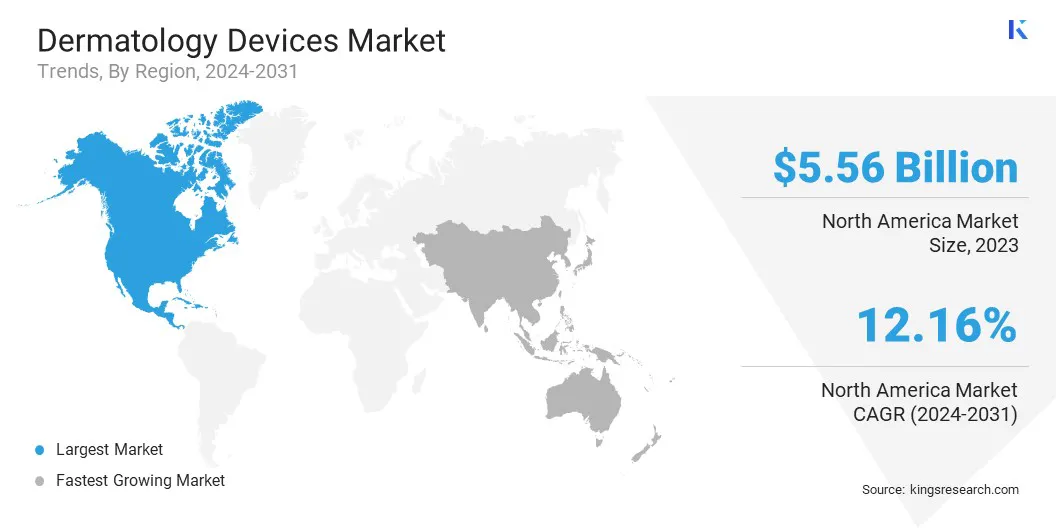
North America accounted for a significant dermatology devices market share of around 36.44% in 2023, valued at USD 5.56 billion. This market leadership is attributed to the high prevalence of skin-related conditions, rising demand for esthetic treatments, and continuous advancements in dermatological technologies.
The region benefits from a well-established healthcare infrastructure, a large number of dermatology clinics, and an increasing emphasis on skincare, all of which contribute to the growing demand for non-invasive procedures and innovative dermatology devices.
The dermatology devices industry in Asia Pacific is poised to grow at a CAGR of 12.87% through the projection period. This growth is attributed to increasing awareness of skin health, rising disposable incomes, and improved access to healthcare services.
The demand for advanced esthetic treatments and dermatology technologies is expanding, with emerging markets in countries like China and India playing a key role in driving the market in the region.
Companies should prioritize continuous innovation to gain a competitive edge in the dermatology devices industry, focusing on advanced technologies that meet consumer needs.
Emphasizing safety, patient comfort, and treatment efficacy will be crucial. Expanding into emerging markets, fostering strategic partnerships, and enhancing brand presence can further strengthen market position.
Recent Developments:
Frequently Asked Questions

Over the years, Versha brings over 15 years of experience managing consulting assignments across industries, including Food and Beverage, Consumer Goods, ICT, Aerospace, and more. Her work has spanned diverse sectors. Her cross-domain expertise and adaptability make her a versatile and dependable professional. She is known for her keen business insight and foresight. With sharp analytical skills and a curious mindset, Versha excels at transforming complex data into actionable insights. She has a proven track record of unraveling market dynamics, identifying trends, and delivering tailored solutions to meet client needs. As a skilled leader, Versha has successfully mentored research teams and directed projects with precision, ensuring high-quality outcomes. Her collaborative approach and strategic vision enable her to turn challenges into opportunities and consistently deliver impactful results. Whether analyzing markets, engaging stakeholders, or crafting strategies, Versha draws on her deep expertise and industry knowledge to drive innovation and deliver measurable value.

Ganapathy Subramaniam Suresh
With over a decade of research leadership across global markets, Ganapathy brings sharp judgment, strategic clarity, and deep industry expertise. Known for precision and an unwavering commitment to quality, he guides teams and clients with insights that consistently drive impactful business outcomes.



.webp&w=128&q=75&dpl=dpl_DPva2LrvfsBdTJm1XZj67UTrvMHL)