
Inquire Now
Key Strategic Points
The market encompasses the production, distribution, and utilization of materials specifically designed for 3D printing, also known as additive manufacturing. These materials are essential for creating physical objects from digital designs and vary based on printer types and application needs.
Global 3D printing materials market size was USD 2,358.1 million in 2023, which is estimated to be valued at USD 2,858.5 million in 2024 and reach USD 12,583.7 million by 2031, growing at a CAGR of 23.58% from 2024 to 2031.
The increasing adoption of 3D printing across industries such as aerospace, automotive, healthcare, and consumer goods is significantly boosting the demand for specialized materials. These sectors rely on 3D printing for prototyping, tooling, and producing end-use parts, requiring advanced materials for optimal performance.
Major companies operating in the 3d printing materials market are 3D Systems, Inc., Arkoma, Stratasys, EOS GmbH, Materialise nv, Sandvik AB, Höganäs AB, Evonik Industries AG, BASF, Henkel Corporation, Syensqo, Sculpteo, Desktop Metal, Inc., Proto Labs, Nexa3D, and others.
The market is evolving rapidly, fueled by innovations in material properties and expanding industry applications. As various sectors adopt additive manufacturing, the demand for high-performance, customizable, and sustainable materials is growing. This evolution is reshaping manufacturing processes by offering greater design flexibility and production efficiency.
The growth of the market is marked by ongoing advancements in material science, presenting new possibilities in product development and the creation of complex, intricate structures previously difficult to achieve.
Market Driver
"Wide Adoption of 3D Printing"
The widespread adoption across industries such as aerospace, automotive, healthcare, and consumer goods is fueling the growth of the 3D printing materials market.
As these industries increasingly integrate 3D printing for prototyping, tooling, and end-use production, the demand for specialized materials rises. This shift necessitates the development of high-performance, tailored materials that meet specific requirements for durability, precision, and functionality, fostering innovation and expanding market offerings.
Market Challenge
"Material Compatibility in 3D Printing"
Material compatibility presents a significant challenge to the growth of the 3D printing materials market, as not all materials are compatible with every 3D printing technology. This limits design flexibility and hinders manufacturers from utilizing multiple materials in one production process.
This challenge can be addressed by developing universal, multi-material-compatible filaments and resins, coupled with advancements in 3D printer technology that allow for easier material switching. Collaborative efforts between material developers and printer manufacturers can create standardized solutions, expanding material usage options and streamlining production.
Market Trend
"Development of Recyclable Materials"
A significant trend in the 3D printing materials industry is the development of recyclable and reusable materials. Manufacturers are increasingly focused on creating 3D printing materials that can be recycled, supporting the principles of the circular economy.
This trend helps reduce waste in the production process, lowers environmental impact, and aligns with sustainability goals across industries. The rise of biodegradable and recyclable filaments, resins, and powders allows companies to minimize material waste while maintaining high-performance standards in their products.
| Segmentation | Details |
| By Technology | Stereolithography (SLA), Fused Deposition Modeling (FDM), Selective Laser Sintering (SLS), Direct Metal Laser Sintering (DMLS), Electron Beam Melting (EBM), Others |
| By Application | Automotive, Medical, Consumer Products & Industrial, Aerospace & Defense, Others |
| By Material | Plastics & Polymer [ABS (Acrylonitrile Butadiene Styrene), PLA (Polylactic Acid), Nylon (Polyamide), Polycarbonate], Thermoplastics, Metals (Titanium, Aluminum, Stainless Steel, Inconel), Others |
| By Form | Powder, Liquid, Filament |
| By Region | North America: U.S., Canada, Mexico |
| Europe: France, U.K., Spain, Germany, Italy, Russia, Rest of Europe | |
| Asia-Pacific: China, Japan, India, Australia, ASEAN, South Korea, Rest of Asia-Pacific | |
| Middle East & Africa: Turkey, UAE, Saudi Arabia, South Africa, Rest of Middle East & Africa | |
| South America: Brazil, Argentina, Rest of South America |
Market Segmentation:
Based on region, the global market has been classified into North America, Europe, Asia-Pacific, MEA, and Latin America.

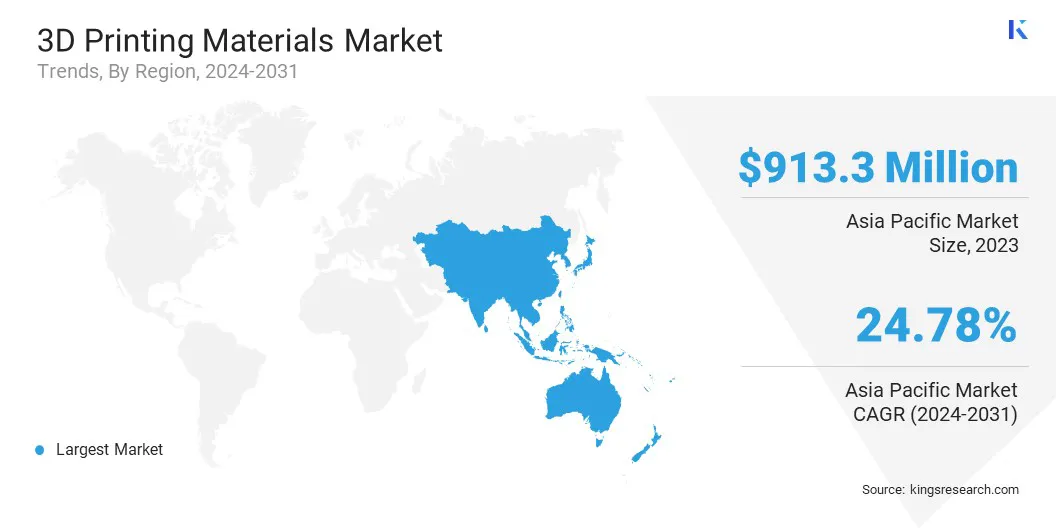
The Asia-Pacific 3D printing materials market accounted for a share of around 38.73% in 2023, valued at USD 913.3 million. This dominance is reinforced by rapid technological advancements, strong manufacturing bases, and increasing adoption of 3D printing across industries such as automotive, healthcare, aerospace, and electronics.
Countries like China, Japan, and South Korea lead in both production and research of innovative 3D printing materials. Additionally, the region's growing focus on smart manufacturing, cost-efficient production methods, and investments in additive manufacturing technologies boosts the demand for advanced 3D printing materials.
Europe 3D printing materials market is set to grow at a CAGR of 23.02% through the estimated timeframe. This growth is mainly propelled by the region's strong emphasis on innovation, research, and development across various industries.
Countries such as Germany, the UK, and France are at the forefront of adopting additive manufacturing technologies, with significant investments in aerospace, automotive, healthcare, and consumer goods.
The region's focus on sustainability and the circular economy, combined with advancements in material science, is fostering demand for specialized 3D printing materials, making Europe a key region in the global market.
The 3D printing materials industry is characterized by a number of participants, including both established corporations and rising organizations. Companies in the market are introducing innovative materials such as high-strength alloys, bio-based resins, and recyclable filaments.
Advancements focus on improved material durability, enhanced printing precision, and sustainability efforts to address diverse industry demands and reduce environmental impact.
Recent Developments:
Frequently Asked Questions

Siddhi is an accomplished professional with deep expertise in research and analysis, excelling in delivering customized reports across a wide range of industries. With a focus on extracting actionable insights, Siddhi's ability to navigate through various sectors demonstrates her cross-domain expertise. She approaches each assignment with a meticulous and data-driven mindset, translating complex market trends into clear recommendations that guide decision-making. Beyond her professional work, Siddhi is passionate about tracking B2B growth opportunities, staying ahead of industry trends, and continually expanding her knowledge through reading and research. Her dedication to precision ensures every report is comprehensive and actionable. Siddhi's ability to synthesize disparate data into cohesive narratives makes her a valuable asset in strategic planning. She tailors her analyses to client-specific contexts, enhancing relevance. Her proactive monitoring of emerging shifts keeps recommendations timely, while her intellectual curiosity drives her to explore adjacent sectors, further broadening her analytical scope and strengthening the insights she delivers.

Ganapathy Subramaniam Suresh
With over a decade of research leadership across global markets, Ganapathy brings sharp judgment, strategic clarity, and deep industry expertise. Known for precision and an unwavering commitment to quality, he guides teams and clients with insights that consistently drive impactful business outcomes.