
Inquire Now
Key Strategic Points
The smart port market refers to the integration of advanced technologies like Internet of Things (IoT), Artificial Intelligence (AI), blockchain, and automation into port operations to enhance efficiency, security, and sustainability.
This market focuses on optimizing logistics, reducing costs, and improving decision-making processes in ports, transforming them into interconnected, data-driven hubs for seamless and eco-friendly global trade.
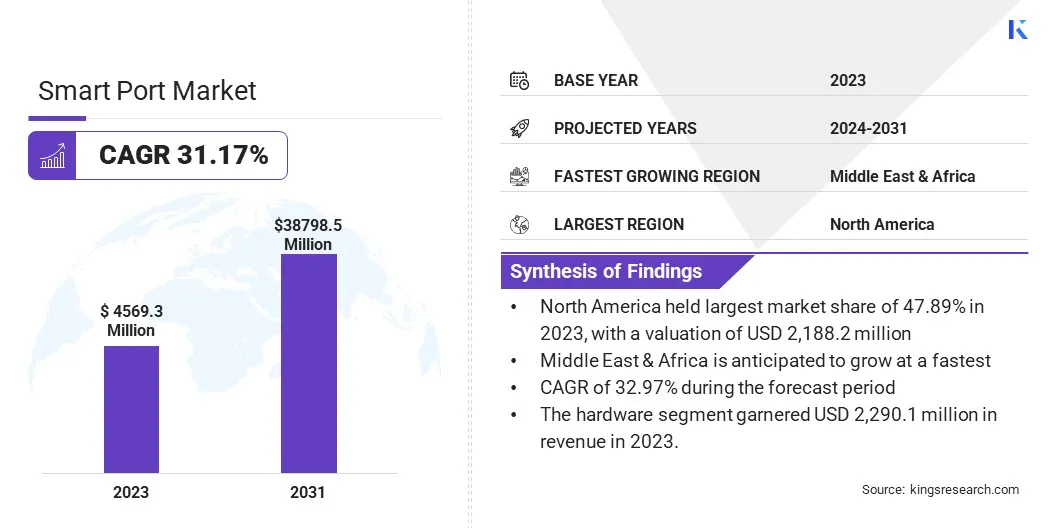
The global smart port market size was valued at USD 4,569.3 million in 2023, which is estimated to be valued at USD 5,807.2 million in 2024 and reach USD 38,798.5 million by 2031, growing at a CAGR of 31.17% from 2024 to 2031.
Technological advancements, such as IoT, AI, and automation, are key growth drivers for the market. These innovations enable enhanced operational efficiency, real-time data insights, sustainability, and improved security, responding to increasing global trade demands and evolving consumer expectations.
Major companies operating in the global market are Intel Corporation, Kaleris, Cisco Systems, Inc., KONGSBERG Gruppen ASA , Wipro, ABB, Trelleborg Marine and Infrastructure, Huawei Technologies Co., Ltd., IBM , Accenture, General Electric Company , Ramboll Group A/S, IKUSI , Envision Enterprise Solutions Pvt. Ltd., and Scientific Enterprises Ltd.
The smart port Industry is evolving rapidly as ports seek to modernize and enhance their operations through the integration of advanced technologies. Ports are becoming more efficient, secure, and sustainable by leveraging automation, digital tools, and real-time data.
This transformation not only boosts logistical capabilities but also creates more interconnected, responsive port ecosystems. As trade volumes grow and environmental considerations take precedence, smart ports are poised to redefine global trade dynamics, offering a more streamlined and resilient infrastructure for the future.
Market Driver
"Increased Global Trade"
The surge in global trade is a significant growth driver for the smart port market, as rising trade volumes create a need for more efficient, scalable port operations.
Amid the increasing traffic and complex logistics, ports are adopting advanced technologies like automation, IoT, and AI to streamline operations, reduce congestion, and improve turnaround times. These innovations enable ports to remain competitive, meet demand, and ensure smoother, faster global trade flows, driving further investment in smart port infrastructure.
Market Challenge
"Cybersecurity Risks"
Cybersecurity risks are a significant challenge for the smart port market as increased reliance on digital systems makes ports more vulnerable to cyber-attacks and data breaches. These threats can disrupt operations, compromise sensitive information, and harm a port's reputation. Thus, ports need to invest in robust cybersecurity frameworks, regular security audits, and employee training on best practices.
Additionally, employing advanced encryption, AI-driven security solutions, and establishing collaboration with cybersecurity experts can enhance protection and ensure smooth, secure port operations.
Market Trend
"AI and Automation Integration"
AI and automation integration is a significant trend in the smart port market, as ports increasingly adopt robotics, AI, and automated systems to enhance operational efficiency. These technologies streamline cargo handling, reduce human error, and speed up turnaround times.
Automated cranes, vehicles, and predictive analytics are helping ports optimize logistics, improve decision-making, and manage traffic more effectively. This shift toward intelligent, automated solutions not only boosts productivity but also enhances safety and reduces operational costs, making ports more competitive and sustainable.
|
Segmentation |
Details |
|
By Technology |
Automation and Robotics, Blockchain, IoT, Artificial Intelligence and Machine Learning. |
|
By Component |
Hardware, Software, Services. |
|
By Application |
Port Operations Management, Fleet Management, Security and Safety, Energy Management. |
|
By Region |
North America: U.S., Canada, Mexico |
|
Europe: France, UK, Spain, Germany, Italy, Russia, Rest of Europe |
|
|
Asia Pacific: China, Japan, India, Australia, ASEAN, South Korea, Rest of Asia Pacific |
|
|
Middle East & Africa: Turkey, UAE, Saudi Arabia, South Africa, Rest of Middle East & Africa |
|
|
South America: Brazil, Argentina, Rest of South America |
Market Segmentation:
Based on region, the global market has been classified into North America, Europe, Asia Pacific, Middle East & Africa, and Latin America.
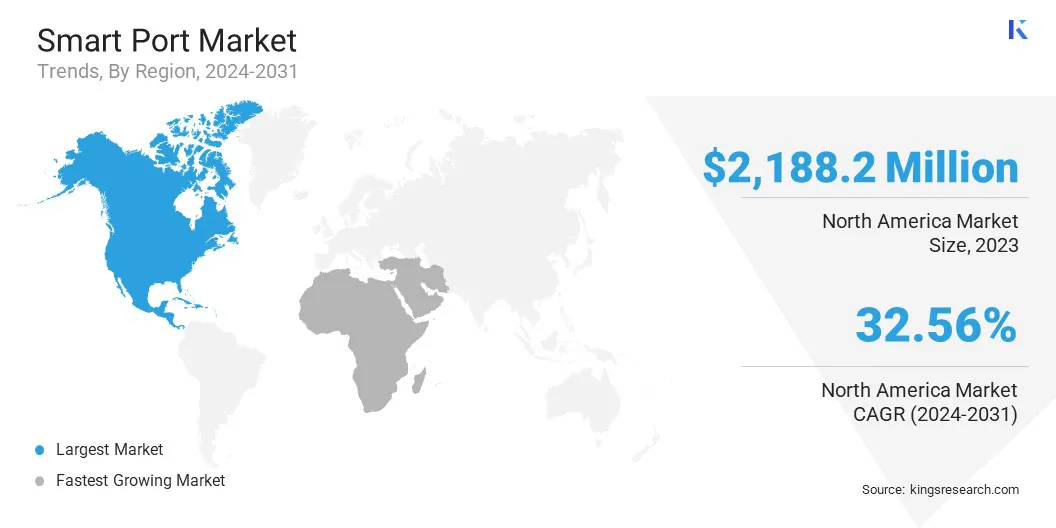
North America accounted for around 47.89% share of the global smart port market in 2023, with a valuation of USD 2,188.2 million. North America is expected to dominate the market, due to its strong infrastructure, technological advancements, and high adoption rates of automation and AI in port operations.
Major ports in the region are investing heavily in digital transformation to enhance efficiency, security, and sustainability. Government initiatives, coupled with a robust demand for smarter logistics solutions, position North America as a key player in shaping the future of global port operations.
The smart port Industry in the Middle East & Africa is poised for significant growth at a robust CAGR of 32.97% over the forecast period. The Middle East & Africa is emerging as the fastest-growing region for the market, driven by rapid infrastructure development and strategic investments in port modernization.
Countries in this region are increasingly adopting AI, IoT, and automation to enhance operational efficiency, reduce costs, and meet growing trade demands. As this region focuses on strengthening its position as a global logistics hub, the adoption of smart technologies in port operations is expected to accelerate, fueling growth in the region’s maritime industry.
The global smart port market is characterized by a large number of participants, including both established corporations and rising organizations. Companies in the market are increasingly forming strategic partnerships to leverage complementary expertise in technology, logistics, and sustainability. These collaborations often focus on developing innovative solutions such as automation, AI, cybersecurity, and data integration, aiming to enhance operational efficiency, port security, and sustainability across global maritime operations.
Recent Developments(Launch/Collaboration/Consolidation/Acquisition)
Frequently Asked Questions

Sharmishtha is a budding research analyst with a strong commitment to achieving excellence in her field. She brings a meticulous approach to every project, delving deep into details to ensure comprehensive and insightful outcomes. Passionate about continuous learning, she strives to enhance her expertise and stay ahead in the dynamic world of market research. Beyond work, Sharmishtha enjoys reading books, spending quality time with friends and family, and engaging in activities that foster personal growth. Her dedication to precision ensures that no critical detail is overlooked, and her analytical rigor consistently produces reliable, evidence-based conclusions. Sharmishtha's proactive curiosity drives her to explore emerging research methodologies, which she readily applies to deliver fresh perspectives on complex market questions. Her collaborative nature and openness to constructive feedback make her a dependable team player. She balances technical accuracy with clear communication, ensuring her insights are actionable for clients and stakeholders alike.

With over a decade of research leadership across global markets, Ganapathy brings sharp judgment, strategic clarity, and deep industry expertise. Known for precision and an unwavering commitment to quality, he guides teams and clients with insights that consistently drive impactful business outcomes.