
Inquire Now
Key Strategic Points
According to Kings Research, the global skincare products market size was recorded at USD 130.15 billion in 2025 and is projected to reach USD 210.31 billion by 2033, growing at a CAGR of 6.18% from 2026 to 2033.
The report covers products offered by companies such as L'Oréal S.A., Beiersdorf AG, Shiseido Co., Ltd., The Procter & Gamble Company, Unilever PLC, Kenvue Inc., The Estée Lauder Companies Inc., Kao Corporation, Amorepacific Corporation, Galderma Group AG, Coty Inc., Himalaya Wellness Company, VLCC Personal Care Private Limited, Oriflame Cosmetics Global SA, Revlon Consumer Products Corporation, e.l.f. Beauty, Inc., LVMH Moët Hennessy Louis Vuitton, and Natura &Co Holding S.A., among others.
The market is experiencing a significant shift toward natural and organic products, driven by growing consumer awareness of synthetic-ingredient risks and rising interest in sustainability. The rising popularity of natural and organic products is driving market growth, particularly among millennials and Generation Z, who prefer products perceived as safe, ethical, and environmentally friendly.
Kings Research finds that brand transparency around ingredient sourcing, combined with social media and influencer-driven education, continues to accelerate this shift, while the broader zero-waste movement is pushing consumers toward recyclable and biodegradable packaging.
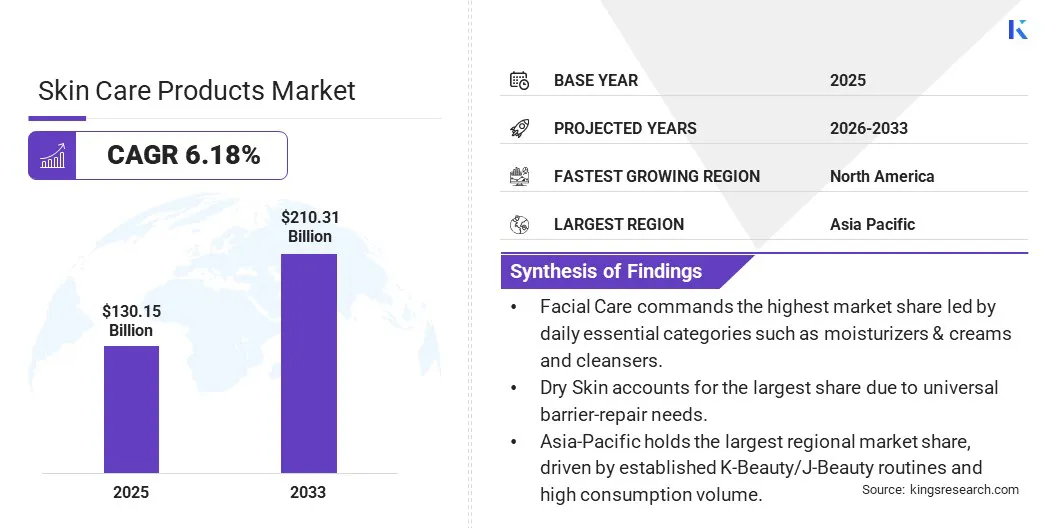
Natural and organic skincare products are formulated without synthetic chemicals, parabens, sulfates, or artificial fragrances, making them well-suited to sensitive skin and allergy-prone consumers. This is one of the four key drivers behind the market's growth. According to the Soil Association Certification, UK sales of certified organic beauty and well-being products grew 11% in 2024, reaching USD 175 million, reflecting the tangible, verified consumer shift toward transparently formulated products.
The skincare market faces challenges in rural areas due to limited access to quality products and skincare education, despite growing urbanization and rising disposable incomes. Inadequate distribution networks and lower brand penetration leave many rural consumers underserved.
This untapped potential offers real growth opportunities but requires strategic investment in infrastructure and awareness campaigns. Brands must overcome logistical challenges to ensure product availability in remote locations lacking urban retail infrastructure, and educating rural consumers about skincare benefits and proper routines is essential for driving demand. Success requires adapting products to rural consumer needs, including affordability and suitability for local climates, delivered through targeted marketing, community engagement, and partnerships with local influencers and healthcare providers.
AI and machine learning are being used to analyze skin types and conditions with increasing precision, enabling highly customized skincare regimens. Advances in biotechnology and dermatology are also driving new active ingredients and delivery systems, such as encapsulation technologies that release ingredients deeper into the skin over time.
For instance, Olay's AI-powered Skin Advisor platform, which analyzes user selfies to assess skin age and condition, has been credited with driving a reported 200% increase in conversion rates following its rollout, illustrating the commercial impact of AI-driven skin diagnostics on purchase behavior.
Smart skincare devices, such as app-connected facial cleansing brushes and at-home diagnostic tools, are also gaining popularity, bringing professional-grade skincare into the home and improving both product performance and the overall consumer experience.
|
Segmentation |
Details |
|
|
By Product |
Facial Care (Cleansers, Moisturizers, Sun Protection, Serums & Anti-Aging Treatments, Others), Lip Care (Lip Mask, Lip Balm, Others), Body Care (Body Lotions & Creams, Body Wash, Body Scrub, Body Mist, Body Oil, Others), Others |
|
|
By Packaging |
Tube, Bottle, Jar, Others |
|
|
By Skin Type |
Dry Skin, Oily Skin, Combination Skin, Others |
|
|
By Distribution Channel |
Supermarkets/Hypermarkets, Specialty Retail Stores, Pharmacies/Drug Stores, Online Retailers, Others |
|
|
By Region |
North America |
U.S., Canada, Mexico |
|
Europe |
France, UK, Spain, Germany, Italy, Russia, Rest of Europe |
|
|
Asia-Pacific |
China, Japan, India, Australia, ASEAN, South Korea, Rest of Asia-Pacific |
|
|
Middle East and Africa |
Turkey, U.A.E., Saudi Arabia, South Africa, Rest of Middle East & Africa |
|
|
South and Central America |
Brazil, Argentina, Rest of South and Central America |
|
Facial care, led by moisturizers and serums, is the largest product sub-segment, supported by consistent daily-use demand and consumers' focus on hydration, barrier repair, and anti-aging benefits. For context, L'Oréal has reported that skincare and sun protection products account for nearly 39.90% of its total sales, reflecting how central facial care has become to major players' portfolios. Sun protection and lip masks are the fastest-growing sub-segments, reflecting rising awareness of UV damage and the popularity of targeted, treatment-style formats driven by social media trends.
Supermarkets and hypermarkets remain the largest distribution channel, offering consumers the convenience of browsing and comparing products in person alongside routine grocery shopping. Online retailers are the fastest-growing channel, driven by direct-to-consumer brand launches, subscription models, and personalized product recommendations that are difficult to replicate in physical retail.
Based on region, the global skincare products market has been segmented into North America, Europe, Asia Pacific, the Middle East and Africa, and South and Central America.
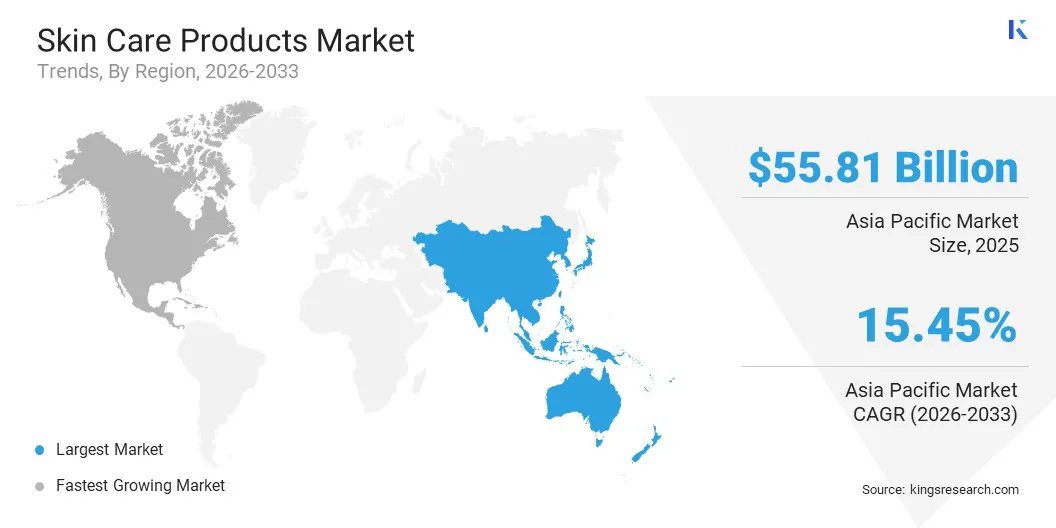
Asia-Pacific is both the largest and fastest-growing region in the skincare products market, accounting for 42.88% of global revenue in 2025 and projected to grow at a CAGR of 7.05% through 2033. This is supported by rising disposable incomes, a large and increasingly beauty-conscious middle class, and the continued global influence of K-beauty and J-beauty routines originating in South Korea and Japan.
North America represents another significant market for skincare products, supported by high consumer awareness of skincare benefits, strong demand for premium and organic formulations among millennial and Gen Z consumers, and a well-developed e-commerce infrastructure that facilitates easy access to a wide range of products. The region also benefits from advanced R&D capabilities and the growing popularity of AI-enabled personalized skincare solutions, which continue to support consumer engagement and category growth.
The global skincare products market is moderately fragmented, with multinational conglomerates competing alongside dermatology-focused specialists and fast-growing direct-to-consumer brands. Companies are focusing on ingredient innovation, sustainable packaging, and AI-driven personalization to differentiate their offerings, while strategic M&A such as L'Oréal's increased stake in Galderma and e.l.f. Beauty's acquisition of Rhode continues to reshape the competitive landscape.
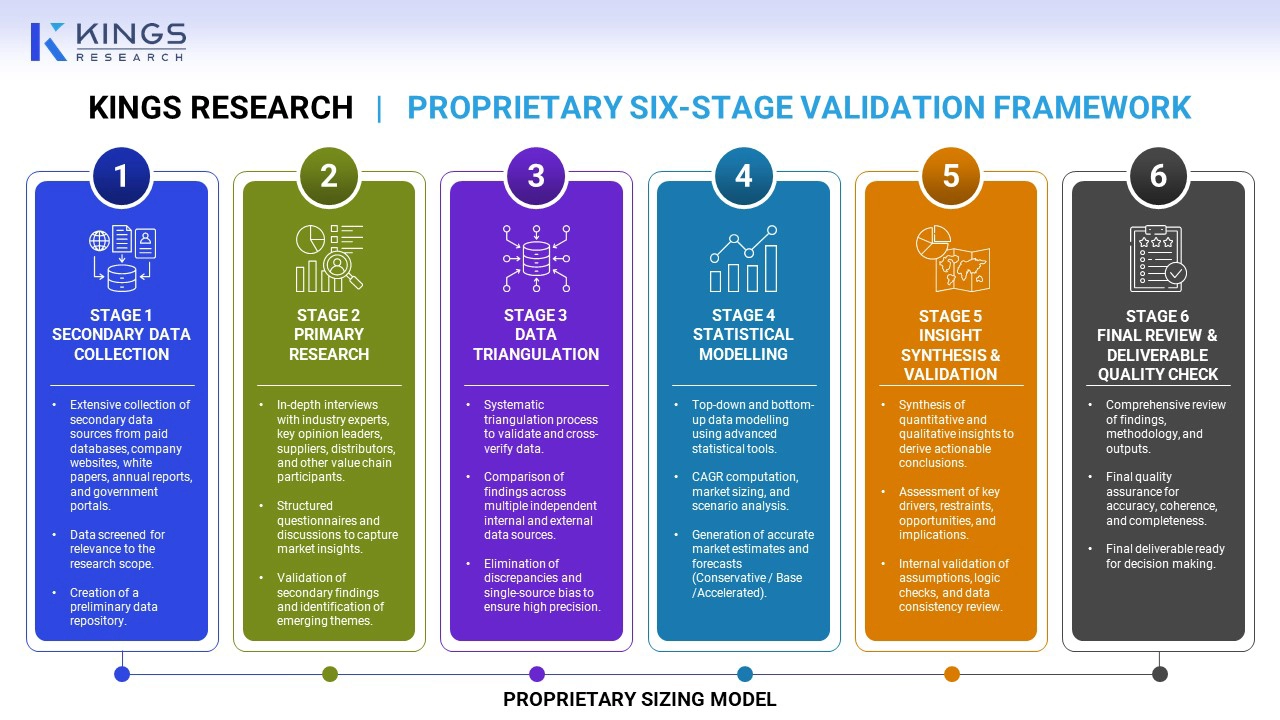
Our methodology triangulates insights from multiple independent and publicly available research databases and is further validated against regulatory filings and public company disclosures. All estimates are cross-verified; no single-source data is presented without validation.
Our custom offerings deliver tailored, data-driven intelligence and strategic guidance to help organizations identify, evaluate, and capitalize on key market opportunities.
Frequently Asked Questions

Ashim Lakhera is a market intelligence professional specializing in the Agriculture and Food & Beverage industry. His work focuses on emerging markets, competitive dynamics, industry trends, and the factors driving market growth and transformation. He has experience in market sizing, forecasting, strategic analysis, and industry research across food, FMCG, and life sciences. His research interests span the broader food and agriculture value chain, with a particular focus on how innovation, changing consumer behavior, sustainability priorities, and evolving production systems are influencing markets. He examines these developments to understand their impact on demand, competition, business models, and growth opportunities across the agri-food ecosystem. His work combines quantitative market analysis with an understanding of the broader industry forces shaping food and agriculture markets. He is particularly interested in the structural changes taking place across global food systems and how businesses are adapting to evolving consumer expectations, technological developments, and sustainability requirements.
Smriti Vinodia is a market research and consumer insights professional with expertise in qualitative research, consumer behavior, and strategic market intelligence across the FMCG and FMCD industries. She has experience supporting leading brands by transforming complex consumer and market insights into actionable strategies that inform product development, innovation, positioning, and business growth. Her expertise spans qualitative consumer research, market and competitive intelligence, consumer trend analysis, and AI-enabled insight generation. She has worked across diverse research engagements, helping organizations understand evolving consumer needs, identify emerging market opportunities, and strengthen customer-centric decision-making. Combining analytical rigor with a strong understanding of consumer psychology and market dynamics, Smriti brings a strategic perspective to research and insights. She focuses on connecting consumer behavior with commercial priorities, enabling organizations to make informed decisions, develop relevant products and experiences, and build sustainable growth strategies in rapidly evolving and competitive markets.