
Inquire Now
Key Strategic Points
Zero waste packaging is primarily designed to minimize environmental impact by eliminating waste generated within the product’s lifecycle. It emphasizes the use of recyclable, compostable, or reusable materials that align with circular economy principles. The approach reduces reliance on single-use plastics, encourages sustainable material innovation, and supports regulatory and corporate sustainability goals while addressing rising consumer demand for eco-friendly alternatives.
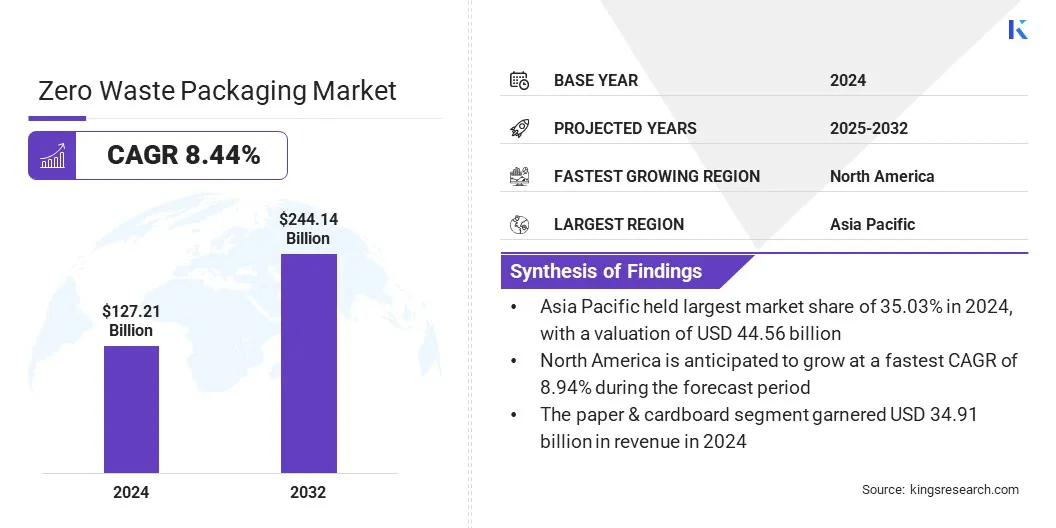
The global zero waste packaging market size was valued at USD 127.21 billion in 2024 and is projected to grow from USD 137.65 billion in 2025 to USD 244.14 billion by 2032, exhibiting a CAGR of 8.44% over the forecast period.
This growth is driven by the rising preference for sustainable designs and reduced packaging waste. Market growth is further supported by retailers adopting minimalist packaging to lower costs and enhance eco-friendly branding.
Major companies operating in the zero waste packaging market are TIPA LTD, Hero Packaging, EcoEnclose, Sealed Air, UPM, Better Packaging Co., Tetra Pak International S.A., Avani, Amcor plc, DS Smith, Notpla Limited, LOLIWARE INC., Regeno, Loop Industries, and Unilever.
The market is experiencing growth driven by consumer packaged goods (CPG) brands adopting bio-based materials. CPG companies are adopting bio-based solutions to strengthen environmental commitments, meet regulatory requirements, and address rising consumer preference for eco-friendly products.
Innovations such as plant-based polymers and bioplastics support scalability, enabling broader implementation of zero waste strategies across diverse packaging applications within the consumer goods sector.
A key factor propelling the progress of the zero waste packaging market is the growing use of compostable materials. These packaging solutions break down naturally without leaving harmful residues, addressing the environmental issues associated with single-use plastics.
Therefore, manufacturers are integrating compostable packaging solutions into foodservice, e-commerce, and retail.
Regulatory policies restricting single-use plastics further accelerate adoption, while advancements in material science enhance performance and durability. This supports waste reduction initiatives, promoting circularity and strengthening the market of compostable packaging.
A major challenge hindering the expansion of the zero waste packaging market is the functional constraints of biodegradable products. These materials face issues related to durability, barrier properties, and suitability for long-term storage compared with conventional plastics.
To address this challenge, manufacturers are investing in advanced material formulations, coating technologies, and hybrid packaging systems to extend shelf stability and enhance performance. These innovations are making biodegradable packaging commercially viable.
A notable trend influencing the zero waste packaging market is the increased adoption of circular economy business models. Companies are shifting toward closed-loop systems that prioritize reuse, refill, and recycling to minimize waste. Retailers and consumer brands are also revamping their packaging formats to facilitate multiple life cycles and reduce material waste.
Further, packaging producers and recycling firms are partnering to support efficient resource recovery, while digital platforms are making traceability and consumer engagement easier. This transition is improving cost-efficiency and reducing environmental footprint, positioning circularity as a strategic framework for achieving long-term sustainability in the packaging industry.
|
Segmentation |
Details |
|
By Type |
Reusable/Recyclable Packaging, Compostable Packaging, Edible Packaging |
|
By Material |
Biopolymer, Paper & Cardboard, Glass, Metal, Others |
|
By Application |
Food & Beverages, Healthcare, Cosmetics & Personal Care, E-Commerce, Industrial, Electrical & Electronics, Others |
|
By Region |
North America: U.S., Canada, Mexico |
|
Europe: France, UK, Spain, Germany, Italy, Russia, Rest of Europe |
|
|
Asia-Pacific: China, Japan, India, Australia, ASEAN, South Korea, Rest of Asia-Pacific |
|
|
Middle East & Africa: Turkey, U.A.E., Saudi Arabia, South Africa, Rest of Middle East & Africa |
|
|
South America: Brazil, Argentina, Rest of South America |
Based on region, the market has been classified into North America, Europe, Asia Pacific, the Middle East & Africa, and South America.
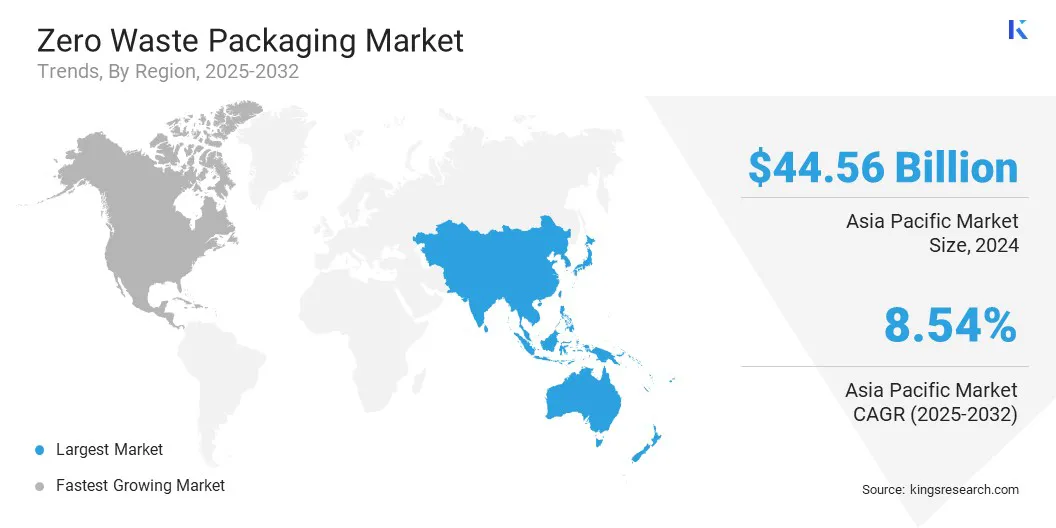
The Asia Pacific zero waste packaging market stood at 35.03% in 2024, valued at USD 44.56 billion. This dominance can be attributed to the expanding consumer awareness, rapid urbanization, and rising investments in sustainable packaging infrastructure.
Companies across retail, e-commerce, and foodservice industries are transitioning to compostable, recyclable, and reusable packaging to comply with stricter waste reduction mandates.
Technological advancements in biodegradable polymers and increased deployment of refill models have further strengthened the region’s growth. Market players are also engaging in partnerships with local suppliers to enhance availability of bio-based materials across packaging applications.
North America zero waste packaging industry is set to grow at a CAGR of 8.94% over the forecast period. This growth is attributed to the adoption of sustainable packaging driven by strict regulatory policies to achieve zero waste targets. Consumer packaged companies are incorporating bio-based, recyclable, and reusable materials into their portfolios to align with circular economy practices.
Continuous innovation in material science and digital traceability solutions are strengthening market expansion. Furthermore, retailers are shifting to minimal packaging designs, while manufacturers are focusing on scaling compostable and biodegradable solutions.
Key players operating in the zero waste packaging industry are pursuing strategies centered on innovation, expansion, and collaboration.
They are increasing investments in advanced material technologies, particularly bio-based polymers and compostable alternatives, to strengthen their portfolios. Strategic alliances with recycling firms and raw material suppliers are enabling secure sourcing and improved supply chain efficiency.
Companies are expanding manufacturing facilities to achieve scalability and reduce production costs. Furthermore, they are adopting acquisitions and partnerships to broaden geographic presence, while maintaining a strong focus on R&D to sustain competitiveness in the evolving market.
Frequently Asked Questions

Antriksh is an experienced analyst specializing in cross-domain research across diverse industries. With a strong foundation in data analysis and statistical interpretation, he delivers insightful market reports that guide strategic decision-making. Antriksh excels in conducting primary research, with a focus on identifying trends and understanding consumer behavior. Thriving in dynamic and high-pressure environments, he combines analytical expertise with a commitment to delivering impactful outcomes. Beyond his professional pursuits, Antriksh's passion for travel fuels his curiosity and broadens his perspectives, enriching his ability to uncover unique insights that enhance his research capabilities. He is equally adept at synthesizing quantitative findings with qualitative context, which allows him to present holistic viewpoints to clients. His disciplined work ethic and intellectual agility make him a trusted partner in navigating market uncertainties. He consistently seeks out new methodologies to refine his analytical toolkit, and his ability to communicate complex insights clearly ensures stakeholders act confidently on his recommendations.

Ganapathy Subramaniam Suresh
With over a decade of research leadership across global markets, Ganapathy brings sharp judgment, strategic clarity, and deep industry expertise. Known for precision and an unwavering commitment to quality, he guides teams and clients with insights that consistently drive impactful business outcomes.



.webp&w=128&q=75&dpl=dpl_DPva2LrvfsBdTJm1XZj67UTrvMHL)